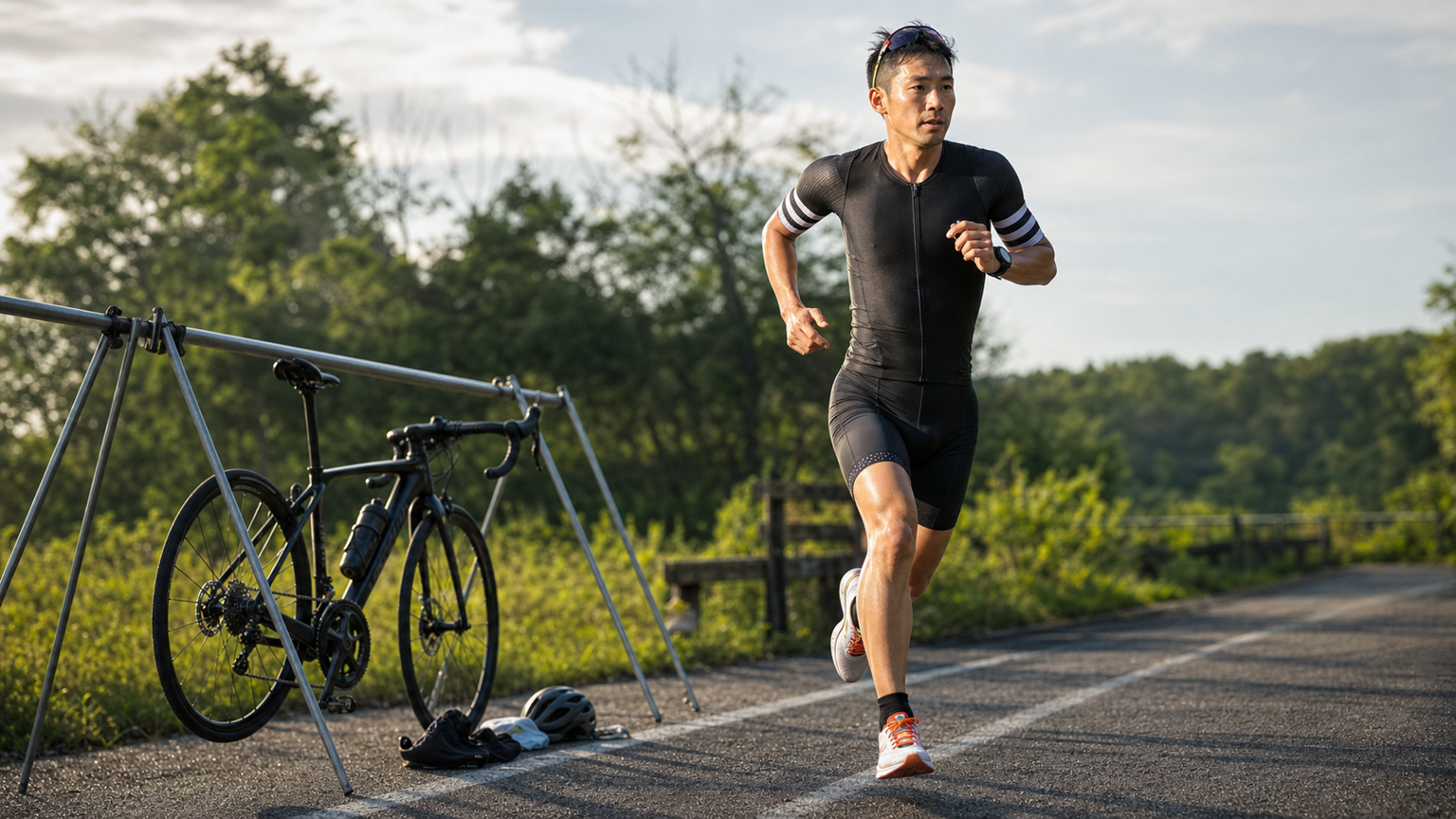
The Neurology of the Bike-Run Transition
Cycling is a closed-chain movement on a fixed trajectory, typically at 85–95 rpm; running is an open chain requiring eccentric shock absorption, with a cadence around 170–185. When you dismount and start running, your nervous system is still locked in the pedaling pattern, resulting in a shortened stride, stiff ankles, and a falsely depressed pace.
Bike-Run Bottlenecks and Solutions
| Problem | Cause | Training Solution |
|---|---|---|
| Cadence won’t climb | Residual pedaling rhythm | 90+ rpm high-cadence before dismount |
| Stiff ankles | Fixed pedaling angle | Short, quick steps on takeoff to wake up |
| Heavy quadriceps | Fatigue in cycling-dominant muscles | Race IF control + Brick |
Specific Prescription: Frequent Short Bricks
1–2 “micro-bricks” per week: ride 30–45 minutes → immediately run 10–15 minutes. The focus is not on distance, but on the “number of transitions repeated.” Neural adaptation relies on frequency, not on a single large dose.
Cadence Warm-Up Before Dismounting
In the final 3 minutes on the bike, do 3×15 seconds of high-cadence spinning (100+ rpm) to bring your nervous system closer to running’s high-frequency pattern in advance. You’ll hit your stride 5–8 steps faster after dismounting.
Takeoff Technique
For the first 400m, use a high cadence with a short stride (cadence 92–96 / deliberately shortened stride length). Don’t slow down for fuel just because your heart rate reads high; by the 2nd km, your stride length will naturally return.
Weekly Volume Allocation and Progression for Micro-Bricks
Beginners do 2 micro-bricks per week (ride 30–45 min + run 10–15 min), focusing on the “number” of transitions rather than distance; advanced athletes can shift to a 90-min ride @race IF + a 30-min run, pushing the training scenario to “maintaining cadence under fatigue.” One often-overlooked metric: cadence after dismounting is typically 6–10 steps/min lower than your usual running cadence. The goal is to compress that gap to within 3 steps through repeated training.
First-Kilometer Pacing Trap Comparison After Dismount
| Kilometer | Relative Heart Rate | True Fitness | Target Pace |
|---|---|---|---|
| 1st km | Falsely high +8–12 bpm | Not actually that tired | 10–15 sec/km slower than goal |
| 2nd km | Begins to stabilize | Close to reality | Pick up 3–5 sec per km |
| From 3rd km | Stable | True value | Settle into goal marathon pace |
Common Mistake: Pacing the First Kilometer After Dismount by “Feel”
In that moment of dismounting, adrenaline plus a falsely elevated heart rate completely distort your body’s signals, and pacing by feel almost guarantees going out too fast and fading later. The most effective countermeasure is to switch the first kilometer to “pace by the watch, not the body,” forcing yourself to hold a preset slower value; many athletes who master this trick end up 30–60 seconds faster on a 5km run segment than when they used to charge out hard.
Brick legs are not fate—it’s just a nervous system that hasn’t been trained. I have my athletes treat short bricks as the main course rather than a side dish, and after three weeks, nearly everyone can hit their target pace right off the bike. The true specialty of triathlon is the “transition” itself.
Related Reading
- The Physiology of Brick Training: Why Your Legs Feel Like Lead After the Bike
- Brick Training for Triathlon: Designing Leg Adaptation Workouts for Running Right After Cycling
- 14-Day Triathlon Brick Plan: The Science of Muscle Adaptation for Running Immediately After Cycling
- The Science of Brick Training — Muscle Adaptation Mechanisms and Workout Design for Bike-to-Run Transitions
單車 一日北高 ( 雙城 ) 肥宅雙人瘋狂行 紀錄片 REACTO
10 年前
一日北高常見問題大集合 | 攻略 | 路線 | 訓練 | 補給 | 自行車 單車 | 一日雙城 | 雙塔 | TWB北高360 | 屁股痛
6 年前
#公路車 #Fitting 靠人工智慧APP 幫你調整單車
6 年前
白沙屯媽祖進香在家走!UREVO 坡度自調走步機 / 可連接訓練遊戲APP MyWhoosh / 邊看直播邊走起來 / CT Yeh
11 個月前
單車AI教練!全新 ChatGPT4o 幫你分析訓練成果!排武嶺課表,分析騎車姿勢! 太神了! / 公路車 / CT Yeh / feat. 緯緯
2 年前
西進武嶺 免費訓練分析服務 Intervals | 練不夠還是練過頭?你哪一種類型選手?AI模型告訴你! | 備戰神器 | 公路車 訓練 | CT Yeh
4 年前
西進武嶺 自製新版AI配速表產生器 x 賽前攻略 抱佛腳! 沒有功率計也可以產生配速表嗎?有什麼其他眉角賽前要注意的呢? | 西進武嶺 / 東進武嶺 KOM 攻略 | 公路車 | CT Yeh
4 年前
Never Stop 西進武嶺 前後雙機 完整全程錄影 訓練台 實境
8 年前