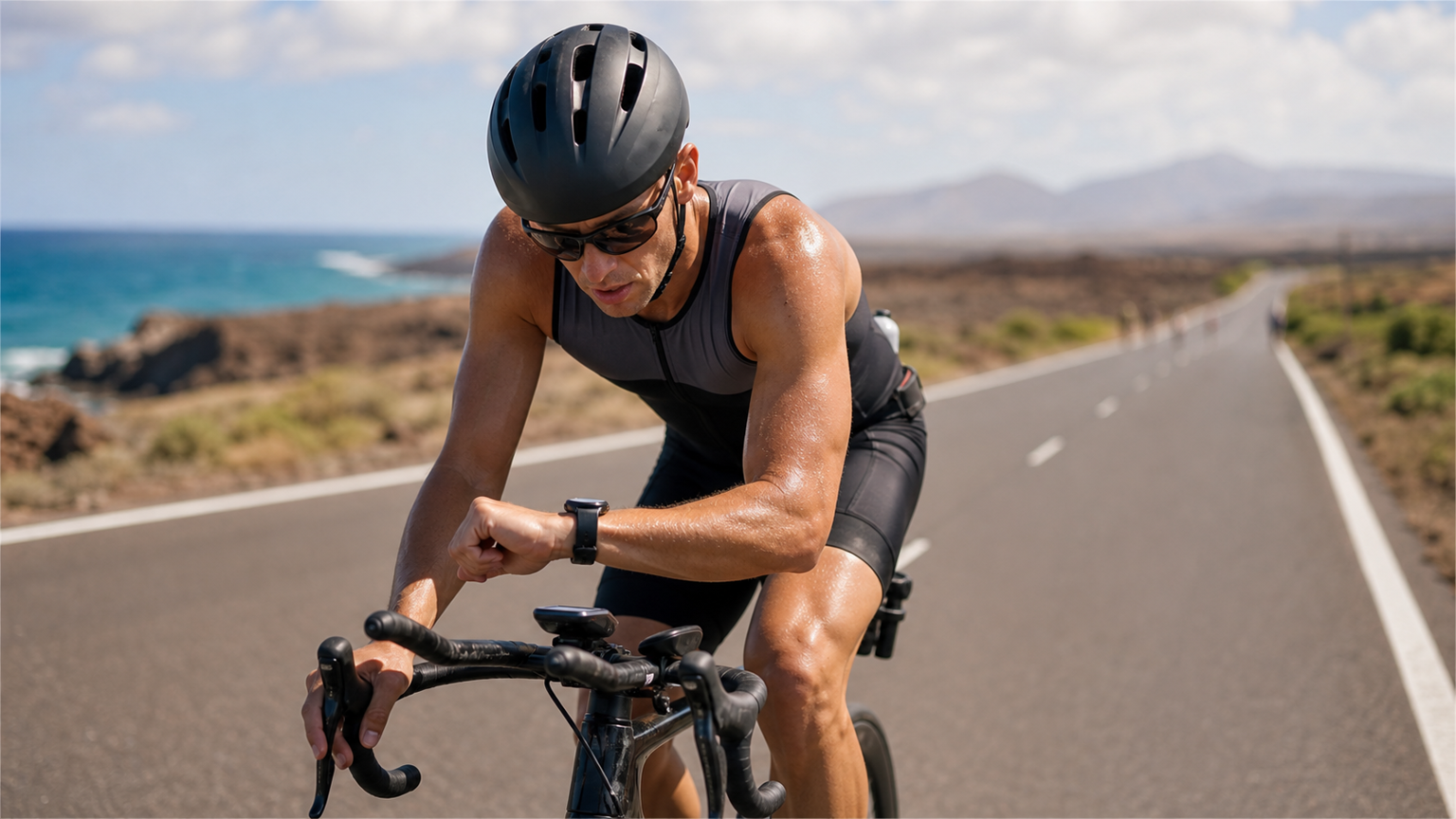
A Single Metric Always Lies
Heart rate drifts with body temperature, dehydration, caffeine, and excitement; power is stable but does not reflect the internal cost. The most robust approach to triathlon pacing is a dual-metric cross-check: “power as the anchor, heart rate as the monitor.”
Dual-Metric Interpretation Matrix
| Power | Heart Rate | Interpretation | Action |
|---|---|---|---|
| Normal | Normal | Everything on track | Maintain |
| Normal | Drifting high | Dehydration/overheating/fatigue | Rehydrate and cool down, possibly slow down |
| Low and unsustainable | High | Near the limit | Reduce intensity immediately |
| Normal | Abnormally low | Parasympathetic over-inhibition/poor form | Be conservative, don’t push hard |
Bike Leg: Power Primary, Heart Rate Secondary
The bike leg is controlled primarily by power (NP / 3-second), because it is real-time and drift-free. Heart rate serves as a secondary gauge for “is the body okay”: if heart rate keeps climbing 8%+ at the same power, it is an early warning of dehydration or overheating.
Run Leg: Pace and Heart Rate Cross-Reference
There is no power on the run (unless using a running power meter), so lap pace is primary, with heart rate monitoring drift. If heart rate drifts significantly but pace holds, it means the tank is running empty—actively slow down to secure the finish.
The “Decoupling” Phenomenon
After prolonged exercise, a heart rate that keeps rising at the same power/pace is called cardiac drift. The earlier decoupling appears, the more your aerobic endurance or fueling strategy needs to be strengthened.
Pre-Race Calibration
Before the race, use the same device to test at race intensity and establish “my race IF corresponding heart rate zone,” so you have a comparable baseline on race day.
The Dual-Metric Cross-Reading Decision Matrix in Practice
A single metric always lies: heart rate drifts with body temperature, dehydration, and caffeine; power is stable but does not reflect the internal cost. The robust approach is “power as the anchor, heart rate as the monitor.” The bike leg is controlled primarily by power (NP/3-second), with heart rate as the secondary gauge—if heart rate keeps climbing more than 8% at the same power, it is an early warning of dehydration or overheating, appearing 10–20 minutes before perceived effort. That lead time is enough to save the whole race with rehydration and cooling.
Dual-Metric Interpretation and Action Matrix
| Power | Heart Rate | Interpretation | Action |
|---|---|---|---|
| Normal | Normal | On track | Maintain |
| Normal | Drifting high | Dehydration/overheating | Rehydrate and cool down, slow down if necessary |
| Low and unsustainable | High | Near the limit | Reduce intensity immediately |
| Normal | Abnormally low | Parasympathetic over-inhibition | Be conservative, don’t push hard |
Common Mistake: Trusting Only One Number and Ignoring the Time Signal of “Cardiac Drift”
Those who look only at power or only at heart rate will miss the most valuable precursor to a collapse—cardiac drift: after prolonged exercise, heart rate keeps rising at the same power/pace. The earlier decoupling appears, the more your aerobic endurance or fueling strategy needs to be strengthened. Before the race, be sure to test at race intensity and establish “my race IF corresponding heart rate zone,” so you have a comparable baseline on race day; only by reading the two metrics together can you catch that warning sign others cannot see.
I never let an athlete trust only one number. Power tells you “how much work was done,” and heart rate tells you “how much the body paid.” Read the two together, and you will catch that precursor to collapse that no one else can see.
Related Reading
- Power Meter and Pacing vs Heart Rate: The Blind Spots and Best Uses of Each of the Three Intensity Anchors
- Heart Rate Pacing vs Power Pacing: Which Should Runners Choose
- Running Pace Watch Applications: Heart Rate vs Pace vs Power Meter Choices in the Marathon
- Cross-Analysis of Heart Rate and Power: The Meaning of Cardiac Decoupling
西進武嶺 免費訓練分析服務 Intervals | 練不夠還是練過頭?你哪一種類型選手?AI模型告訴你! | 備戰神器 | 公路車 訓練 | CT Yeh
4 年前
武嶺配速表最佳使用方式 #bike
1 年前
全台首發!邁金P715踏板功率計!市場價格撼動者再出招 / 功率對比實測 / FAVERO ASSIOMA 可參考! / 公路車 / CT Yeh
1 年前
西進武嶺 自製新版AI配速表產生器 x 賽前攻略 抱佛腳! 沒有功率計也可以產生配速表嗎?有什麼其他眉角賽前要注意的呢? | 西進武嶺 / 東進武嶺 KOM 攻略 | 公路車 | CT Yeh
4 年前
2026 車錶排行榜!誰是最多車友正在使用?練家子最愛哪款?🏆 (2萬名車友數據) / 公路車 / CT Yeh
5 個月前
2025 自行車錶排行榜 兩萬車友大數據 / Garmin Bryton 排名會大洗牌嗎? / 全新的碼表前身分析 /公路車 / CT Yeh
1 年前
#公路車 #Vo2Max #最大攝氧量 測驗 體驗 | 心肺測試
6 年前
西進武嶺配速器 3.0更新 / NEW 免功率FTP估算! / 大數據xAI體能模型 / 如何模擬人止關前集團效應 / 配速儲存功能 / AI全台自行車賽事行事曆 / 公路車 / CT Yeh
1 年前