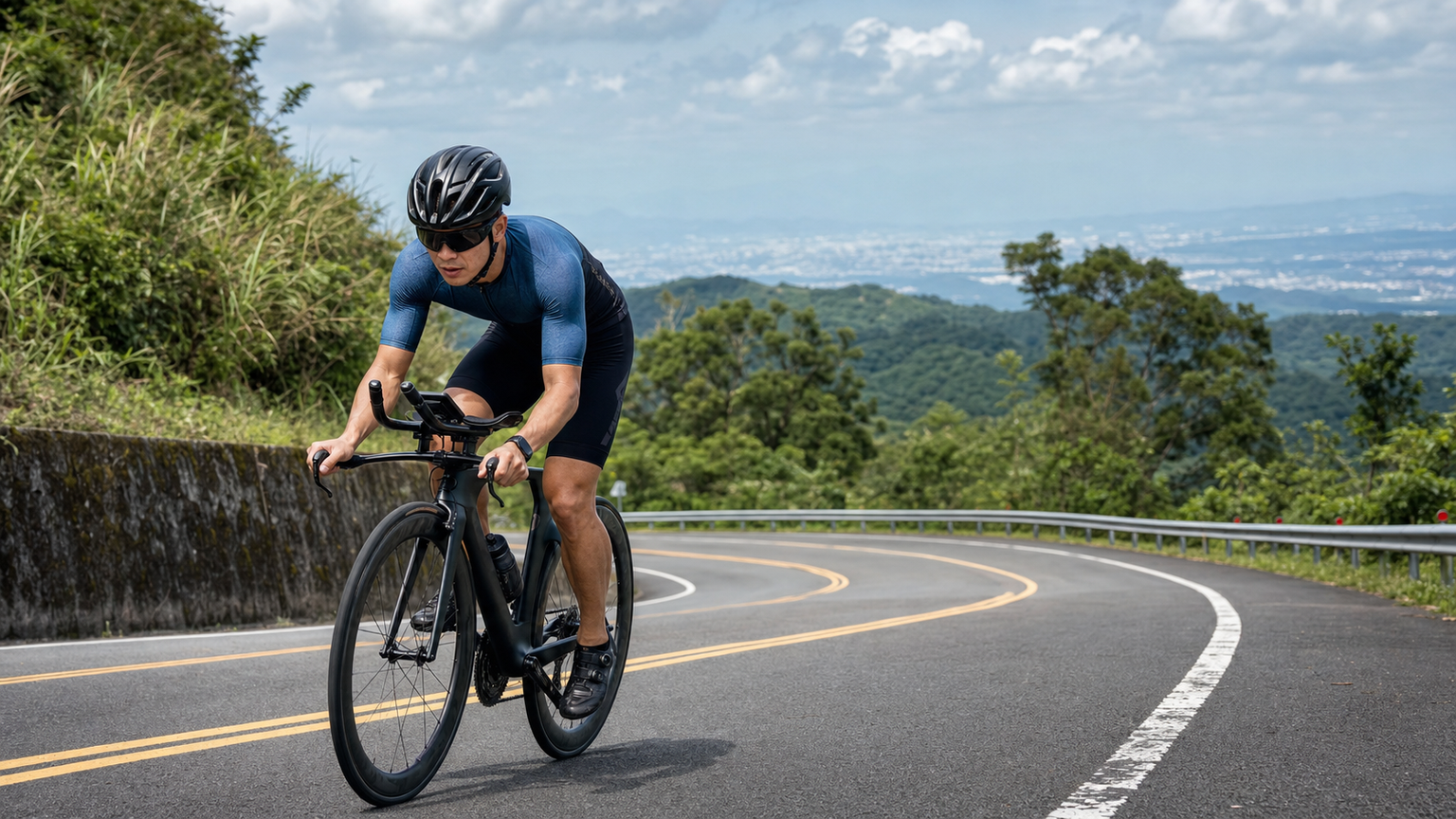
Rolling Courses: The Flat-Road Approach Won’t Work
On flat roads, you aim for steady power. But if you also “average your output” on a rolling course, you’ll lose speed on climbs and spin uselessly on descents—slow and hard on the legs. What climbing courses demand is “terrain-specific power distribution” and downhill risk control.
Terrain-Based Power Distribution Principles
| Segment | Power Strategy | Rationale |
|---|---|---|
| Uphill | Target IF +5% to +10% | Low speed, high marginal benefit |
| Flat | Hold target IF | Baseline |
| Downhill | Cut power significantly or coast | Watts wasted at high speed |
| Before sharp corners | Brake early | Safety > those few seconds |
Why Uphills Are Worth Extra Watts
On climbs, overcoming gravity is the main task, bike speed is low, and aerodynamic drag has little impact—so extra power yields high time gains. On descents, the opposite holds: at high speed, wind resistance dominates, and an extra 30W buys almost no speed—pure waste.
The Variability Index Trade-Off
On a rolling course, VI will inevitably be higher than on flat roads (undulations can’t be avoided), so there’s no need to force it down to 1.05. But the double waste of “blasting uphill, then chasing hard on the flats” must still be avoided—make the high uphill power a plan, not a loss of control.
Downhill Risk Management
In triathlon, most time losses and crashes happen in downhill corners. The key principle is: “Brake early when you need to, and accelerate after the corner.” The cost of one crash far outweighs the 20 seconds saved on a descent.
Protecting Your Run
The extra watts spent on climbs are still bound by the overall constraint that “you have to run afterward.” On long, steep climbs, you can slightly drop cadence to protect your cardiovascular system, but don’t let your quads get hollowed out on the climb, or the marathon will fall apart.
The Physics and Numbers Behind “Spending Watts on the Climb”
A rolling course can’t be handled with the flat-road approach of even output. The physics: on climbs, overcoming gravity is the main task, bike speed is low, and aerodynamic drag has little impact—so extra power yields high time gains; at high speed on descents, wind resistance dominates, and an extra 30W buys almost no speed—pure waste. In practice, set uphill power at target IF +5% to +10%, cut power significantly or coast on descents, and brake early before sharp corners—concentrate your power budget on the climbs, where marginal benefit is highest.
Terrain-Based Power Distribution Principles
| Segment | Power Strategy | Rationale |
|---|---|---|
| Uphill | Target IF +5% to +10% | Low speed, high marginal benefit |
| Flat | Hold target IF | Baseline |
| Downhill | Cut power significantly / coast | Watts wasted at high speed |
| Before sharp corners | Brake early | Safety > those few seconds |
Common Mistake: The Double Waste of Blasting Uphill and Chasing Hard on the Flats
On a rolling course, VI will inevitably be higher than on flat roads, so there’s no need to force it down to 1.05; what you must avoid is the double waste of “losing control and surging uphill, then chasing hard to make up time on the flats”—make the high uphill power a plan, not a loss of control. Downhill corners are where triathletes lose the most time and have crashes; the key principle is “brake early when you need to, and accelerate after the corner.” The cost of one crash far outweighs the 20 seconds saved on a descent. The extra watts spent on climbs are still bound by the overall constraint that “you have to run afterward,” so don’t hollow out your quads on the climb.
Flat races are about who holds the steadiest power; rolling races are about who distributes it best. When I teach athletes to read elevation profiles, I ask only one question: Which climb are you spending your watts on? Spend your money on the climbs, don’t scatter it on the descents—that’s the whole wisdom of pacing on a rolling course in one sentence.
Related Reading
- Climbing Race Power Strategy: Power Distribution and Pacing on Uneven Climb Sections
- Complete Guide to Climbing Race Pacing: Power Management from Start to Finish
- Power Strategy for Different Terrains: Power Distribution Principles for Flats, Climbs, and Descents
- Trail Running Uphill Technique: Cadence, Push-Off, and Efficient Power Distribution
#公路車 #西進武嶺 配速配瓦實驗 坡度分析 四小時內攻略 建大盃 NeverStop #西進武嶺攻略
6 年前
如果Pogačar騎西進武嶺可以多快?會破2嗎?各種情況深度推估探討 / 公路車 / CT Yeh
2 年前
西進武嶺 自製新版AI配速表產生器 x 賽前攻略 抱佛腳! 沒有功率計也可以產生配速表嗎?有什麼其他眉角賽前要注意的呢? | 西進武嶺 / 東進武嶺 KOM 攻略 | 公路車 | CT Yeh
4 年前
西進武嶺各路段 前8000名 大數據分析 配速攻略/功率/心律/推力比/維持率/踏頻/踏瓦比/牽車率 大公開 | 建大盃 NeverStop 可參考 | 公路車 | CT Yeh
5 年前
西進武嶺 8000名單車友數據分析 PART1 | 從新手到高手數量/瓦數/推力比/FTP推力比/功率計使用率 大解析 | 公路車 | CTYeh
5 年前
公路車 爬坡 破PR 紀錄 小技巧 分享
6 年前
西進武嶺配速器 3.0更新 / NEW 免功率FTP估算! / 大數據xAI體能模型 / 如何模擬人止關前集團效應 / 配速儲存功能 / AI全台自行車賽事行事曆 / 公路車 / CT Yeh
1 年前
東進武嶺 西進武嶺 AI 配速 上線囉 公路車
5 年前