/no_think
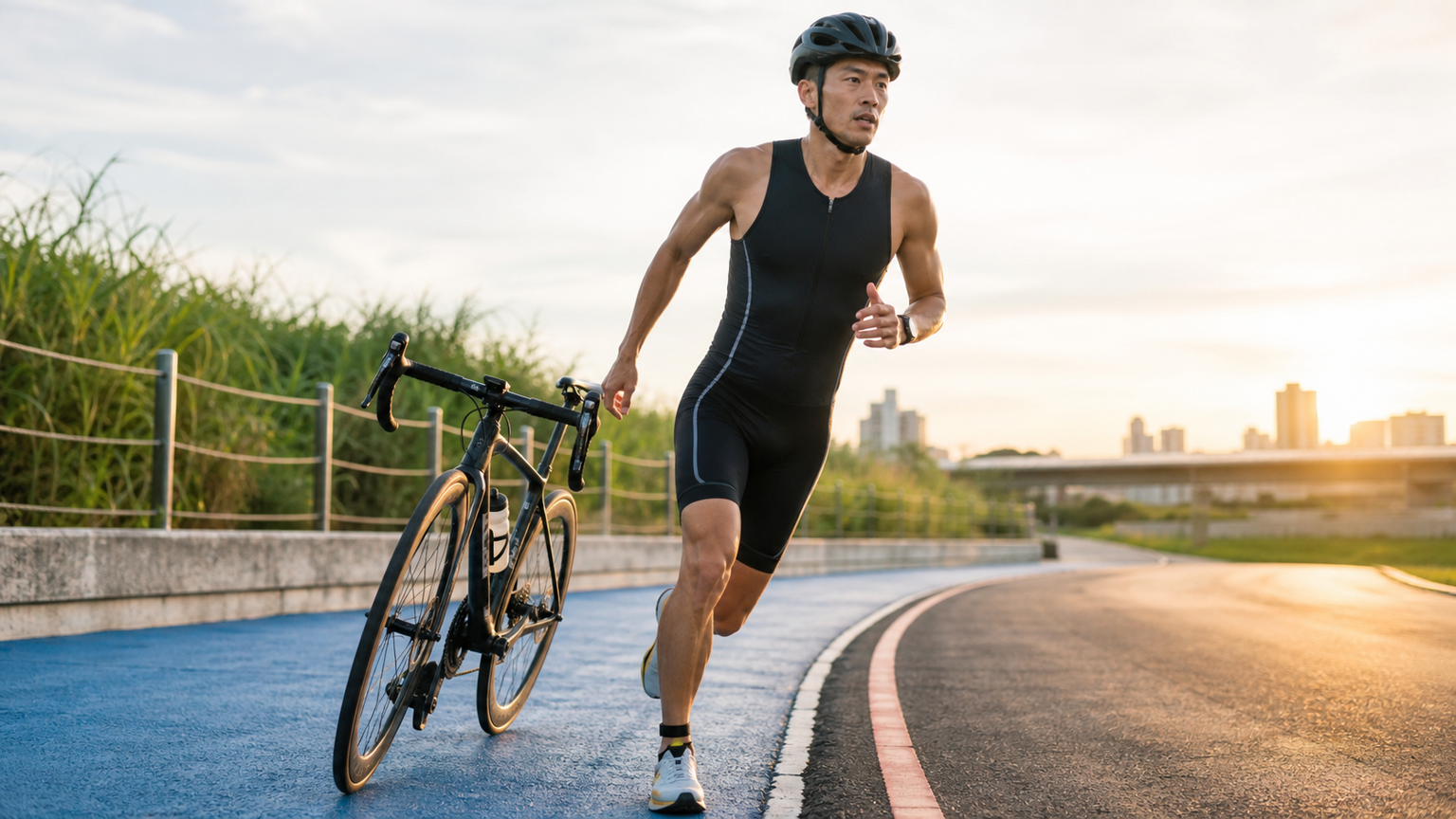
The Most Sport-Specific Training Block: The Transition Run
The true uniqueness of a triathlon isn’t in the swim, the bike, or the run—it’s in the transition of “running immediately after cycling.” The transition run (commonly called a T-run or brick run) is the only tool that directly trains this transition.
Three Levels of Transition Run Training
| Level | Structure | Purpose |
|---|---|---|
| Beginner | 30 min bike + 10 min run | Neuromuscular system first learns the transition |
| Advanced | 90 min bike @ race IF + 30 min run | Steady pacing under fatigue |
| Race Simulation | Race-distance bike + race-pace run | Integrate fueling and mental preparation |
Why Frequency Matters More Than Intensity
Improving wobbly legs off the bike comes from accumulating the number of transition repetitions to build neuromuscular adaptation. Two short transition runs per week (40 min bike + 10 min run each) far outperform one ultra-long brick every two weeks. Prioritize frequency first, then duration.
Cadence Ramp-Up Before Dismounting
In the final 3 minutes before dismounting, do 3×15 seconds of 100+ rpm high-cadence spinning to bring your nervous system closer to the high-frequency running pattern in advance. Your run cadence can reach race state 5–8 steps faster, shortening the dead-leg period.
Pacing Discipline: The First Kilometer Is a Trap
During the first 1 km of the transition run, heart rate reads 8–12 bpm artificially high and legs feel heavy. Deliberately run 10–15 sec/km slower than your target marathon pace, then shave 3–5 seconds per kilometer from the 2nd km onward. What you’re training is “holding back in the first 1 km and not letting false fatigue scare you into bad pacing.”
Advanced: Posture Maintenance Under Fatigue
Advanced transition runs must practice maintaining running form and cadence while genuinely tired. This is something pure running can never train—race meltdowns mostly happen in this exact scenario, so training must replicate it.
Quantifying Progress
Use a fixed test of “bike X min at a set power + run 1 km,” tracking your first-kilometer pace off the bike and the time it takes for heart rate to stabilize. The faster your HR stabilizes and the closer your first kilometer is to target, the better your transition adaptation.
The Neurological Basis for “Frequency Over Duration” in Transition Runs
The transition run is the only tool that directly trains the unique triathlon transition of “running immediately after cycling.” Improving wobbly legs comes from accumulating transition repetitions to build neuromuscular adaptation, so two short transition runs per week (40 min bike + 10 min run each) far outperform one ultra-long brick every two weeks. A quantifiable goal: cadence off the bike is typically 6–10 steps/min lower than in normal running; through repeated training, compress that gap to within 3 steps, and you’ll be able to hit your target pace right off the bike.
Three Levels of Transition Run Training
| Level | Structure | Purpose |
|---|---|---|
| Beginner | 30 min bike + 10 min run | Neuromuscular system first learns the transition |
| Advanced | 90 min bike @ race IF + 30 min run | Steady pacing under fatigue |
| Race Simulation | Race-distance bike + race-pace run | Integrate fueling and mental preparation |
Common Mistake: Letting the “False Fatigue” of the First Kilometer Off the Bike Ruin Your Pacing
In the first 1 km off the bike, heart rate reads 8–12 bpm artificially high and legs feel heavy—this is an illusion caused by body position and the neuromuscular transition, not actual depletion of energy stores. The most typical mistake is letting that heaviness scare you into bad pacing (either panicking and slowing down, or gritting it out and surging). The correct approach is to deliberately run the first 1 km 10–15 sec/km slower than your target marathon pace, then shave 3–5 seconds per kilometer from the 2nd km onward. In the final 3 minutes before dismounting, do 3×15 seconds of 100+ rpm high-cadence spinning to bring your nervous system closer to the running high-frequency pattern in advance, which further shortens the dead-leg period.
If I could only add one type of training to a week, I would always choose the transition run. It directly targets the one ability in triathlon that no single discipline can replace. Plenty of people can run and ride; the ones who can still run after getting off the bike are the triathletes—and that can only be built through transition run after transition run.
Related Reading
- The Brick Workout in Triathlon: The Art of Running After Cycling
- Triathlon Brick Training: Designing Leg Adaptation Workouts for Running Right After Cycling
- Swim to Bike: The Science of Brick Training to Overcome “Heavy Legs”: From Zero to Advanced (Series 288)
- Swim to Bike: The Science of Brick Training to Overcome “Heavy Legs”: From Zero to Advanced (Series 36)
西進武嶺 免費訓練分析服務 Intervals | 練不夠還是練過頭?你哪一種類型選手?AI模型告訴你! | 備戰神器 | 公路車 訓練 | CT Yeh
4 年前
邁金 T500 訓練台開箱!有下坡輔助、路感模擬、不用插電、直驅電機 !兩萬級距頂規享受新選擇!/ 公路車 / 室內訓練 / CT Yeh
1 年前
福隆鐵人團練隨拍
8 年前
單車AI教練!全新 ChatGPT4o 幫你分析訓練成果!排武嶺課表,分析騎車姿勢! 太神了! / 公路車 / CT Yeh / feat. 緯緯
2 年前
一個測試有沒有認真練車的方法😂 #公路車
10 個月前
Fitting訓練兩用功率車 ! Thinkrider ST900 完整實測!/ 坡度升降 / 鄰居測試/ smart bike/公路車/ CT Yeh
2 年前
#公路車 #Fitting 靠人工智慧APP 幫你調整單車
6 年前
本週北高前練習,連同天比的226們也來⋯鐵車真的太猛了 #cycling #北高
2 年前