Road Bike Brake Systems Compared: Rim Brakes vs. Disc Brakes — Which Suits Taiwan Riding?
文章導覽
Road Bike Brake Systems Compared: Rim Brakes vs. Disc Brakes — Which Suits Taiwan Riding?
One of the biggest debates in the cycling industry during the 2020s has been: “Are disc brakes really better than rim brakes?”
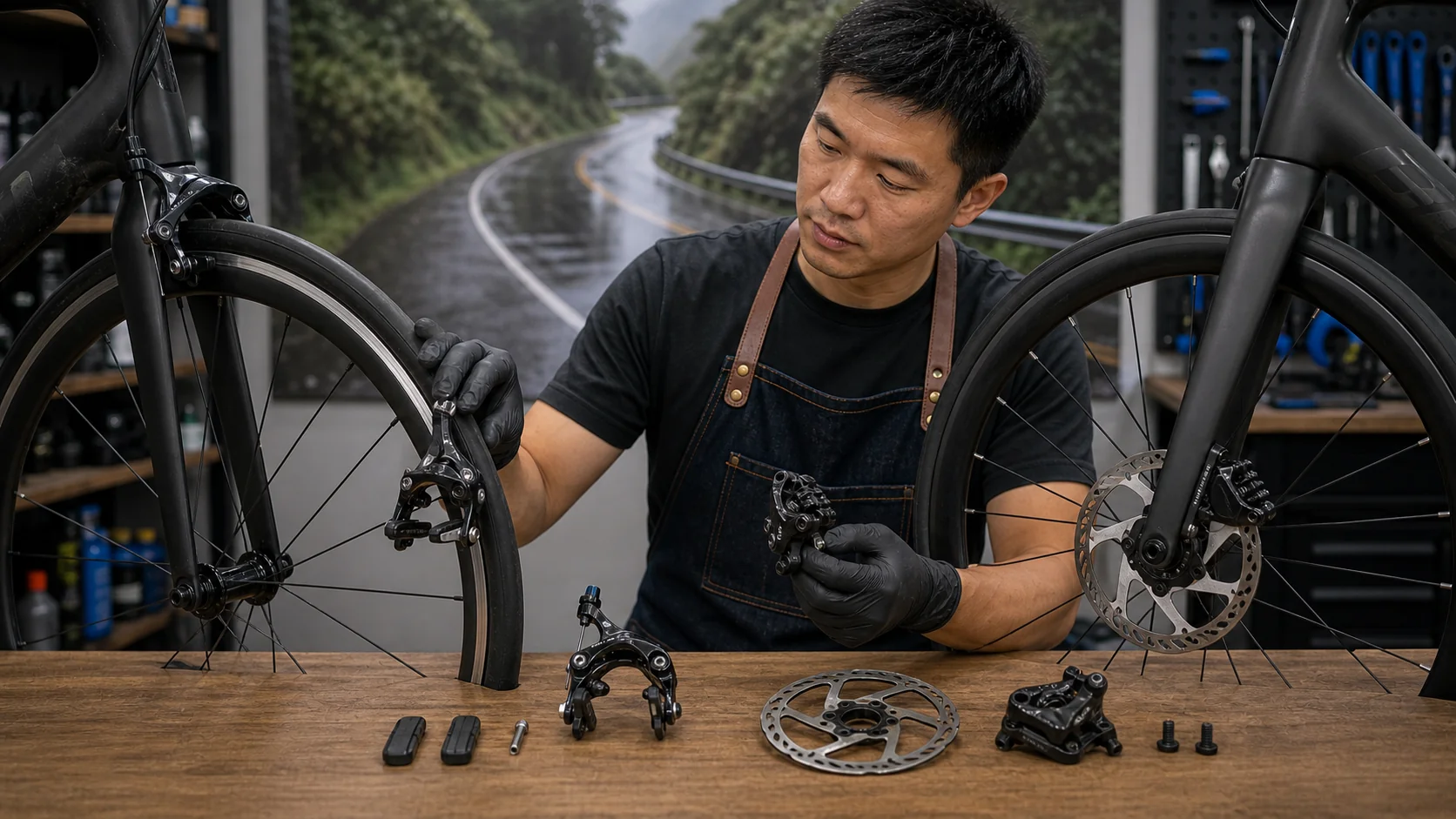
A few years on, the market has given its answer — disc brake market share has climbed rapidly, but rim brakes haven’t disappeared. This article offers a clear comparison from the perspective of actual use by riders in Taiwan.
Basic Principles of the Two Braking Systems
Rim Brake
A brake caliper clamps the outer edge of the wheel rim, generating friction to slow the bike.
Main types:
- Dual-Pivot: currently the most common rim brake on road bikes
- Direct-Mount: common on race bikes, more compact
Disc Brake
A brake caliper clamps a rotor attached to the wheel hub, generating braking force.
Main types:
- Cable-Actuated (mechanical): operated by a steel cable
- Hydraulic: operated by hydraulic fluid, with a more linear response
Performance Comparison
Braking Power
| Condition | Rim Brake | Disc Brake |
|---|---|---|
| Dry surface | Excellent | Excellent (little difference) |
| Wet surface | Poor (braking power drops 30-50% when rims are wet) | Excellent (almost unaffected) |
| Long descents | Poor (rim overheating) | Excellent |
| Fine modulation | Good | Excellent (more linear) |
Key factor for Taiwan’s environment:
Mountain riding in Taiwan (Wuling, North Cross-Island Highway, Alishan) often involves long, continuous descents, and combined with Taiwan’s plum rain season and summer afternoon thunderstorms, wet-weather braking performance matters more here than in some drier regions.
In this environment, the advantage of disc brakes becomes more pronounced.
Weight
| System | Typical Weight |
|---|---|
| Rim brake set | ~100-150g |
| Hydraulic disc brake set | ~250-350g |
| Disc brake wheelset (heavier than rim wheelset) | +200-400g |
Weight gap: Disc brake systems are typically about 400-700g heavier than rim brake systems.
Impact on climbing:
For a 70kg rider, an extra 600g adds roughly 1.5-2 minutes to a climb of Wuling. For recreational riders this gap isn’t decisive, but for KOM chasers it’s a meaningful number.
Rim Protection
Since disc brakes don’t apply braking force to the rim, they protect carbon fiber rims from braking heat and wear.
Significance for carbon wheelsets:
With carbon fiber rims, sustained braking on long descents can cause the rim to overheat (in severe cases, this can even cause a blowout!). Disc brake systems eliminate this risk entirely.
Conclusion: If you have carbon fiber wheels, disc brakes are strongly recommended.
Maintenance and Repair
Routine Maintenance
| Item | Rim Brake | Disc Brake |
|---|---|---|
| Pad replacement | Simple, DIY-friendly | Moderate (replacing larger caliper pads) |
| Adjustment | Relatively simple | Slightly more complex (requires rotor alignment) |
| Hose replacement | Not applicable | Requires professional tools and skill |
| Hydraulic bleed | Not applicable | Needed every 1-2 years |
Repair convenience in Taiwan:
Rim brake maintenance can be done easily at any bike shop in Taiwan. Bleeding hydraulic disc brakes requires specific tools and know-how, which can be hard to find in rural areas.
On a long round-island tour, if a disc brake fails in a remote area, repairs are harder than with a rim brake.
Cost Considerations
Frame Price Difference
Current frame pricing for disc brake vs. rim brake versions:
| Tier | Rim Brake | Disc Brake | Difference |
|---|---|---|---|
| Entry (aluminum) | NT$30,000-50,000 | NT$35,000-55,000 | +NT$5,000 |
| Mid-range (carbon) | NT$60,000-100,000 | NT$70,000-110,000 | +NT$10,000 |
| High-end (carbon) | NT$120,000+ | NT$130,000+ | +NT$10,000+ |
Component Costs
Disc brake wheelsets are typically about NT$5,000-10,000 more expensive than comparable-quality rim brake wheelsets.
Replacing disc brake fluid and rotors costs somewhat more than replacing rim brake pads.
Who Should Choose Disc Brakes?
Disc brakes strongly recommended if you:
- Enjoy riding in wet conditions or rain
- Frequently ride Taiwan’s long mountain descents (Wuling, Alishan, etc.)
- Plan to use carbon fiber wheels
- Don’t consider bike weight the top priority
- Want higher standards of safety and braking control
Rim brakes remain suitable when:
- You focus mainly on climbing races (KOM), where weight is the top priority
- You mostly ride in dry weather conditions
- Budget is limited
- You’re doing a long round-island tour (repair convenience matters most)
Market Trends
The current market trend is very clear:
- New high-end models from mainstream brands have largely all switched to disc brakes
- Entry-level and mid-range models still offer rim brake options
- Since disc brakes were fully allowed in professional racing in 2020, adoption has risen rapidly
Prediction: Over the next five years, new high-end rim brake products will diminish significantly, but existing rim brake users don’t need to rush to switch.
Conclusion
For Taiwan’s riding environment (mountain roads, frequent rain, long descents), the advantages of disc brakes are real, especially when paired with carbon fiber wheels.
But rim brakes haven’t disappeared — for riders focused mainly on climbing and weight, rim brakes remain a reasonable choice.
The most important thing is: whichever system you choose, make sure your brakes function fully and are properly adjusted — that is the most critical safety guarantee.
Related Reading
- Bicycle Brake Systems: Disc Brakes vs. Caliper Brakes on Taiwan’s Mountain Roads
- Road Bike Brake Selection: A Complete Comparison of Disc Brakes vs. Rim Brakes
- Evolution of Road Bike Brake Systems: Mechanical Disc vs. Hydraulic Disc vs. Caliper Brakes
- Road Bike Brake Upgrades: The Difference Between Mechanical and Hydraulic Disc Brakes