文章導覽
Bicycle Light Buying Guide: Lighting Solutions to Keep You Safe in the Dark
Night riding is becoming more and more common in Taiwan’s cycling culture — riverside parks at 5am, mountain training after work, early-morning starts for round-island tours.
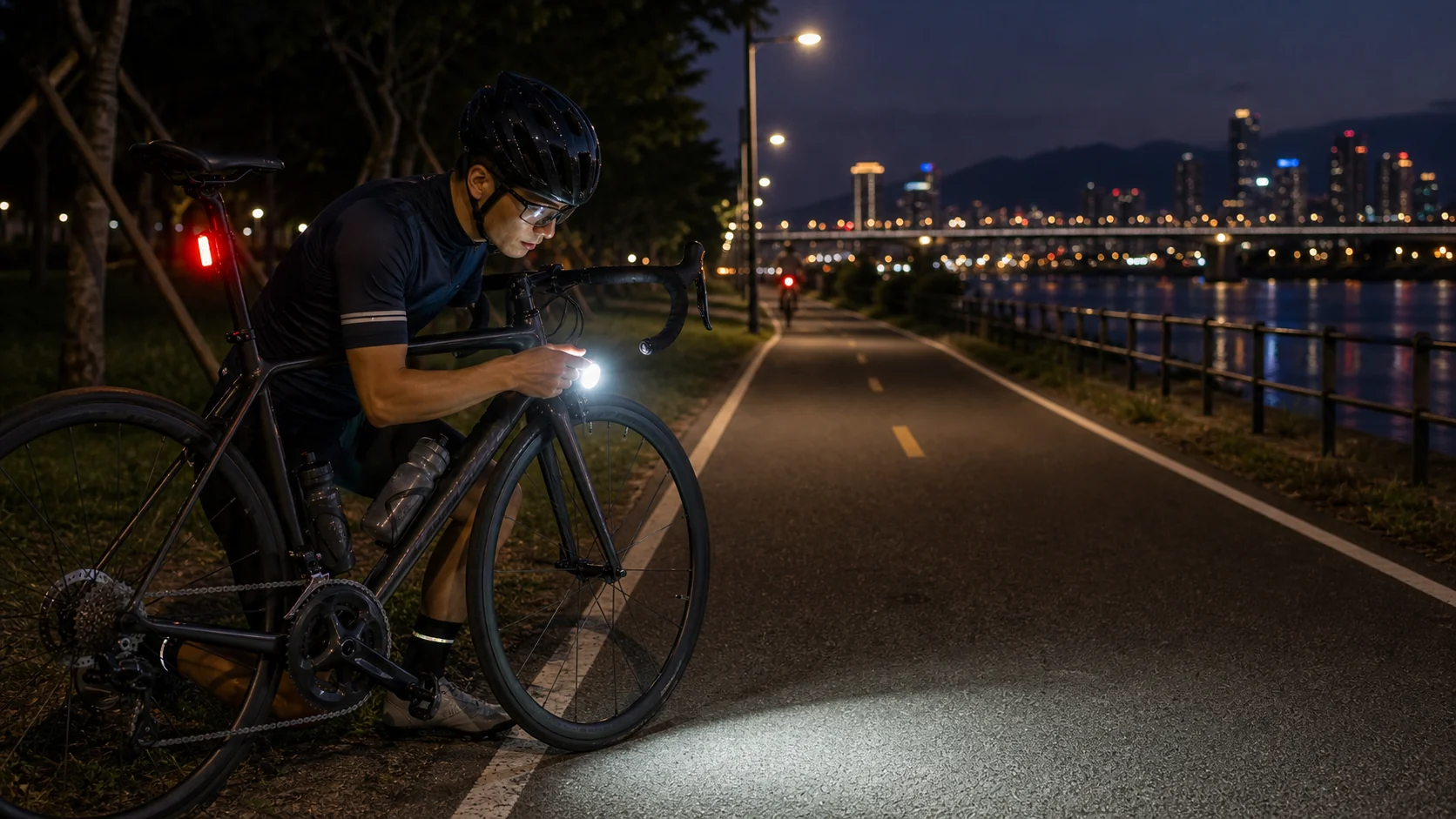
A good bike light isn’t just a legal requirement — it’s a matter of life and death. This article offers a comprehensive guide to buying bike lights.
Understanding Basic Light Specifications
Lumens
Lumens describe the total amount of light output — the higher the number, the stronger the light.
Lumen reference guide:
| Scenario | Recommended headlight lumens |
|---|---|
| City streets with lighting | 200-400 lm |
| Rural roads without streetlights | 600-1,000 lm |
| Mountain roads without streetlights | 1,000-2,000 lm |
| High-speed mountain descents | 2,000 lm+ |
Note: Different brands may measure lumens differently, so a higher rated lumen count doesn’t always mean the light is actually brighter in practice.
Beam Pattern
Spotlight:
The beam is concentrated straight ahead, illuminating far distances — ideal for high-speed riding where you need to see obstacles far in advance.
Floodlight:
A wider beam that illuminates a broader area, ideal for slower city riding.
Hybrid (Spot + Flood):
Modern high-end lights typically offer a hybrid beam, balancing both long-distance throw and peripheral visibility.
Recommendation for Taiwan’s mountain roads:
Taiwan’s mountain roads have many curves, so floodlight or hybrid beams are more helpful for peripheral vision (seeing the road surface around a bend).
Battery Life
| Light mode | Typical battery life |
|---|---|
| Maximum lumens | 1-2 hours |
| Medium lumens | 3-6 hours |
| Flashing mode | 8-20 hours |
| Lowest daytime running mode | 30-80 hours |
Recommendation: Choose a light whose battery life at your commonly used lumen setting exceeds the length of your typical ride, and get into the habit of charging it before every ride.
Choosing a Headlight
Entry-level headlights (NT$1,000-3,000)
Representative products:
- Cateye Volt 400 / 800
- Lezyne Lite Drive
Features: A comfortable 600-800 lm output, sufficient for city and suburban riding. Suitable for daily commuting and general training rides.
Mid-range headlights (NT$3,000-8,000)
Representative products:
- Garmin Varia UT800
- Exposure Lights Strada
- Blackburn Dayblazer 1500
Features: 1,000-1,500 lm, suitable for most riding scenarios in Taiwan, including mountain roads and areas without streetlights.
Recommendation: The Garmin Varia UT800 is currently the most recommended mid-range headlight among Taiwanese cyclists, with an excellent beam design, reasonable battery life, and strong integration with Garmin bike computers.
High-end headlights (NT$8,000-20,000)
Representative products:
- Light & Motion Taz 2000
- Busch+Müller IQ-X (requires a hub dynamo or external battery)
- Lupine SL series
Features: Over 2,000 lm, suitable for high-speed mountain descents and fast riding in dark conditions.
Analysis for Taiwan’s needs:
For most amateur cyclists in Taiwan, a mid-range headlight of 1,000-1,500 lm is already sufficient. 2,000+ lm lights are mainly suited for professional training or extreme night conditions.
Choosing a Taillight
A taillight’s job is to let vehicles behind you “see you” — it doesn’t need to illuminate the road, but it does need to make you visible from a distance.
Key Metrics
Visibility distance: A good taillight should be visible from over 500 meters away (and visible during the day too).
Flashing mode: Studies show that flashing modes attract attention more effectively than a steady light.
Waterproof rating: Taiwan gets a lot of rain, so taillights need at least an IPX5 (water jet resistant) rating.
Recommended Taillights
Entry-level:
- Cateye Rapid X3
- Lezyne Femto Drive (ultra-lightweight)
Mid-to-high-end:
- Garmin Varia RTL515 (radar + taillight, can detect the distance of approaching vehicles from behind)
- Bontrager Flare RT (from the Bontrager lineup, very bright)
Special feature of the Garmin Varia RTL515:
This taillight comes with a built-in radar function that can display approaching-vehicle warnings on your Garmin bike computer or phone app. On some of Taiwan’s busier mountain roads, this is a genuinely meaningful safety feature.
The Importance of Daytime Running Lights
Many riders assume lights are only needed at night, but research shows that using a daytime running light significantly increases a bicycle’s visibility even during the day.
Especially important in Taiwan:
Taiwan’s traffic conditions are complex, and multiple studies show a relatively high rate of accidents where cyclists are overlooked at intersections. A daytime running light (especially in flashing mode) can effectively improve visibility.
Recommendation:
Use your headlight’s high-output flashing mode as a daytime running light. Use your taillight’s flashing mode as well (even during the day).
Charging Management
General Charging Habits
Recommendations:
- Charge after every ride, once you get home (make it a habit)
- Check the battery level before setting out on long rides
- Carry a spare battery (for important rides)
Charging Interfaces Across Brands
Most modern bike lights use USB-C or Micro-USB charging, which is convenient. But keep in mind:
- Make sure your charger matches the current requirements
- When storing the light, charge it to at least 50% first (to avoid battery damage from full discharge)
Bike Light Installation Notes
Headlight Mounting Angle
The angle of your headlight directly affects:
- The effective illumination distance ahead
- The risk of glaring oncoming traffic
Recommended angle: Tilt downward about 5-10 degrees, to ensure you’re illuminating the road surface ahead rather than shining into the eyes of oncoming riders or drivers.
Taillight Mounting Position
- Seatpost: The most common choice, at a moderate height
- Under the saddle: Preferred by some, but may be obstructed
- Helmet: A high mounting position offers good visibility
Conclusion
Bike lights aren’t just accessories — they’re safety equipment.
Taiwan’s riding environment — winding mountain roads, complex city traffic, and a rainy summer season — makes a good lighting setup all the more important.
The most basic recommendation: A headlight of at least 1,000 lm (for those who ride at night), a high-visibility flashing taillight, and a flashing daytime running mode used even in daylight.
Safe riding starts with being seen.