Cyclist Training Tracking Gear: The Best Combo of Smart Bike Computer, Heart Rate Strap, and Power Meter
文章導覽
- What the Three Major Training Tracking Devices Actually Do
- Smart Bike Computer (GPS Cycling Computer)
- Heart Rate Monitor (Heart Rate Strap)
- Power Meter
- Recommended Purchase Priority
- Stage 1: Getting Started (Budget < NT$10,000)
- Stage 2: Intermediate (Budget NT$10,000-30,000)
- Stage 3: Competitive (Budget > NT$30,000)
Cyclist Training Tracking Gear: The Best Combo of Smart Bike Computer, Heart Rate Strap, and Power Meter
“What electronic gear do I actually need?” is a question many serious cyclists ask.
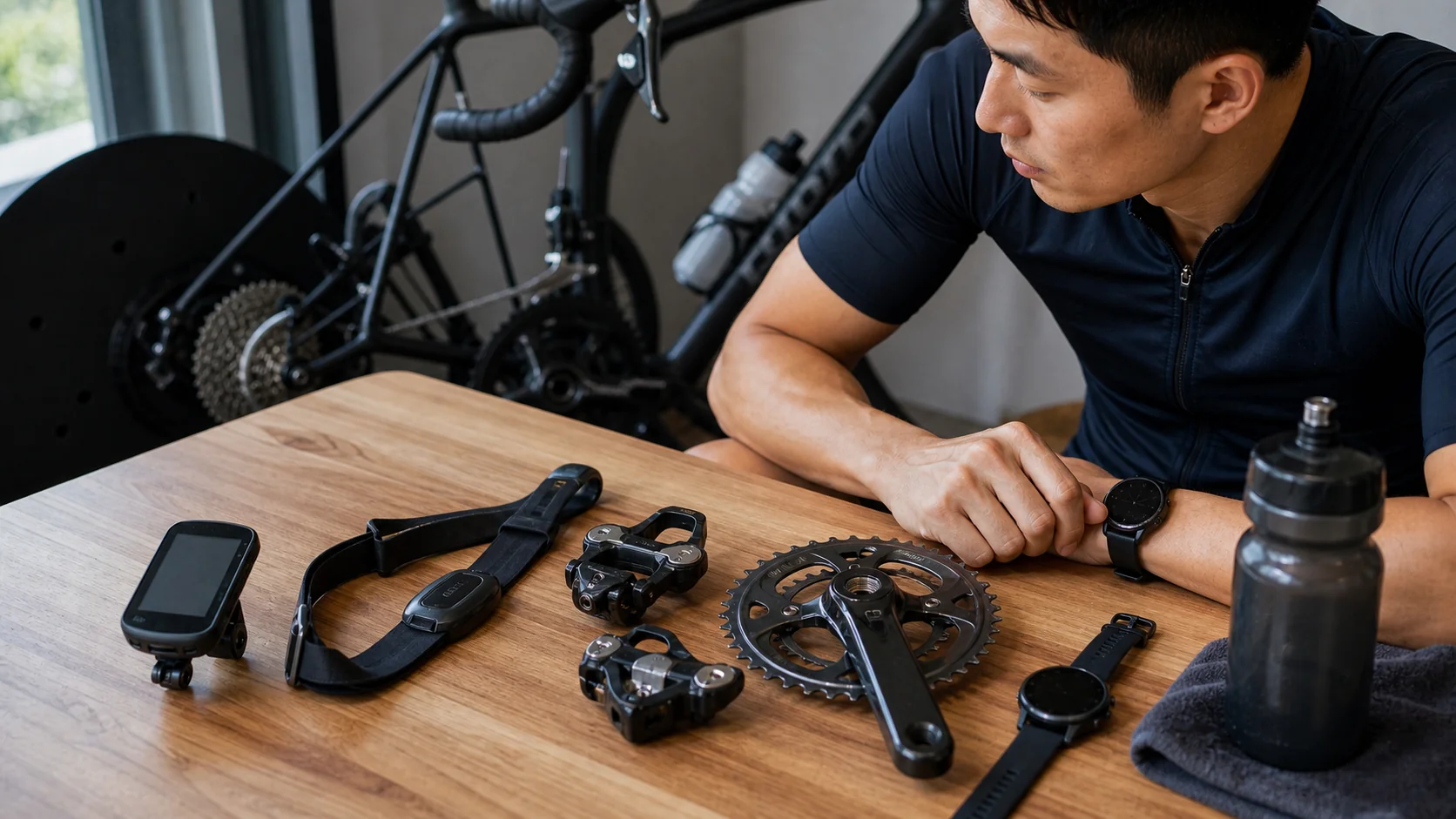
Smart bike computers, heart rate straps, power meters — each one claims to be essential. But budgets are limited. How should you prioritize?
This article starts from “what information does your training actually need” to help you understand the real value of each device.
What the Three Major Training Tracking Devices Actually Do
Smart Bike Computer (GPS Cycling Computer)
Data provided: speed, distance, time, elevation, GPS route, maps, navigation
Value for training:
The bike computer is the most fundamental training tracking tool. Knowing how far, how fast, and how much climbing you did is the foundation for analyzing training.
The problem without one:
It’s very difficult to objectively assess the intensity and volume of each session, or to track long-term progress.
Conclusion: Of the three devices, the bike computer should be your top purchase priority.
Heart Rate Monitor (Heart Rate Strap)
Data provided: real-time heart rate, heart rate zones, post-exercise recovery heart rate
Value for training:
Heart rate is the body’s response to exercise intensity. Although it has some lag and is affected by external factors (temperature, caffeine, etc.), for beginner and intermediate cyclists it’s the most intuitive intensity reference available.
The problem without one:
You’re left relying on subjective perceived exertion (RPE), which tends to run either too easy or too hard.
Conclusion: The heart rate strap should be your second purchase.
Power Meter
Data provided: real-time power output (watts), Normalized Power (NP), Training Stress Score (TSS)
Value for training:
The power meter is the most precise intensity indicator of the three — unaffected by external factors and without lag.
The problem without one:
You can’t precisely control training intensity, especially during high-intensity interval work, making it hard to confirm whether you actually hit the target intensity.
Conclusion: The power meter is the most valuable device for advanced training, but beginners should get a heart rate strap first.
Recommended Purchase Priority
Stage 1: Getting Started (Budget < NT$10,000)
Must buy: a basic smart bike computer + heart rate strap
Recommended combo:
- Garmin Edge 130 Plus (NT$5,000-6,000)
- Garmin HRM-Dual heart rate strap (NT$1,500-2,500)
Training capability of this setup:
You can track distance, speed, and heart rate, and train within heart rate zones — enough for the needs of most recreational cyclists.
Stage 2: Intermediate (Budget NT$10,000-30,000)
Upgrade options: a better bike computer + entry-level power meter
Combo A (prioritizing bike computer features):
- Garmin Edge 540 / 840 (NT$15,000-20,000)
- Stages Gen3 single-sided power meter (NT$8,000-12,000)
Combo B (prioritizing power meter accuracy):
- Wahoo ELEMNT BOLT (NT$8,000-12,000)
- Favero Assioma Uno (NT$10,000-15,000)
Stage 3: Competitive (Budget > NT$30,000)
Full competition setup:
- High-end bike computer (Garmin Edge 1040 Solar or Wahoo ELEMNT ROAM)
- Dual-sided power meter (Favero Assioma Duo or Garmin Rally)
- Advanced heart rate strap (with HRV monitoring)
Bike Computer Brand Comparison
Garmin Edge Series
Pros:
- The most comprehensive feature set (Connect IQ, Garmin ecosystem integration)
- Widely available after-sales service in Taiwan
- The most mature integration with Di2 electronic shifting
Cons:
- Relatively complex interface
- Some features require a paid subscription
Best-selling models in Taiwan:
- Edge 540 (mid-range, NT$14,000-18,000)
- Edge 840 (mid-range, with touchscreen, NT$18,000-22,000)
- Edge 1040 (flagship, NT$25,000-32,000)
Wahoo ELEMNT Series
Pros:
- Clean interface, easy to pick up
- Smooth integration with iOS/Android
- Fast setup sync (via the phone app)
Cons:
- Less feature depth than Garmin
- After-sales service in Taiwan is less widespread than Garmin’s
Main models:
- ELEMNT BOLT (NT$8,000-12,000)
- ELEMNT ROAM (NT$15,000-20,000)
Bryton (Taiwanese Brand)
Pros:
- A homegrown Taiwanese brand, convenient after-sales service
- High value for money
- Good Chinese-language interface support
Cons:
- Less feature depth than Garmin
- Smaller ecosystem
Recommended model:
The Rider 750 (NT$8,000-12,000) is Taiwan’s most popular value-for-money choice.
Heart Rate Monitoring Method Comparison
Chest Strap
Examples: Garmin HRM-Pro Plus, Wahoo TICKR
Pros: highest accuracy, best real-time responsiveness
Cons: can feel uncomfortable during long wear
Recommended for: cyclists serious about training
Optical Wrist HR
Built into most GPS watches (Apple Watch, Garmin Fenix, etc.).
Pros: convenient, no extra device needed
Cons: less accurate than a chest strap, especially during high intensity or in warm conditions
Suggestion: if you’re using a GPS watch as a secondary device, optical wrist HR is fine for everyday use. But if you want precise heart rate zone control, a chest strap is more reliable.
Armband (Optical)
Armband-style optical heart rate monitors such as the Polar OH1 and Wahoo TICKR FIT.
Sits between chest strap and wrist optical: more accurate than wrist optical, less comfortable than a chest strap.
Advanced Applications of HRV Monitoring
Heart Rate Variability (HRV) has become an important training reference metric in recent years.
What HRV means:
HRV reflects the balance of the autonomic nervous system and is a good indicator of the body’s recovery state. High HRV usually indicates good recovery; low HRV may indicate fatigue or stress.
How to measure HRV:
- Measure at rest first thing in the morning (most accurate)
- Use a Garmin HRM-Pro Plus or Polar H10 chest strap
- Log it with an app (such as HRV4Training or Elite HRV)
Training application:
Decide the day’s training intensity based on your morning HRV reading — high HRV means you can go hard; low HRV means choosing light recovery training instead.
Conclusion
Your choice of training tracking gear should be driven by “what information does your training goal actually need.”
Best starting point for beginners: a smart bike computer (Garmin Edge 130 or Bryton 750) + heart rate strap.
Essential for intermediate training: add a single- or dual-sided power meter.
Full competitive-level setup: high-end bike computer + dual-sided power meter + HRV monitoring.
Don’t let gear define your training, but the right gear can make your training far more efficient.