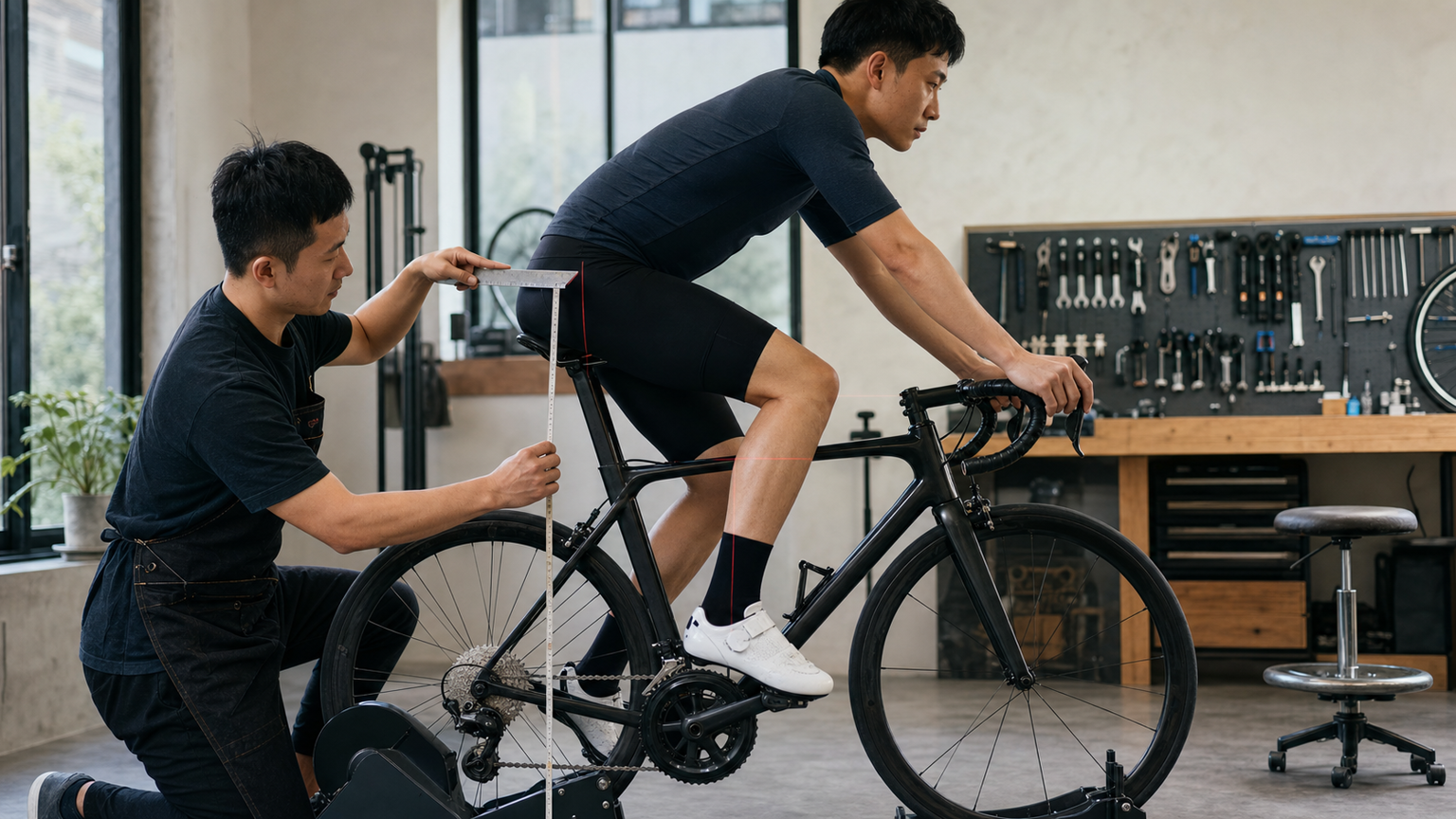
Bike Fit Is the Investment That Saves the Most on Medical Bills
The most expensive component on a bike isn’t the wheelset—it’s your knees and lower back. A 1 cm difference in saddle height, or handlebars that are too far away, adds up to chronic overuse injuries over time. Bike fit is essentially about “using setup to prevent injury and improve efficiency,” and it’s often the most undervalued yet most worthwhile investment.
DIY Adjustments vs. Professional Services
| Item | At-Home DIY | Professional Dynamic Fit |
|---|---|---|
| Tools | Plumb line, protractor, smartphone app | Motion capture, laser, pressure insoles |
| Precision | Captures the big picture | Quantified, reveals left-right asymmetry |
| Cost | Nearly zero | Medium to high |
| Best for | Healthy, pain-free riders; initial setup | Those with pain, chasing performance, or buying a new bike |
Three Things You Can Adjust Yourself First
1. Saddle Height
The most common mistake. Classic starting point: with your heel on the pedal at the bottom of the crank stroke, your knee should be nearly straight; when pedaling normally (on the ball of your foot), your knee should retain about 25 to 35 degrees of slight bend. Too high hurts the back of the knee and the hip; too low hurts the front of the knee.
2. Saddle Fore-Aft Position and Level
This affects sit-bone pressure and knee alignment. First aim for a roughly level saddle, then fine-tune based on riding comfort, avoiding sliding forward and compressing the perineum or sliding back and straining the hamstrings.
3. Handlebar Reach
Too far causes lower back and neck soreness, and numb hands; too close restricts breathing. Start from a comfortable position where you can easily grip the drops without excessive back rounding.
Reverse-Engineering Setup Issues from Pain Location (Self-Diagnosis Chart)
Where your body hurts often points directly to a specific fit parameter being off. This reference chart can help you narrow down the direction first:
| Pain/Discomfort Area | Common Possible Causes | Adjustment Direction |
|---|---|---|
| Front knee pain | Saddle too low / too far forward | Raise saddle slightly, move slightly back |
| Back of knee pain | Saddle too high / too far back | Lower saddle slightly, move slightly forward |
| Lower back soreness, neck tightness | Handlebars too far / too much drop | Shorten reach, raise the stem |
| Numb palms, pain at the base of the thumb | Too much weight shifted forward, low handlebars | Relieve forward pressure, adjust hand position |
| Perineal numbness | Incorrect saddle tilt or poor fit | Level the saddle, switch to a cut-out saddle |
Note: This is only for “narrowing down the direction.” For persistent pain, you should still seek a professional dynamic fit, using video and pressure measurement to reveal the left-right asymmetry that home tools can’t see.
When to Spend the Money on a Professional
- Persistent pain while riding (knee, lower back, numb hands, perineal numbness)
- Want to break through performance plateaus and hold an aero position comfortably for long periods
- Bought a new bike or replaced key components (crank length, saddle, handlebars)
Tool Purchase Recommendations
Start at home with: a plumb line (or app), an adjustable angle gauge, a hex wrench set, and a notebook to record your settings. Quantify and write down your “correct setup” so you can quickly replicate it when you switch bikes.
The value of a bike fit is something you only understand once your knees stop hurting. The most expensive frame paired with incorrect settings means the more you ride, the deeper the damage—align the rider and the bike first, then talk about speed.
Related Reading
- The Complete Guide to Bike Fitting: Why You Need a Professional Fit?
- The Biomechanics of Bike Fit: The Causal Chain of Knee Joint Load, Saddle Height, and Long-Term Injury
- The Biomechanics of Bike Fit: Saddle Height, Fore-Aft Position, and Knee Tracking
- Fine-Tuning Stem, Handlebars, and Saddle Height: Finding Your Optimal Riding Position
#公路車 #Fitting 靠人工智慧APP 幫你調整單車
6 年前
Fitting訓練兩用功率車 ! Thinkrider ST900 完整實測!/ 坡度升降 / 鄰居測試/ smart bike/公路車/ CT Yeh
2 年前
ThinkRider 智騎 XXPRO 訓練台,高階機種功能 只要 1/3價格!? 實測功率對比、噪音實測 / 公路車 / CT Yeh
1 年前
單車 一日北高 ( 雙城 ) 肥宅雙人瘋狂行 紀錄片 REACTO
10 年前
訓練台體驗) 2019台北自行車展 三大家 訓練台體驗 Tacx Neo Flux 2 Xepdo Apx Wahoo Kickr
7 年前
單車 重低音 藍芽喇叭 音質實測 SoundBot SB525 Real Sound Test
8 年前
摔車後補裝備: 好市多新款單車安全帽& Specialized Romin 北高整路屁股都不痛的坐墊 | 一千元居然有MIPS | CT Yeh | 公路車
4 年前
2022 前十五大自行車錶 !? 兩萬名車友大數據統計 | 你的上榜了嗎? | 菁英車友都用哪些錶? | Bryton Garmin 誰能拔得頭籌?| 車錶推薦 | 公路車 CT Yeh
4 年前