Cyclists’ Eye Protection: UV Rays, Insects, and Airflow Damage & Prevention
When cycling, your eyes face more threats than most people realize: intense ultraviolet radiation, insects and debris flying into you head-on, dryness from prolonged airflow exposure, and sudden changes in light.
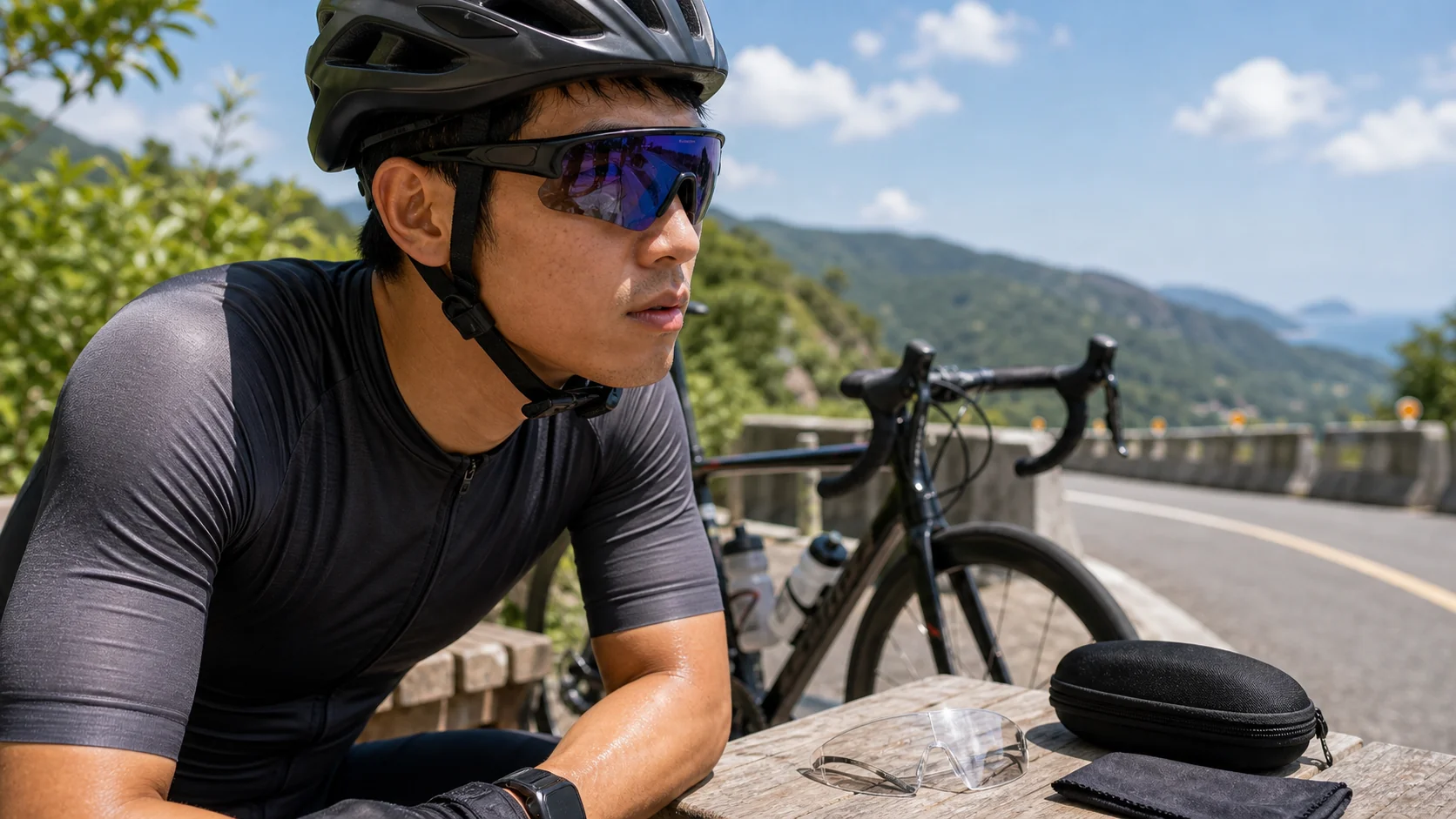
Good eye protection isn’t just about comfort — it’s an essential factor in riding safely.
Main Risks to the Eyes
UV (Ultraviolet) Damage
Why it’s a risk:
- Long ride times mean high cumulative UV exposure
- Taiwan’s summer UV index can reach 10-12 (extreme)
- High-altitude riding (such as Wuling) means even stronger UV
Long-term UV damage:
- Cataracts (clouding of the lens)
- Pterygium (a fleshy growth on the surface of the eye)
- Photokeratitis (UV “sunburn” of the cornea)
Prevention: Choose eyewear with 100% UVA/UVB protection (labeled UV400 or UV100%)
Insect and Debris Impacts
At speeds of 30-50 km/h, even a small insect or bit of gravel can strike the eye with surprising force.
On Taiwan’s summer mountain rides, bees, dragonflies, and other insects are common, and riding without eyewear is a real and practical risk.
Airflow-Induced Dry Eye
Continuous airflow accelerates tear evaporation, and after long rides your eyes may feel dry and irritated.
This problem is even more pronounced for contact lens wearers, since contact lenses themselves already tend to reduce tear film stability.
Choosing Sports Eyewear
Frame Design
Wraparound design:
Good cycling eyewear should have strong wraparound coverage to keep wind and insects from entering from the sides.
Lightweight materials:
For long wear, you need a lightweight frame (nylon or TR90 material) to avoid pressure on the nose bridge and behind the ears.
Anti-slip design:
Anti-slip nose pads and temple tips ensure the glasses don’t slide off when you sweat.
Lens Selection
Effect of tint/coating:
| Lens Tint | Suitable Conditions | Contrast Enhancement |
|---|---|---|
| Clear/Light yellow | Overcast, tunnels, night riding | Enhances contrast in low light |
| Pink/Red-orange | Cloudy, partial sun | Moderate contrast enhancement |
| Brown/Amber | Bright sunlight | Natural color, comfortable |
| Dark gray/Blue | Bright sunlight | True color, reduces glare |
| Mirror coating | Bright sunlight | Reflects intense light |
Photochromic lenses:
Lenses that automatically adjust their tint based on light intensity, ideal for riding conditions with changing light (such as entering and exiting tunnels).
Note: some photochromic lenses have limited effect behind glass or windshields (such as inside a car), which has less impact on cyclists riding outdoors.
Polarized lenses:
Eliminate reflective glare, especially effective on water, wet roads, or strong glass reflections.
Note: polarized lenses may cause display issues when viewing LED digital screens (such as bike computers).
Interchangeable Lens Systems
Many high-end sports eyewear brands offer interchangeable lens systems, letting you prepare different lenses depending on the weather.
Recommended brands:
- Oakley (USA, mature lens-swap system)
- 100% (USA)
- BBB (Netherlands, good value)
- Scicon (Italy, lightweight)
Eye Protection for Special Situations
Advice for Contact Lens Wearers
The problem:
Contact lenses are more prone to shifting in the airflow while riding, and can also make the eyes drier.
Recommendations:
- Consider daily disposables (discard after each ride, so you don’t bring insects and dust home)
- Use highly wraparound eyewear to reduce airflow impact
- Carry artificial tears (to use during the ride if needed)
- After a long ride your eyes may be dry — avoid driving immediately afterward
One consideration: if contact lens problems are frequent, consider prescription sports eyewear or evaluate laser surgery.
Special Considerations for Taiwan’s Mountain Roads
Taiwan’s mountain roads have many tunnels, where the light inside is very dark and riding speed is fast.
Recommendation:
Use photochromic lenses, or carry two pairs of glasses (dark lenses for bright sunlight, light yellow/clear lenses for tunnels/overcast conditions).
If you need to swap glasses before entering a tunnel, stop at a safe location to do so — do not attempt a quick lens change right at the tunnel entrance, as this is dangerous.
Daily Habits for Eye Protection
Eye Care After Riding
- Rinse with clean water (to remove pollen and dust)
- If your eyes feel dry, use preservative-free artificial tears
- If you feel something in your eye, do not rub it — this can cause corneal abrasion
Regular Eye Exams
Cyclists who ride frequently and at high volume are advised to get an annual eye exam to:
- Check for changes in vision
- Screen for early cataracts or retinal issues
- Check intraocular pressure (risk of exercise-related glaucoma)
Conclusion
Eye protection is often treated as an afterthought among cycling gear, but it’s actually an essential part of riding safely.
A good pair of cycling glasses isn’t just equipment — it’s an investment in the long-term health of your eyes.
Choose eyewear with UV400 protection, good wraparound coverage, and lens tints suited to the lighting conditions where you usually ride, so every ride is eye-friendly.
Related Reading
開箱) 近視車友 也可以很帥的 Envis Transform 太陽眼鏡開箱 翔鷹 配近視框超便宜秘訣
7 年前
再快都跟的上!? 單車跟隨攝影機之王 HOVERAir X1 PROMAX 全面實測 / 唯一!8K畫質&自行車專用模式和跟蹤信標&前後避障 / DJI Neo 可參考/ 公路車 / CT Yeh
1 年前
#東眼山 #公路車 單車約騎 空拍 北 113 水蜜桃冰沙 Mavic Pro
9 年前
用了AirTag 單車就不怕被偷?盲點大測試 結果… |公路車|CT Yeh
5 年前
#Canyon Aeroad 公路車 三年騎乘 #心得 | 出保方式 | 購買價格計算 | 同場加映累積三年大保養慘況
6 年前
一日北高/長距離團騎 常見問題補充篇 / 組團或跟團的眉角 / 壯車友容易被瘦車友慢性拉爆 / 原來屁股痛可能是這個原因...? / 風場配速法 / 公路車 / CT Yeh
2 年前
CT 喇低賽) 單車 比賽總是沒照片? 攝影師的觀點大公開 姿勢就是力量! 請加速1.25倍收看
7 年前
碟煞公路車 銑面器 !? 原來銑完差這麼多! 降低蹭碟機率! | TIME 公路車 保養小記錄 | CT Yeh
3 年前