文章導覽
- The Remarkable Numbers Behind Dutch Cycling
- History: How the Netherlands Became a Cycling Paradise
- The 1970s Oil Crisis: A Turning Point of Fate
- Concrete Policy Shifts
- Design Principles Behind Dutch Cycling Infrastructure
- The "CROW" Design Standards
- The Physical Design of Bike Lanes
- Amsterdam: Urban Cycling Taken to the Extreme
The Dutch Cycling Utopia: How the World’s Most Bike-Friendly Cities Were Built
In the Netherlands, cycling isn’t a “lifestyle choice for the environmentally conscious” — it simply is life itself. The average Dutch person cycles more than 1km every day, and the country’s 23 million bicycles serve a population of 17.7 million (an average of 1.3 bikes per person). Dutch cycling culture is a global model, and a subject of study for urban planners everywhere.
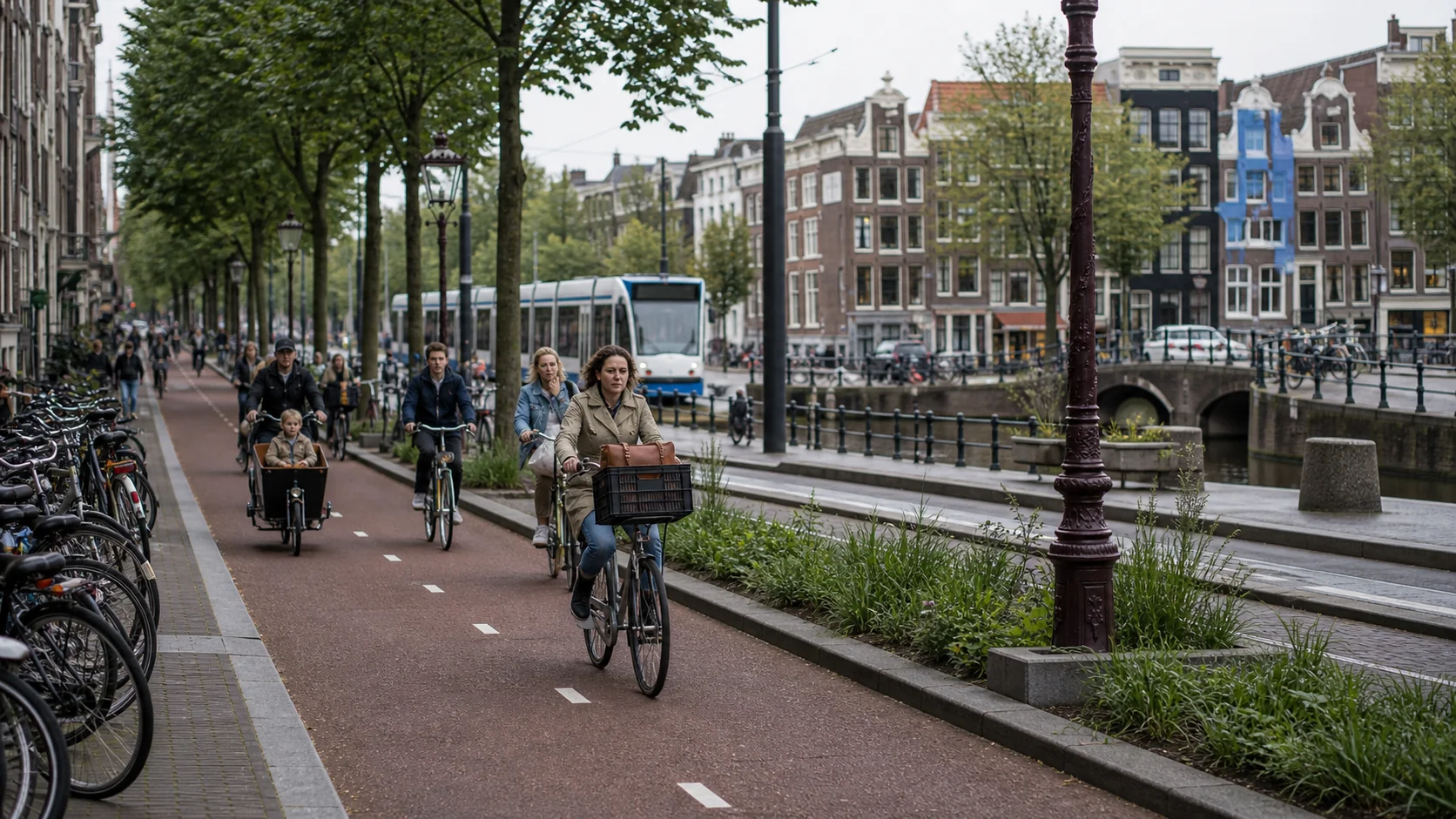
The Remarkable Numbers Behind Dutch Cycling
| Metric | Netherlands | United States | Taiwan (estimated) |
|---|---|---|---|
| Share of daily trips by bike | 26% | 0.6% | 2-4% |
| Total dedicated bike lane length | 35,000km | ~75,000km | 3,000km+ |
| Share of trips by bike in Amsterdam | 38% | — | — |
| Annual bicycle trips (billions) | 15 | 5 | N/A |
History: How the Netherlands Became a Cycling Paradise
The 1970s Oil Crisis: A Turning Point of Fate
Today’s Dutch cycling culture didn’t happen by accident — it was the response to a series of crises in the 1970s:
1. The 1973 Oil Crisis
OPEC’s oil embargo caused fuel shortages across Europe, prompting the Dutch government to implement “Car-Free Sunday” (Autovrije Zondag) policies. People discovered just how pleasant a city without cars could be.
2. A Peak in Child Traffic Deaths
In the early 1970s, child deaths in traffic accidents reached alarming levels in the Netherlands, sparking the “Stop de Kindermoord” (Stop the Child Murder) movement, which drove fundamental changes in road policy.
3. Rising Environmental Awareness
The environmental movement of the 1970s led the public to start questioning car-centric urban planning.
Concrete Policy Shifts
Starting in the 1970s, the Dutch government systematically built a bike-friendly environment:
- Large-scale investment in cycling infrastructure
- Redesigning roads — narrowing car lanes and adding bike lanes
- Implementing traffic calming measures
- Legal frameworks that prioritize protecting cyclists and pedestrians
Design Principles Behind Dutch Cycling Infrastructure
The “CROW” Design Standards
The Netherlands has a set of cycling infrastructure design standards called CROW, which have influenced the world:
Five Core Principles:
- Cohesion: The bicycle network must be fully connected, with no gaps
- Directness: Cycling routes should be as direct as possible — detours discourage riders
- Safety: Complete separation from motor vehicles so people feel safe
- Comfort: Smooth surfaces, sufficient width, minimal need to stop at red lights
- Attractiveness: Beautiful scenery that makes cycling a pleasure
The Physical Design of Bike Lanes
Standard Dutch cycling infrastructure includes:
| Facility | Specification | Feature |
|---|---|---|
| Two-way bike path | Minimum 3.5m wide | Separated from car lanes by a green buffer |
| One-way bike lane | Minimum 2.5m wide | Physically separated (not just painted) |
| Intersections | Designed with cyclist priority | Vehicles yield to cyclists |
| Parking facilities | Ample and secure | Train stations have thousands of parking spaces |
Amsterdam: Urban Cycling Taken to the Extreme
The Numbers Tell the Story
- Daily: More than 500,000 bicycle trips
- Commuting share: 38% of residents’ trips are made by bike
- More bikes than people: Roughly 900,000 bicycles for 880,000 residents
- Bike lanes: Over 800km within the city
Characteristics of Amsterdam’s Cycling Culture
1. Practicality, Not “Sport”
Amsterdammers almost universally ride the Omafiets (“grandma bike”) — an upright, practical bicycle with internal gears, fenders, and a rear rack. Nobody wears cycling kit or a helmet (except sport cyclists) — just as we don’t need special gear to walk.
2. The Bicycle as an All-Purpose Vehicle
- Dropping off and picking up children (front-mounted child seats or cargo bikes)
- Grocery shopping (bags hung on the rear rack)
- Commuting to work (riding in business attire is completely normal)
- Socializing (riding slowly side-by-side with friends while chatting)
3. Parking Is a Serious Challenge
The most ironic problem in Amsterdam: not enough space to park bicycles. Underground bike parking garages in the city center (such as the one near Central Station) can hold 5,000-7,000 bikes, and demand still outstrips supply.
What Can Taiwan Learn?
The Current State of Bike-Friendliness in Taiwan
Taiwan has significantly improved its cycling infrastructure in recent years, but gaps remain:
| Metric | Netherlands | Taiwan Today | Taiwan’s Goal |
|---|---|---|---|
| Bike lane continuity | Excellent | Fragmented | Improving |
| Cyclist-priority intersections | Common | Rare | Pilot programs underway |
| Parking facilities | Ample | Limited | Increasing |
| Cultural friendliness | Very high | Moderate | Continuously improving |
Taiwan’s Concrete Progress
- Taipei’s YouBike: A bike-share system with one of the highest usage rates in the world
- Riverside bike paths: High-quality bike paths along the Tamsui and Xindian Rivers
- County and city bike paths: Dedicated lanes are being extended year by year across counties and cities
- Regulation of e-bikes: Laws are gradually being established
The Challenges of Learning from the Netherlands
| Challenge | Description |
|---|---|
| Terrain differences | The Netherlands is almost entirely flat; Taiwan has extensive hills |
| Climate differences | Taiwan’s hot summers reduce willingness to cycle |
| Motor vehicle culture | Taiwan’s scooter-centric culture is deeply entrenched |
| Density differences | Taiwan’s cities are denser, leaving less available space |
What the World Can Learn from the Dutch Experience
The Netherlands proves that cities can be designed for people, not for cars.
When you:
- Give bicycles enough space and route priority
- Make cycling more convenient and safer than driving
- Build a culture where cycling is part of daily life for every age group
…you can create a more livable, healthier, and more sustainable city.
The Results, in Numbers
| Benefit | Quantified Data |
|---|---|
| Personal health | The Dutch have a longer average lifespan than comparable countries without a cycling culture |
| Traffic efficiency | Within cities, bicycles are faster than cars (avoiding traffic jams) |
| Environment | A significant reduction in carbon emissions and air pollution |
| Social equity | Bicycles are a low-cost mode of transport that narrows the income gap |
| Urban space | The space for one car parking spot can hold 10 bicycles |
Conclusion
The Dutch cycling utopia wasn’t built overnight — it took 50 years of sustained investment, cultural change, and policy commitment.
Taiwan is walking this same path, one bike lane, one parking lot, one policy at a time. Perhaps in a few more decades, Taipei’s cycling mode share could also reach 38%, just like Amsterdam.
What would that Taipei look like? Picture that scene — it might just be the best reason to choose a bike over a car, every single time.
Related Reading
- The Dutch Cycling Utopia: Experiencing the World’s Most Bike-Friendly Culture
- Dutch Cycling Infrastructure: The World’s Most Advanced Bike City Planning
- The World’s Best Cycling Cities Ranked: From Copenhagen and Amsterdam to Taipei
- The Dutch Cycling Paradise Report: The Social Structure Behind 1.3 Bikes Per Person