Introduction
Choosing your race fueling strategy may seem like a minor detail, but it’s a critical factor in determining your performance in the latter half of the race. Energy gels are the standard fueling product for modern endurance sports, but not every athlete can force down artificially sweetened gel when dealing with gastrointestinal discomfort. On the other hand, while solid food tastes better and offers greater psychological satisfaction, it takes longer to digest and places a heavier burden on the stomach, making it not always a good idea during high-intensity exercise. Understanding the differences between the two is key to making a smart choice.
Energy Gels: Pros and Cons
Pros:
- Rapid absorption (primarily fast-acting carbs, peaking in 20–30 minutes)
- Easy to carry, takes up little space
- No chewing required, suitable for use while running
- Precise dosing, easy to calculate carbohydrate intake
Cons:
- Monotonous taste; repeated consumption over long periods can cause nausea (“sweet fatigue”)
- If not consumed with enough water, high concentration may delay gastric emptying
- Some brands contain caffeine; if poorly timed, it can affect sleep (ultra-distance events)
- For those with sensitive stomachs, artificial sweeteners may cause gastrointestinal irritation
Solid Food: Pros and Cons
Pros:
- High psychological satisfaction (especially in events lasting over 3 hours)
- Offers a variety of flavors to combat taste fatigue
- Some solid foods contain protein (muscle repair)
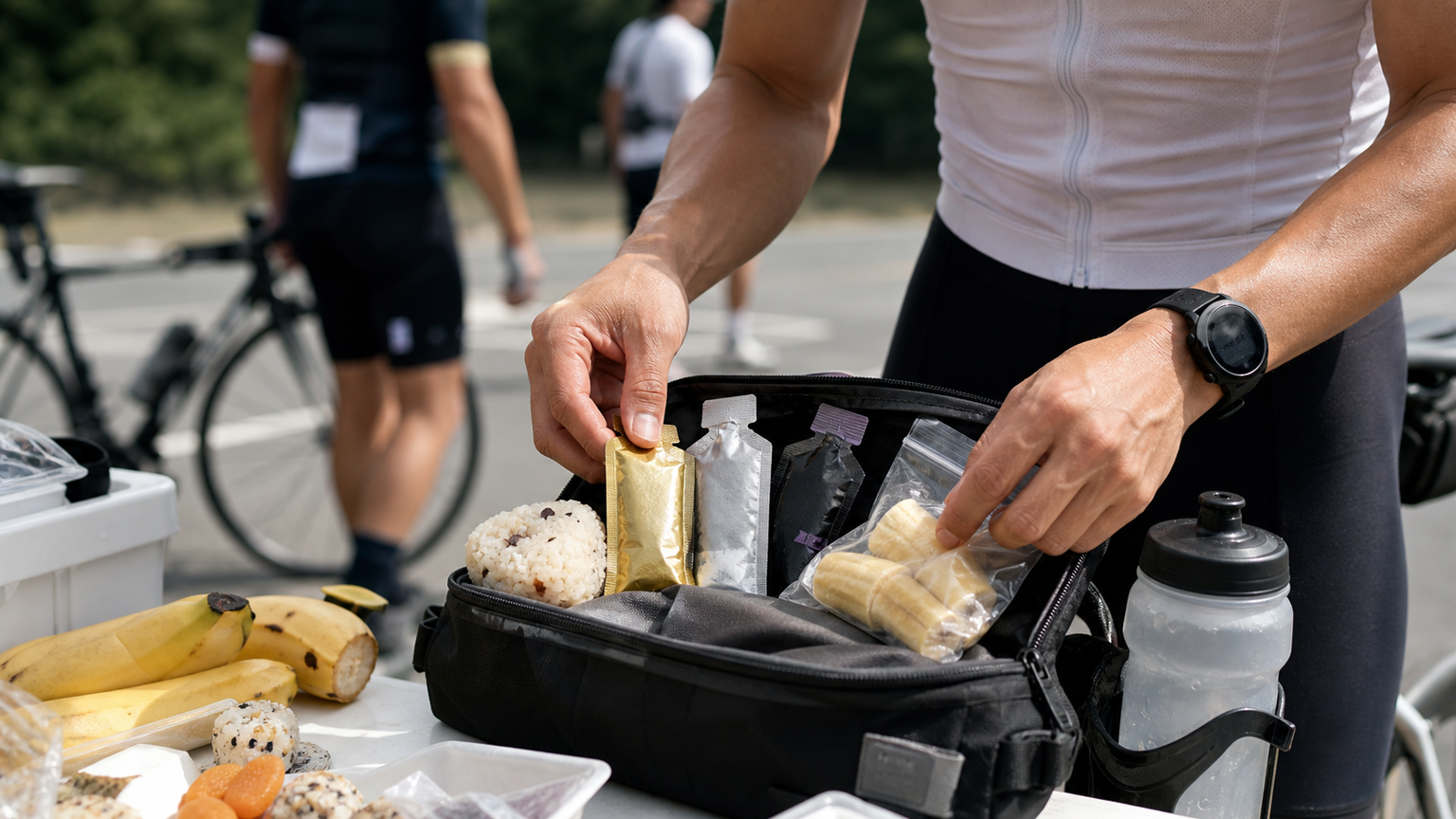
- Taiwan-specific ingredients (rice balls, bananas) are cheap and effective
Cons:
- Longer digestion time; gastric emptying is slow during high-intensity efforts
- Difficult to chew while running, with a risk of choking
- Under the vibration of the digestive tract (while running), certain foods can easily cause discomfort
- Heavier, inconvenient to carry on your own
Fueling Format Choices for Three Sports
| Sport | Primary Recommendation | Supplementary Options | Notes |
|---|---|---|---|
| Cycling | Solid food + energy bars | Energy gels, sports drinks | Can stop to refuel; hands can leave the handlebars |
| Road Running | Energy gels + sports drinks | Bananas (aid stations) | High impact; solid food requires caution |
| Swimming (Open Water) | Energy gels | Sports drinks | Refuel after stopping |
| Triathlon | Solid food on the bike, gels on the run | Solid food in transition area | Switch according to the segment |
Reference by Race Duration
| Race Duration | Recommended Fueling Format |
|---|---|
| <90 minutes | Sports drinks are sufficient; no need for solid food/gels |
| 90 minutes–3 hours | Primarily energy gels (one pack every 20–30 minutes) + sports drinks |
| 3–5 hours | Alternate gels and solid food; solid food makes up 30–50% |
| >5 hours | Solid food as the main source (rice balls, sandwiches, bananas), gels as a supplement |
Local Taiwanese Solid Fueling Options
Below are solid fueling foods commonly used by Taiwanese athletes and supported by research:
| Food | Carbs (g) | Advantages | Suitable Sports |
|---|---|---|---|
| Banana (medium) | 25–27 | Potassium, easy to digest | Cycling, aid stations |
| Plain white rice ball | 35–40 | Low fiber, pure starch | Cycling feed bags |
| White toast strips | 25/2 slices | Light, low fiber | Cycling |
| Saltine crackers | 20/4 pieces | Contains sodium, low fat | Cycling (alternating salty/sweet) |
| Small steamed buns | 20–25 | Low fiber, gentle | Cycling, ultramarathons |
| Grapes (small bunch) | 15 | Juicy, cooling sensation | Aid stations |
| Glutinous rice dumplings | 30–40 | Slow release | Ultra-distance events |
Building Your Personal Fueling Plan
Recommended Strategy: 2:1 alternating gels and solid food
- Minute 20: Energy gel + sports drink
- Minute 40: Banana or crackers + water
- Minute 60: Energy gel + sports drink
- Minute 80: Solid food
This rotation reduces taste fatigue while maintaining a steady supply of carbohydrates.
Practical Tips
- Practice your race-day fueling plan during long training sessions (2+ hours) to confirm gastrointestinal tolerance.
- Find 2–3 “fallback foods”—items you can get down even when fatigued or nauseous—as a backup plan.
- Salty foods (salt tablets, saltine crackers) are easier to consume than sweet ones in the latter half of a long-distance event, so be sure to prepare them.
- Avoid trying new fueling products within 3 days before a race.
Conclusion
There’s no absolute answer in the solid vs. gel debate; the key is finding a combination that suits your sport, race duration, and stomach. Experiment during training, execute on race day, and make fueling your competitive advantage rather than your weakness.
Related Reading
- Complete Guide to Energy Gel Types: How to Choose Between Real Solid, Semi-Solid, and Liquid
- Choosing and Timing Energy Gels: Race Planning with Caffeinated vs. Non-Caffeinated Gels
- Energy Supplementation During Exercise: A Comparison of Gels, Bars, and Real Food
- Energy Bars vs. Energy Gels for Cycling: Selection and Timing
CT暗黑廚房) 車友必備 宇宙無敵鮮蚵湯 幫助訓練恢復 天然食補 好市多 超肥鮮蚵 破PR
7 年前
一日北高前的高裝檢 | 北高 360 | 挑戰11小時的裝備 | 一日雙塔 | 補給
6 年前
靠單車減肥35公斤 心得分享與整理
7 年前
一日北高/長距離團騎 常見問題補充篇 / 組團或跟團的眉角 / 壯車友容易被瘦車友慢性拉爆 / 原來屁股痛可能是這個原因...? / 風場配速法 / 公路車 / CT Yeh
2 年前
#公路車 #Fitting 靠人工智慧APP 幫你調整單車
6 年前
#KOM 夏季登山王之路 比賽實況 #東進武嶺
7 年前
2021 96聯賽 桃園市長盃 4K多視角實況 當天選手瓦數/推力比/均速/時間 即時數據分析 | 公路車 | CT Yeh
5 年前
大家都在開箱的...單車用藍芽對講耳機真的有幫助嗎? SENA BiKom 20 長距離旅遊 & 海鷗繞圈賽 實際體驗心得 / 公路車 / CT Yeh
9 個月前