Road Running Headlamp Buying Guide: Lumens, Wide-Angle Beam Distribution, and Practical Night Running Tips for Taiwan
Introduction
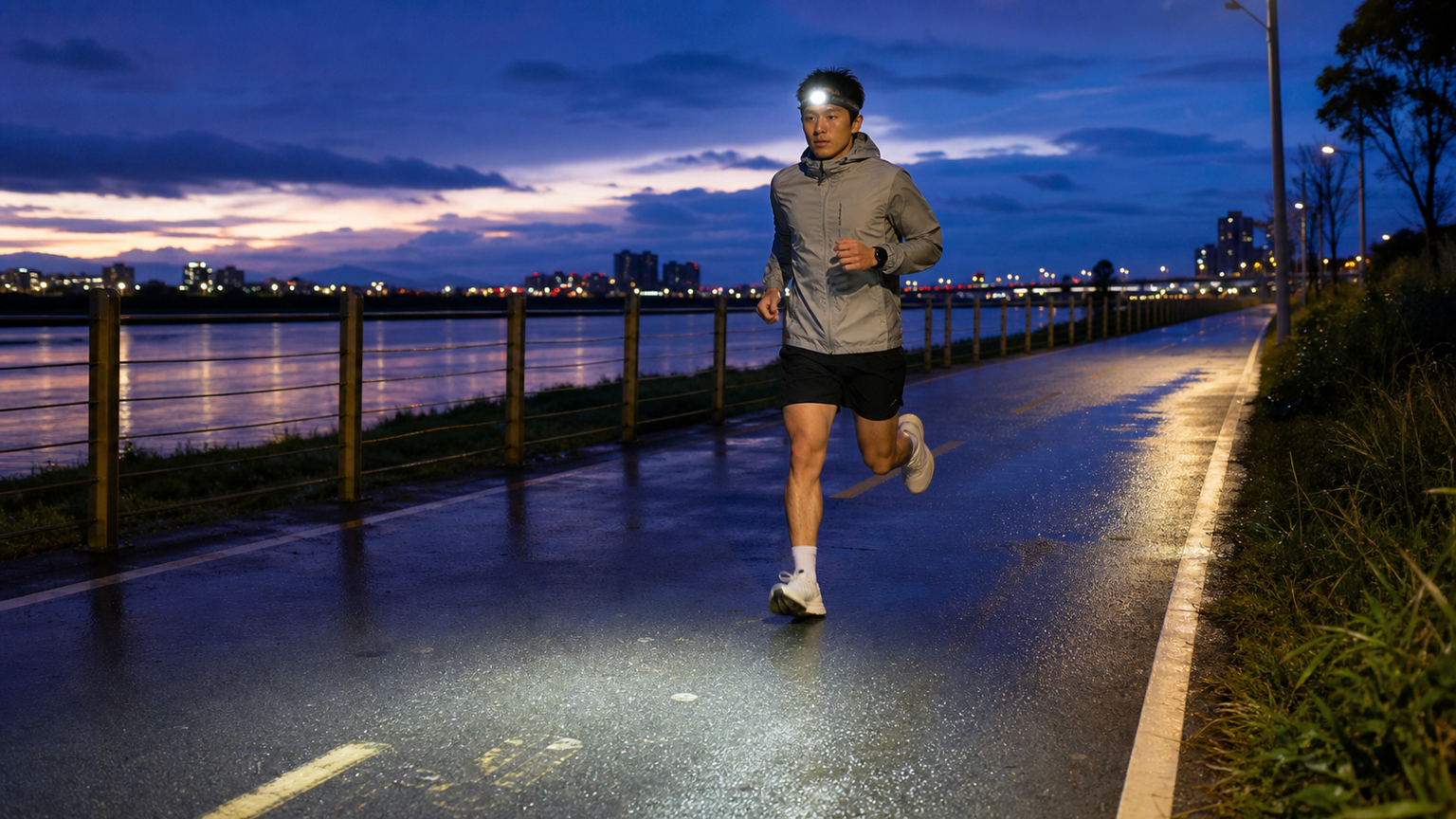
The proportion of runners in Taiwan who run at night is relatively high globally, mainly because summer daytime temperatures are high, and most runners choose to run in the evening or early morning. Streetlights may be sufficient for urban road running, but once you enter mountain trails, remote sections of riverside parks, or 4 AM race-prep training sessions, a good headlamp becomes a crucial safeguard for both safety and comfort.
However, choosing a headlamp can often be confusing: What’s the difference between 200 and 500 lumens? Which suits running better—wide-angle or focused beams? What are the pros and cons of battery-powered versus rechargeable models? This article addresses all these questions based on the real-world needs of night running in Taiwan.
The Lumen Myth
Lumens are the unit of luminous flux, representing a headlamp’s total light output. But a high lumen count doesn’t mean “seeing farther and clearer”—what matters more is the beam design (spot shape) and light uniformity.
Urban Running: 100–300 Lumens Is Enough
Urban road-running environments in Taipei, Taichung, and Kaohsiung already have a considerable degree of street lighting. The headlamp’s main role is increasing your own visibility (so vehicles and pedestrians can see you) and supplementing lighting in dark corners. In this scenario, 100–200 lumens is completely sufficient—chasing higher brightness will only dazzle oncoming runners.
Riverside Parks and Suburbs: 200–400 Lumens
Riverside cycling/running paths across Taiwan are not well lit at night. A 200–400 lumen headlamp can illuminate the ground clearly at a sufficient distance, helping you avoid rocks, puddles, and changes in elevation.
Mountain Trail Running: 400+ Lumens
Steep trails and root-covered mountain paths require stronger illumination. A 500–800 lumen headlamp lets you see trail conditions clearly from 10–15 meters away. Top-tier trail headlamps (such as the Petzl ULTRA RUSH or Silva Trail Speed Elite) can reach 1,000–2,000+ lumens, suitable for nighttime competitive trail races.
Wide-Angle vs. Focused Beam
A running headlamp’s beam design matters more than its lumen count:
- Flood: Wide beam that illuminates a large area ahead, ideal for observing the ground beneath your feet and your surroundings while running.
- Spot: Long-reaching beam that projects far, suitable for trail races where you need to see the route ahead clearly.
- Hybrid Mode: Most high-end headlamps offer both flood and spot modes, or automatically adjust the beam distribution.
For running, choose a flood or flood+spot hybrid—a pure spot headlamp won’t illuminate the ground at your feet, making uphill and downhill running very dangerous.
Comparison of Mainstream Running Headlamps
| Brand/Model | Max Lumens | Weight | Power Source | Water Resistance | Taiwan Price |
|---|---|---|---|---|---|
| Petzl Actik Core | 600 lm | 80g | USB rechargeable/AA | IPX4 | NT$1,800 |
| Black Diamond Spot 400-R | 400 lm | 110g | USB rechargeable/AAA | IPX8 | NT$1,500 |
| Ledlenser MH5 | 400 lm | 105g | USB rechargeable | IP54 | NT$1,200 |
| Nitecore NU25 | 400 lm | 40g | USB rechargeable | IP66 | NT$900 |
| Petzl SWIFT RL | 900 lm | 90g | USB rechargeable | IPX4 | NT$3,500 |
| Silva Trail Runner Free | 400 lm | 97g | USB rechargeable | IPX5 | NT$2,800 |
Weight and Wearing Comfort
The weight of a running headlamp has a significant impact on the long-distance running experience. A headlamp over 100g may start causing forehead pressure or neck fatigue after 2 hours, especially with models lacking good headband or anti-slip design.
It is recommended to keep running headlamp weight within 80–120g, equipped with a wide elastic headband (to reduce pressure points), and to confirm that the headlamp won’t slide down and obstruct your vision from running vibration.
Rechargeable vs. Battery-Powered
| Feature | USB Rechargeable | AA/AAA Battery-Powered |
|---|---|---|
| Backup for long races | Requires power bank | Easy to swap batteries |
| Low-temperature performance | Lithium batteries perform steadily | Alkaline batteries lose capacity in cold |
| Eco-friendliness | Rechargeable, fewer waste batteries | Requires ongoing battery purchases |
| Emergency backup | Must be charged in advance | Batteries available anytime at convenience stores |
Practical advice for Taiwanese runners: choose rechargeable models for daily training (convenient), and dual-power models (rechargeable + battery) for ultramarathons or multi-day events (such as the Petzl Actik Core). If the battery runs out, you can still buy replacements at a convenience store—in Taiwan, there’s a 7-Eleven almost everywhere.
Water Resistance Ratings Explained
Taiwan’s plum rain season and typhoon season make water resistance an important consideration:
- IPX4: Splash-resistant; fine for running sweat and light rain
- IPX5: Can withstand water jet washing
- IPX8: Fully submersible; the highest rating
For running purposes, IPX4–5 is sufficient—there’s no need to specifically pursue IPX8.
Practical Recommendations
- For your first night-running headlamp purchase in Taiwan, a budget of NT$1,000–1,800 is recommended. The Petzl Actik Core or Black Diamond Spot 400-R are the most recommended entry-level models among Taiwanese runners.
- After purchase, test the different brightness modes indoors to find a balanced setting that is “bright enough to see clearly but preserves battery life.”
- Headlamp angle adjustment is very important. It is recommended to tilt it forward 15–20 degrees rather than keeping it level, so it illuminates the ground about 3–5 meters ahead of your feet.
- Carrying a small backup headlamp (such as the Nitecore NU25, 40g) in your waist pack is standard practice for ultramarathon runners.
Conclusion
The choice of a running headlamp should start from your primary running environment: urban jogging doesn’t require high lumens, while mountain trail running needs 500+ lumens. Wide-angle beam design, comfortable weight, and a charging approach that fits Taiwan’s convenience-store culture are the most practical purchasing criteria for Taiwanese runners.
Related Reading
- Trail Running Headlamp Buying Guide: Complete Comparison of Lumens and Battery Life for Night and Morning Runs
- Running Light Buying Guide: Lumen Requirements and Battery Life for Night Running Headlamps
- Running Light Buying Guide: Headlamp Lumens, Battery Life, and Night Running Safety in Taiwan
- Night Running Safety Lighting Systems: A Complete Buying Guide from Headlamp Lumens to Reflective Gear
雷達尾燈 雷不雷? 邁金L508 智慧雷達尾燈 情境考驗實測 | 同場加映 2千元等級的專業車錶 C406 Pro | 公路車 | CT Yeh
3 年前
趣味單車配件:多功能智慧尾燈 / 有方向燈 可app編輯圖案!? / GRC x Lumii 聯名款 / 公路車 CT Yeh
9 個月前
拍單車比賽能賺多少?一日Phomi攝影師實境測試| #公路車 | CT Yeh | 用科學分析賺錢!
3 年前
大家都在開箱的...單車用藍芽對講耳機真的有幫助嗎? SENA BiKom 20 長距離旅遊 & 海鷗繞圈賽 實際體驗心得 / 公路車 / CT Yeh
9 個月前
沉浸室內單車練功房開箱! 100吋大畫面,最便宜的花費? 居然還能K歌!? | 公路車 | CT Yeh
3 年前
單車 一日北高 ( 雙城 ) 肥宅雙人瘋狂行 紀錄片 REACTO
10 年前
再快都跟的上!? 單車跟隨攝影機之王 HOVERAir X1 PROMAX 全面實測 / 唯一!8K畫質&自行車專用模式和跟蹤信標&前後避障 / DJI Neo 可參考/ 公路車 / CT Yeh
1 年前
備戰 戀戀197 賽前關門點分析 西濱團練 #公路車 4K高畫質
6 年前