Introduction
For many swimmers, the first movement a coach corrects is often the entry angle. Commands like “Slice your hand in!” or “Don’t slap the water!” conceal complex hydrodynamic principles. The moment of entry in freestyle determines the quality of the subsequent catch, which in turn affects the efficiency of the entire arm stroke cycle.
Thumb-first entry and flat-hand entry are two techniques that have long been debated in the professional swimming community. From slow-motion footage of Olympic athletes to coaching manuals, you’ll encounter starkly contrasting recommendations. This article will help Taiwanese swimming enthusiasts make an informed choice by examining biomechanics, common mistakes, and practical applications.
The Biomechanical Foundation of Entry Angle
At the moment the arm extends forward into the water, the hand angle affects two things: surface resistance and the starting position of the catch.
The Mechanics of Thumb-First Entry
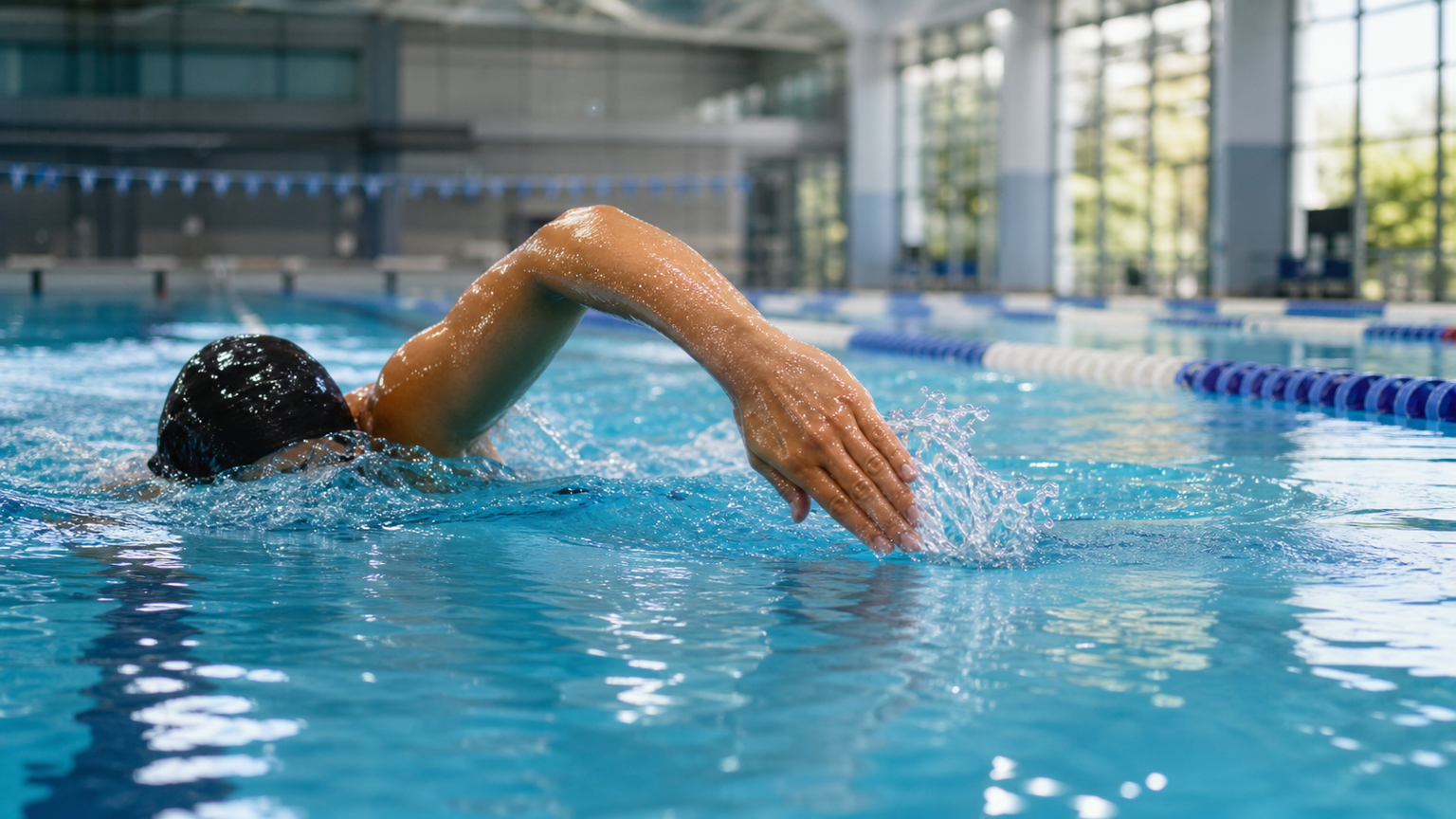
With thumb-first entry, the wrist rotates slightly inward, and the hand slices into the water at approximately a 45-degree angle. This angle allows the hand to cut through the water’s surface like a blade, reducing the “splash” upon entry and decreasing forward resistance. After entry, the arm naturally extends to the catch starting position, with the elbow maintained high, which is conducive to the subsequent “high elbow catch.”
Many American training systems have historically adopted this method, emphasizing a clean, bubble-free entry that allows the hand to maintain a sense of grip on the water.
The Mechanics of Flat-Hand Entry
With flat-hand entry, the palm is nearly parallel to the water’s surface, fingers pointing slightly downward, with the wrist in a neutral position. This entry method appears “heavier” visually, but its proponents argue that it allows the arm to reach an effective catch position more quickly, shortening the “glide dead zone.”
In recent years, some Australian and European coaching systems have begun promoting this method, arguing that overemphasizing thumb-first entry leads to excessive wrist internal rotation, placing stress on the shoulder joint.
Comparison of the Two Techniques
| Comparison Item | Thumb-First Entry | Flat-Hand Entry |
|---|---|---|
| Entry Resistance | Lower (strong slicing feel) | Higher (slight splash) |
| Catch Preparation | Requires additional wrist angle adjustment | More direct entry into catch position |
| Shoulder Joint Stress | Greater internal rotation angle, may accumulate over time | Neutral position, stress more distributed |
| Suitable For | Sprint distances, advanced swimmers | Long distances, beginner to intermediate swimmers |
| Learning Difficulty | Moderate (requires precise wrist control) | Lower (more natural movement) |
Common Mistakes and Corrections
Regardless of which entry method you choose, the following mistakes must be avoided:
Crossing the Midline Excessively
Many swimmers enter the water with their hand landing on the opposite side of the body’s midline, causing the body to snake and increasing resistance. The correct entry point should be on the extension line of the shoulder on the same side, at shoulder width or slightly narrower.
Entering Too Close (Short-Arm Entry)
The elbow bends too early, and the hand pierces the water directly in front of the head, losing forward reach distance. The entry point should be as far forward as possible, allowing the body to fully extend.
Slapping the Water with the Palm
After swinging the arm too high, the hand strikes the water at a near-vertical angle, generating excessive bubbles and resistance. Regardless of the technique, the entry angle should be controlled between 30–45 degrees.
| Common Mistake | Resulting Problem | Correction Method |
|---|---|---|
| Crossing the midline on entry | Body snakes, increased resistance | Practice single-arm extension positioning with a kickboard |
| Entry point too close | Reduced forward reach, shortened stroke cycle | Focus on “extend fully before entering” |
| Slapping the water | Bubbles adhere to the hand, losing the feel of the water | Lower arm swing height, adjust entry angle |
| Excessive wrist internal rotation | Long-term shoulder joint stress | Switch to slight external rotation, adopt flat-hand entry |
Practical Recommendations
- Beginners and long-distance swimmers: It is recommended to start practicing with flat-hand entry to reduce interference from technical details and allow the body to first establish a stable stroke rhythm.
- Advanced and sprint-type swimmers: You may try thumb-first entry, combined with high elbow catch technique, to improve stroke efficiency.
- Those with prior shoulder injuries: Prioritize flat-hand entry to avoid repetitive wrist internal rotation that could aggravate shoulder strain.
- Training method: Use slow-motion recording (a smartphone is sufficient) to film your entry from the side, observing whether the entry point is on the shoulder’s extension line and whether there is obvious splashing.
Conclusion
Thumb-first entry and flat-hand entry are not an either-or choice; rather, they should be adjusted based on individual shoulder flexibility, training goals, and swimming distance. More importantly, any entry technique must adhere to the fundamental principles of “not crossing the midline, full forward extension, and no splashing.” Finding your own entry rhythm is often more effective than rigidly adhering to the dogma of any single school.
Related Reading
- Freestyle Hand Entry Angle: The Controversy Over Thumb-Down Entry Correctness
- Freestyle High Elbow Entry Technique: The Biomechanical Advantage of Elbow-First Entry
- Freestyle Stroke Entry Angle: Propulsion Differences Between 45-Degree and Vertical Entry
- The “High Elbow Entry” Technique in Freestyle Strokes: The Effect of Elbow Angle on Pushing Efficiency
西進武嶺 自製新版AI配速表產生器 x 賽前攻略 抱佛腳! 沒有功率計也可以產生配速表嗎?有什麼其他眉角賽前要注意的呢? | 西進武嶺 / 東進武嶺 KOM 攻略 | 公路車 | CT Yeh
4 年前
[教學] Premiere 影片 手震 修正 教學 防抖 單眼 影像 GoPro 穩定 Video Stabilization
8 年前
CT 喇低賽) 武嶺牽車 才是王道 西進牽車四小時內秘訣 攝手位置 如何判斷 防抽筋小秘訣
7 年前
類空拍神器 Feiyu Pocket 2s (有優惠連結)三軸穩定 運動攝影機 開箱!比GoPro 還強的滑順視角!三小時長時間錄影 行車記錄器 | 環花東365實測 | 公路車 CT Yeh
4 年前
西進武嶺 免費訓練分析服務 Intervals | 練不夠還是練過頭?你哪一種類型選手?AI模型告訴你! | 備戰神器 | 公路車 訓練 | CT Yeh
4 年前
戰略) Zwift Race 如何咬在第一集團 如何評估自己要開多少推力 (請開1.5倍速看)
7 年前
如何把 GoPro 影片 翻轉 批次 轉正?
6 年前
多機位拍片神器 DJI Action 2 拍出速度張力感 | 類空拍機視角 4陣列麥克風超強降風噪 實測! | 公路車 | CT Yeh
3 年前