Introduction
If you learned to swim fifteen years ago, your coach likely demonstrated the “S-shaped pull”—the arm tracing an S-curve in the water, sweeping outward, pushing inward, then pressing backward. This technique dominated swimming instruction for decades and even appeared in many official teaching materials.
However, in recent years, more and more coaches and researchers have begun questioning the efficiency of the S-shaped pull, advocating instead for a more direct “high-elbow straight catch.” What scientific basis lies behind this technical revolution? Should the S-shaped pull really be thrown into the dustbin of history?
The History and Logic of the S-Shaped Pull
The theoretical foundation of the S-shaped pull comes from lift-based propulsion theory. In the 1970s, researchers observed that elite swimmers’ arms did not push straight back but traced curved paths. Borrowing concepts from aeronautics, they proposed that the hand acts like a propeller blade generating lift in the water, and that a curved pull allows the hand to continuously find “fresh water,” avoiding strokes through already-disturbed water.
This theory sounded convincing and did explain some phenomena at the time. The problem is that later three-dimensional motion analysis technology became more precise. When researchers re-examined elite swimmers’ underwater movements, they found that many so-called “S-shapes” were actually visual illusions caused by viewing angles.
Modern Technique: The Core of High-Elbow Catch
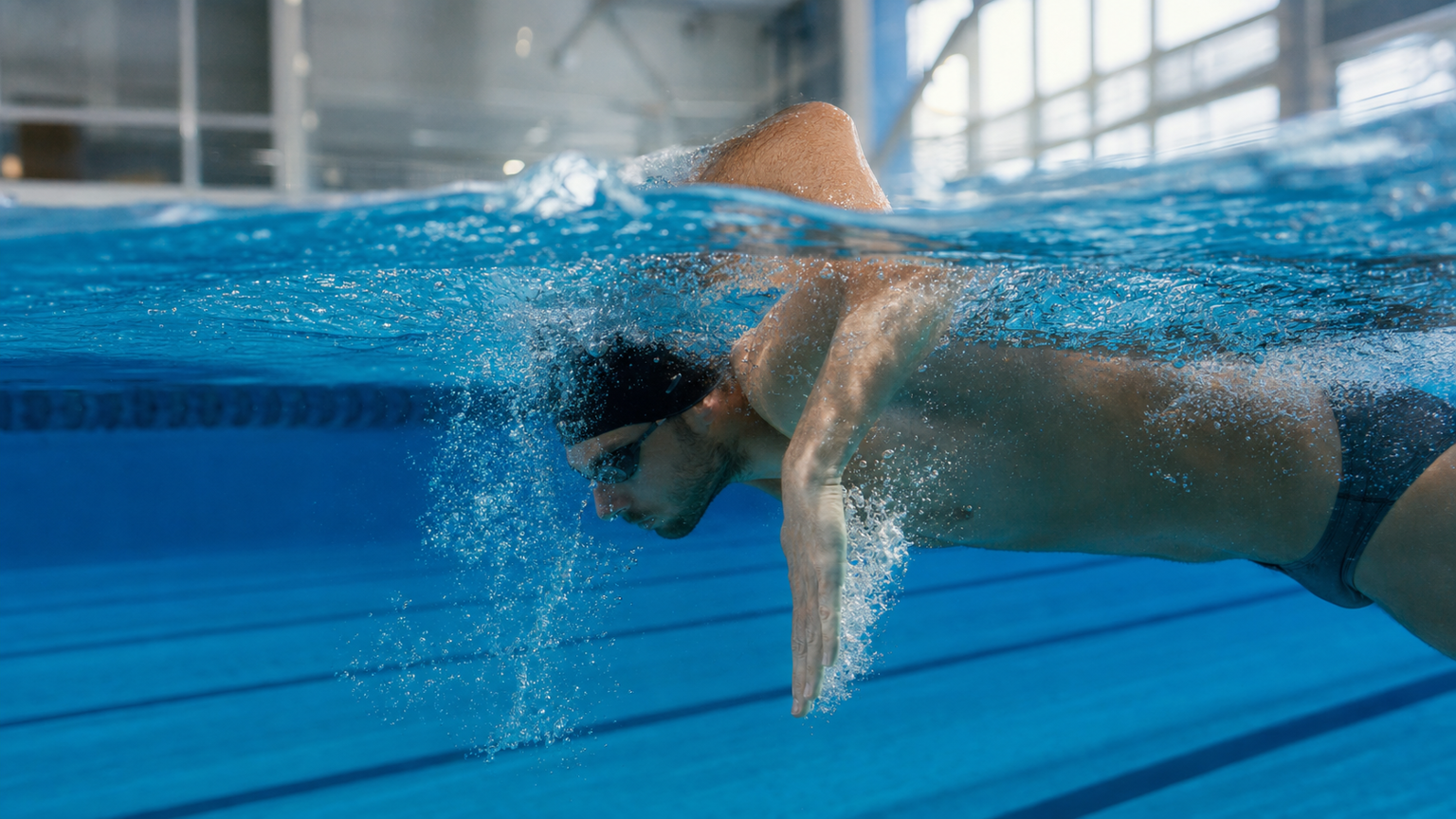
The contemporary mainstream technique emphasizes Early Vertical Forearm (EVF), with the core concepts being:
- After the hand enters and extends, the elbow stays high, allowing the forearm to become vertical as quickly as possible
- The hand and forearm form a “paddle surface,” pushing water backward along a nearly straight path
- Avoid sweeping the arm outward (outward sweeping wastes propulsive force)
- Throughout the pull, the elbow should not drop below the wrist
| Technical Element | S-Shaped Pull | High-Elbow Straight Catch |
|---|---|---|
| Propulsion Principle | Lift-based | Drag-based propulsion |
| Elbow Position | Varies with the curve | Maintained high throughout |
| Pull Path | Outward sweep → inward press → backward push | Direct backward push after catch |
| Paddle Surface Area | Palm only | Palm + forearm |
| Water Feel Requirement | High | High |
| Suitable Swimmers | Those with excellent shoulder flexibility | Most swimmers |
Why Is Straight-Line Propulsion More Efficient?
Fluid dynamics research shows that within swimming speed ranges, drag-based propulsion (pushing water directly backward like a paddle) is more efficient than lift-based propulsion. The outward sweep of the S-shaped pull not only fails to generate sufficient lift but also causes the hand to deviate from the optimal propulsion direction, wasting force.
More critically, the high-elbow catch brings the forearm into the “paddle surface,” greatly increasing the effective pushing area. Imagine rowing a boat with a wide paddle versus a thin stick—which is more efficient goes without saying.
Common Error Checklist:
- Overly wide outward sweep: arm sweeps outward beyond 30 degrees, resulting in noticeable propulsion loss
- Dropping elbow: forearm cannot stay vertical, paddle surface shrinks to just the palm
- Pulling with the elbow too early: elbow retracts backward, losing the high-elbow position
- Pull path too short: push ends before reaching the hip, losing rear-end propulsion
Practical Advice
- Beginner stage: Focus first on the basic concept of “elbow not below wrist.” There’s no need to deliberately pursue an S-shape or straight line—let the body feel the water’s resistance.
- Advanced drills: Use paddles to slow down the catch motion and feel the timing of the forearm becoming vertical in the water. This is one of the most effective tools for building the high-elbow catch.
- Common transition error: When switching from the S-shaped pull to a straight catch, many people overcorrect and push straight back with a completely rigid arm, which instead creates shoulder strain. Proper high-elbow catch still requires a moderate elbow bend (around 90 degrees).
- Observation method: Have someone film you underwater from the pool bottom or side to observe your forearm angle at the moment of the catch.
Conclusion
The S-shaped pull is not entirely without merit—at a certain historical stage, it helped countless swimmers develop water feel. But as sports science has advanced, we now have a better framework for understanding. The high-elbow straight catch has been adopted by most international elite coaching systems, not because it’s trendy, but because it better aligns with the principles of physics. If your coach is still emphasizing a large-amplitude S-shaped outward sweep, perhaps it’s time to start a conversation about fluid dynamics.
Related Reading
- Freestyle Pull Arc: Is the S-Shaped Pull Outdated? What the Latest Research Says
- Freestyle Stroke Technique: Modern Perspectives on High-Elbow Entry and S-Shaped Pull
- Backstroke Pull Path: Modern Technique for S-Shaped Pull vs. Straight-Arm Pull
- Freestyle High-Elbow Pull: The Core Key to Water Feel Technique
CT 喇低賽) 武嶺牽車 才是王道 西進牽車四小時內秘訣 攝手位置 如何判斷 防抽筋小秘訣
7 年前
2025崇越「西進武嶺」挑戰VLOG / 賽前改短成165曲柄會如何? / 選手昏倒? / 公路車 / CT Yeh
1 年前
一起升級!海鷗盃LSD團練...JJSC Zone2招待 騎到手抖 / 公路車 / CT Yeh
1 天前
3D 列印車褲墊 / 舒適改善? / 無痕 x 分區壓縮 / ATK & Decider系列 / JE22黑科技 / #公路車 #CTYEH
11 個月前
CT 喇低賽) 單車 比賽總是沒照片? 攝影師的觀點大公開 姿勢就是力量! 請加速1.25倍收看
7 年前
鉅齒紋輪組!? ControlTech MEG-T50 EVO 碳纖維幅條輪組/ 功率對比實驗 / 公路車 / CT Yeh
2 年前
備戰 戀戀197 賽前關門點分析 西濱團練 #公路車 4K高畫質
6 年前
單車高張力拍攝神器 Antigravity A1 全景空拍機! / CT Yeh
30 天前