Butterfly Breathing Frequency Strategy: Breathing Every Stroke vs Every Two Strokes in Competitive Choice
Introduction
Butterfly is the most physically demanding of the four competitive strokes, and the choice of breathing frequency is often the key strategic factor that determines success or failure in a race. Every time you lift your head to breathe, you break the body’s streamline and increase drag; but breathing less frequently may leave you collapsing from oxygen debt in the latter part of the race.
Elite butterfly swimmers typically adjust their breathing frequency flexibly based on race distance, individual ability, and tactical needs. Understanding the difference between breathing every stroke and breathing every two strokes is an important foundation for mastering butterfly strategy.
The Impact of the Breathing Motion on Speed
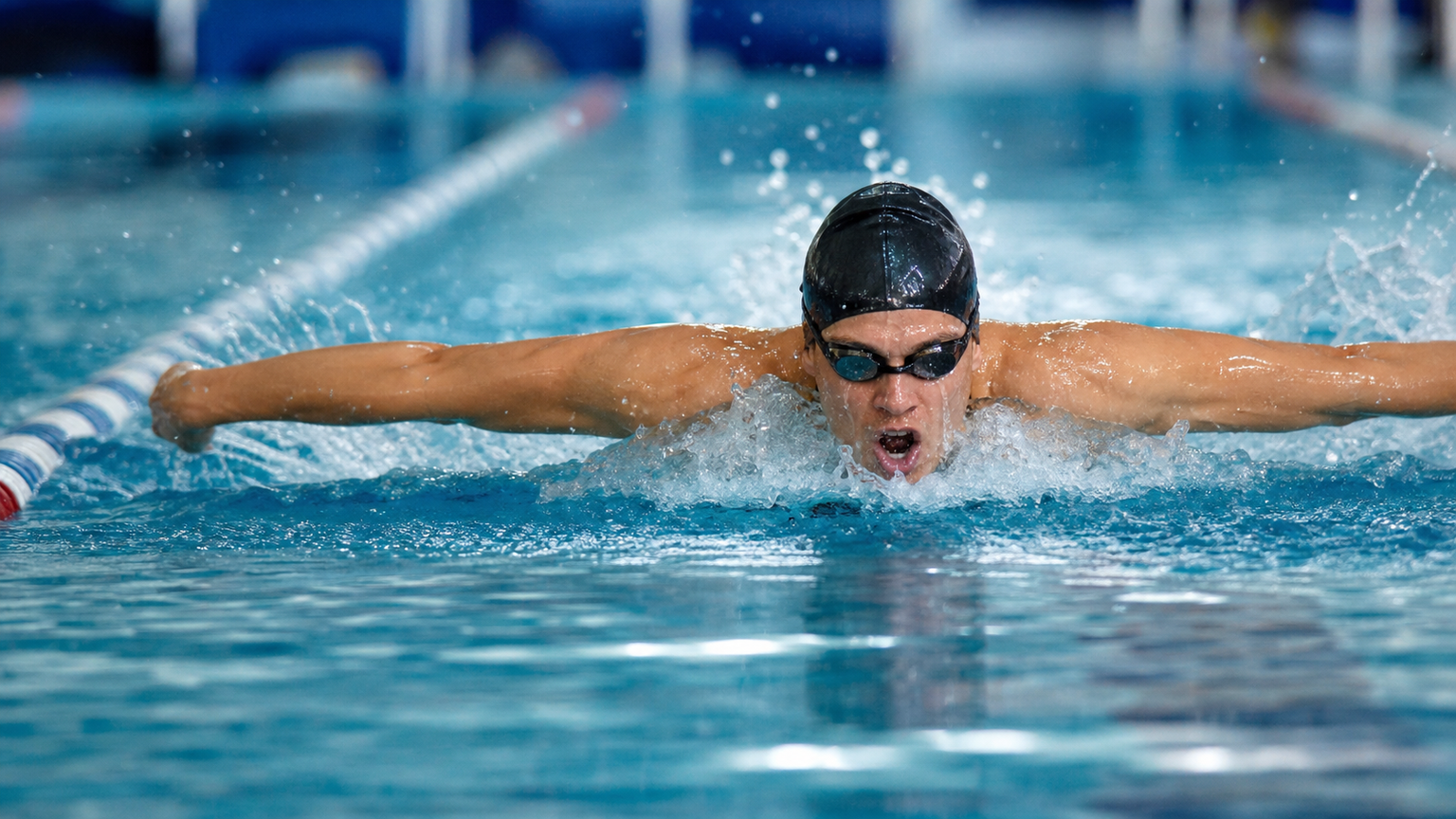
Butterfly propulsion comes from the synchronized arm pull and the body’s undulation. Each time you breathe, the head must lift above the water, and this motion breaks the body’s horizontal line, causing two main speed losses:
Increased drag: When the head lifts, the frontal surface area increases, and fluid resistance rises significantly. Research shows that speed during the breathing stroke in butterfly is typically lower than during non-breathing strokes.
Disrupted undulation rhythm: Butterfly efficiency relies on a smooth body undulation, and the breathing motion requires extra effort from the neck and upper back muscles, which may disrupt the overall rhythm.
Comparison of Breathing Every Stroke vs. Every Two Strokes
| Comparison Item | Breathing Every Stroke (Single-Stroke) | Breathing Every Two Strokes (Double-Stroke) |
|---|---|---|
| Breathing frequency | Once per arm cycle | Once every two arm cycles |
| Oxygen replenishment | Ample | Limited, requires higher anaerobic tolerance |
| Drag impact | Breathing drag on every stroke | Drag interference halved |
| Speed rhythm | More stable but interrupted every stroke | More streamlined, faster on non-breathing strokes |
| Suitable distance | 100–200m butterfly | 50m sprint or used tactically |
| Physical demand | Requires steady cardiovascular output | Requires higher anaerobic capacity |
Strategic Choices for Different Distances
50m Butterfly
Many swimmers choose to breathe only 1–2 times for the entire race, or even not at all. Because the distance is extremely short, anaerobic energy supply is sufficient, and reducing breaths maximizes speed. However, this requires a high level of breath-holding training and is not suitable for all swimmers.
100m Butterfly
The most common strategy is to breathe every two strokes for the first 50m, then switch to breathing every stroke as needed for the final 50m to replenish oxygen. Some swimmers breathe every stroke for the entire race, trading a steady rhythm for sustained propulsion.
200m Butterfly
Longer butterfly races almost always require breathing every stroke; otherwise, oxygen debt in the latter stages will cause technique to break down and speed to plummet. High-level swimmers may attempt breathing every two strokes early on to conserve energy, then switch when going all-out in the final stretch.
Breathing Technique Key Points
Regardless of which frequency you choose, the quality of the breathing motion itself determines the amount of drag:
- Chin close to the water surface: When breathing, the head should stay as low as possible, with the chin nearly skimming the water, rather than lifting high
- Eyes looking forward and down: Don’t lift your head to look ahead; keep your gaze angled downward toward the water ahead
- Coordinate with arm timing: Breathe when the arms are pushed outward to their widest point and the body is at its highest, using the natural upward force of the arm pull to bring the head up
- Quick in and out: The breathing motion should be decisive; don’t linger at the surface
Common mistakes:
- Lifting the head too high with the neck fully extended
- Poor breathing timing, lifting the head only after the arm pull has begun
- Body overly tense while holding breath, affecting the undulation
- Breathing to one side only, disrupting left-right symmetry
Practical Advice
- Build breath-holding capacity: Add no-breath butterfly drills to every training session, starting from 12.5m and gradually increasing the distance. This is the foundation for improving your ability to breathe every two strokes.
- Feel the speed of the non-breathing stroke: Deliberately practice breathing every two strokes and feel how the body is more streamlined and faster on the non-breathing stroke, using this to establish the right technical direction.
- Plan your strategy before the race: Based on your physical condition and target time, decide your breathing strategy in advance rather than deciding randomly on the spot.
Conclusion
Breathing frequency in butterfly is the intersection of technique, fitness, and strategy. There is no absolutely correct choice—only the choice that best fits the conditions of the race at hand. By experimenting broadly with different breathing strategies in training, you can develop the ability to respond flexibly in competition rather than being locked into a fixed pattern.
Related Reading
- Breathing Rhythm for Long-Distance Swimming: Endurance Benefits of 3-Stroke, 5-Stroke, and 7-Stroke Breathing
- Swimming Breathing Pattern Training: Building Tolerance for 3-Stroke and 5-Stroke Breathing
- Freestyle Breathing Technique: Bilateral Breathing Training Methods and Race Application
- Swimming Breathing Technique: Pros and Cons of Side Breathing vs. Bilateral Breathing
#公路車 #Vo2Max #最大攝氧量 測驗 體驗 | 心肺測試
6 年前
戰略) Zwift Race 如何咬在第一集團 如何評估自己要開多少推力 (請開1.5倍速看)
7 年前
多機位拍片神器 DJI Action 2 拍出速度張力感 | 類空拍機視角 4陣列麥克風超強降風噪 實測! | 公路車 | CT Yeh
3 年前
CT 喇低賽) 武嶺牽車 才是王道 西進牽車四小時內秘訣 攝手位置 如何判斷 防抽筋小秘訣
7 年前
福隆鐵人團練隨拍
8 年前
風櫃嘴 衝刺慢動作回放!
8 年前
類空拍神器 Feiyu Pocket 2s (有優惠連結)三軸穩定 運動攝影機 開箱!比GoPro 還強的滑順視角!三小時長時間錄影 行車記錄器 | 環花東365實測 | 公路車 CT Yeh
4 年前
西進武嶺 免費訓練分析服務 Intervals | 練不夠還是練過頭?你哪一種類型選手?AI模型告訴你! | 備戰神器 | 公路車 訓練 | CT Yeh
4 年前