Introduction
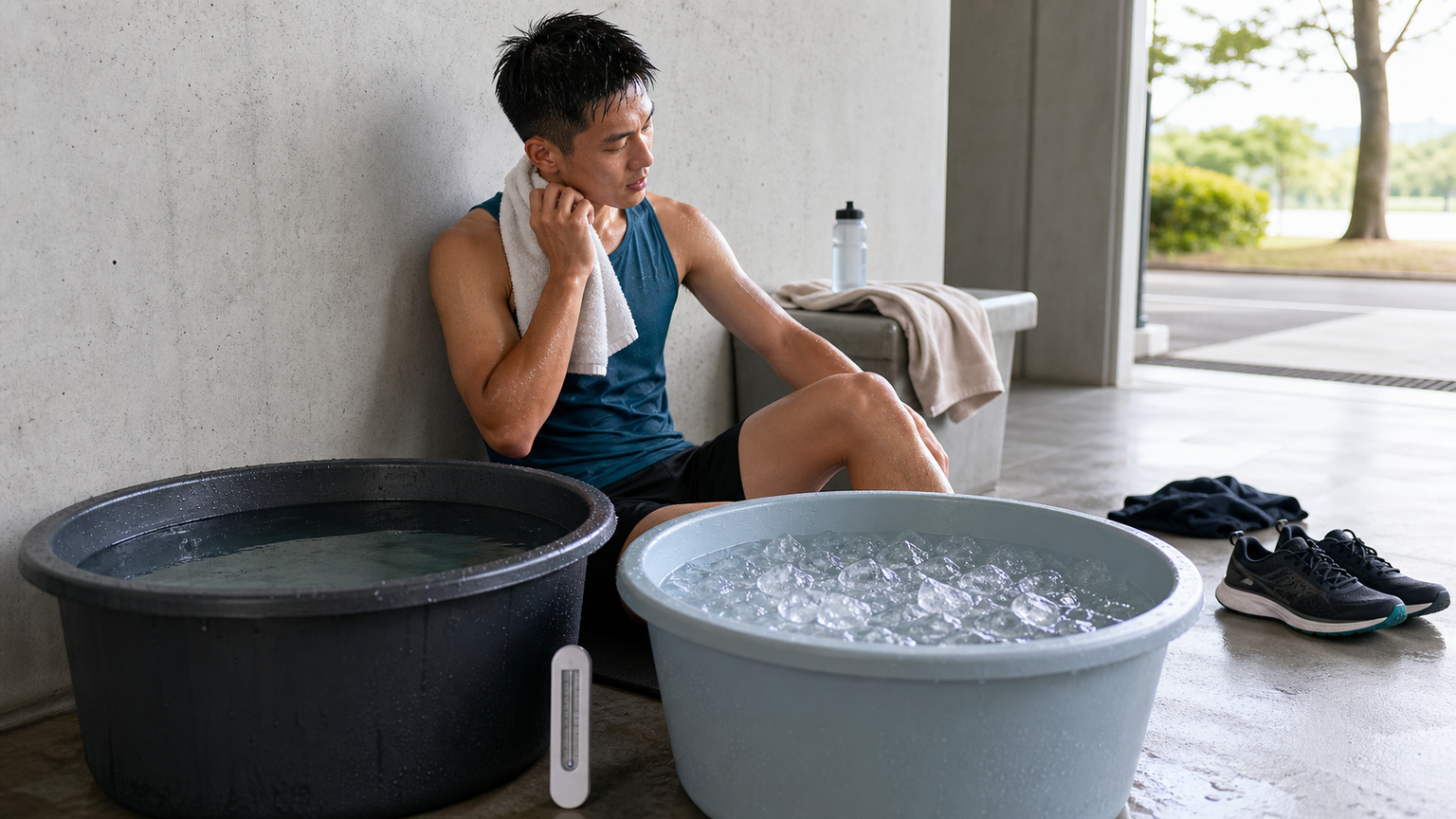
In Taiwan’s road running community, “soaking in an ice bucket after a run” has almost become a ritual for serious runners. However, the differences between ice baths and cold water immersion (CWI) are rarely discussed in detail. Different temperatures and different immersion durations result in completely different benefits and potential risks for the body. This article will help you clarify the correct usage of these two recovery tools from a scientific perspective.
Basic Definitions: Cold Water Bath vs Ice Bath
| Type | Water Temperature | Recommended Duration | Characteristics |
|---|---|---|---|
| Cold Water Bath (CWI) | 10–15°C | 10–20 minutes | Relatively mild, suitable for daily recovery |
| Ice Bath | 5–10°C | 8–12 minutes | Intense stimulation, suitable for acute post-race recovery |
| Control Group (Warm Water) | 35–37°C | — | Provides psychological comfort but no cold therapy benefits |
Physiological Mechanisms of Cold Therapy
The recovery benefits of cold water immersion primarily stem from the following physiological mechanisms:
The “Squeeze Effect” of Vasoconstriction and Vasodilation:
Cold water stimulation causes peripheral vasoconstriction, directing blood toward core organs. Upon leaving the cold water, blood vessels rapidly dilate, creating a “squeeze effect” that flushes metabolic waste and inflammatory substances from muscle tissue.
Lowering Tissue Temperature to Suppress Inflammation:
For every 1°C decrease in muscle temperature, metabolic rate drops by approximately 13%, helping to suppress acute post-exercise inflammatory responses and reduce muscle swelling.
Neural Analgesic Effect:
Cold stimulation activates cold receptors in the skin, inhibiting pain signal transmission (gate control theory), which subjectively significantly reduces delayed onset muscle soreness (DOMS).
Potential Risks of Ice Baths
Although ice baths offer significant benefits, the risks are equally important to consider:
Suppressed Muscle Adaptation:
Research published in the Journal of Physiology found that long-term use of ice baths for recovery may suppress muscle protein synthesis signaling (mTOR pathway), weakening training adaptations in strength and muscle hypertrophy. Therefore, ice baths are not recommended after strength training.
Risk of Cold Shock:
Water temperatures below 5°C with immersion durations exceeding 15 minutes may trigger cardiac arrhythmias. Individuals with cardiovascular disease are strictly prohibited from this practice.
Special Caution for Taiwan Summers:
Taking an ice bath immediately after training in a hot environment can cause dizziness due to rapid body temperature changes. It is recommended to first allow body temperature to drop below 38°C before proceeding.
Optimal Usage Guidelines
After Daily Training (Light to Moderate Fatigue):
- Choose a cold water bath (12–15°C)
- Immerse for 10–15 minutes
- Follow with a warm shower for 3–5 minutes
Acute Post-Race Recovery (High-Intensity Competition):
- An ice bath (8–10°C) may be considered
- Strictly limit to 10–12 minutes
- Immerse up to the waist (focusing on the lower body)
- Most effective when performed within 30 minutes after the race
After Strength Training:
- Avoid ice baths; choose a warm bath or active recovery instead
- Cold therapy interferes with muscle adaptation signals from strength training
Contrast Bath:
- Cold water 1 minute → warm water 2 minutes, repeat 4–6 cycles
- Studies show this is more effective at eliminating DOMS than cold water baths alone
Practical Recommendations
- For Taiwanese households without a bathtub, a cold shower (10 minutes) can serve as an alternative
- Convenient option: use the cold pool at a swimming pool (most public pools have water temperatures around 26–28°C, which is not cold enough but still provides some benefit)
- Do not take an ice bath on an empty stomach: low blood sugar combined with cold stimulation can easily cause dizziness
- The psychological benefits of cold therapy (reduced anxiety, enhanced subjective vitality) are also genuine contributors to recovery
Conclusion
Both cold water baths and ice baths are effective recovery tools, but “colder is better” is not the truth. Choosing the appropriate temperature and duration based on training type allows you to promote recovery without sacrificing long-term training adaptation benefits. For most Taiwanese runners, regular cold water baths offer more practical benefits than occasional ice baths.
Related Reading
- Hot and Cold Therapy After Swimming: Comparing Recovery Benefits of Ice Baths and Hot Baths
- Post-Run Ice Bath vs Hot Bath: Which Recovery Strategy Fits Your Training Cycle?
- The Science of Contrast Baths in Running Recovery: Optimizing Ice Bath Temperature and Duration
- Cold Water Immersion Recovery: Research on Duration and Anti-Inflammatory Benefits of 10°C Cold Baths
西進武嶺 免費訓練分析服務 Intervals | 練不夠還是練過頭?你哪一種類型選手?AI模型告訴你! | 備戰神器 | 公路車 訓練 | CT Yeh
4 年前
2016/05/13 單車 冷水坑下滑
10 年前
CT暗黑廚房) 車友必備 宇宙無敵鮮蚵湯 幫助訓練恢復 天然食補 好市多 超肥鮮蚵 破PR
7 年前
水金九不厭五分 10度寒流冷到不願停!feat. 卡卡 / 公路車 / CT Yeh
6 個月前
[防寒衣體驗] 鐵人魂 三鐵 防寒衣試穿會 於松運 深水游泳池 鯨魚池
8 年前
Live) 備戰2019彰化經典百K 賽前攻略 (已完賽請看新影片
7 年前
實景訓練台) 彰化經典百K 高強度喵團 90分鐘 跟著一起練功 2019 Indoor workout Changhua Classic 100 Taiwan
7 年前
CT 喇低賽) 武嶺牽車 才是王道 西進牽車四小時內秘訣 攝手位置 如何判斷 防抽筋小秘訣
7 年前