Introduction
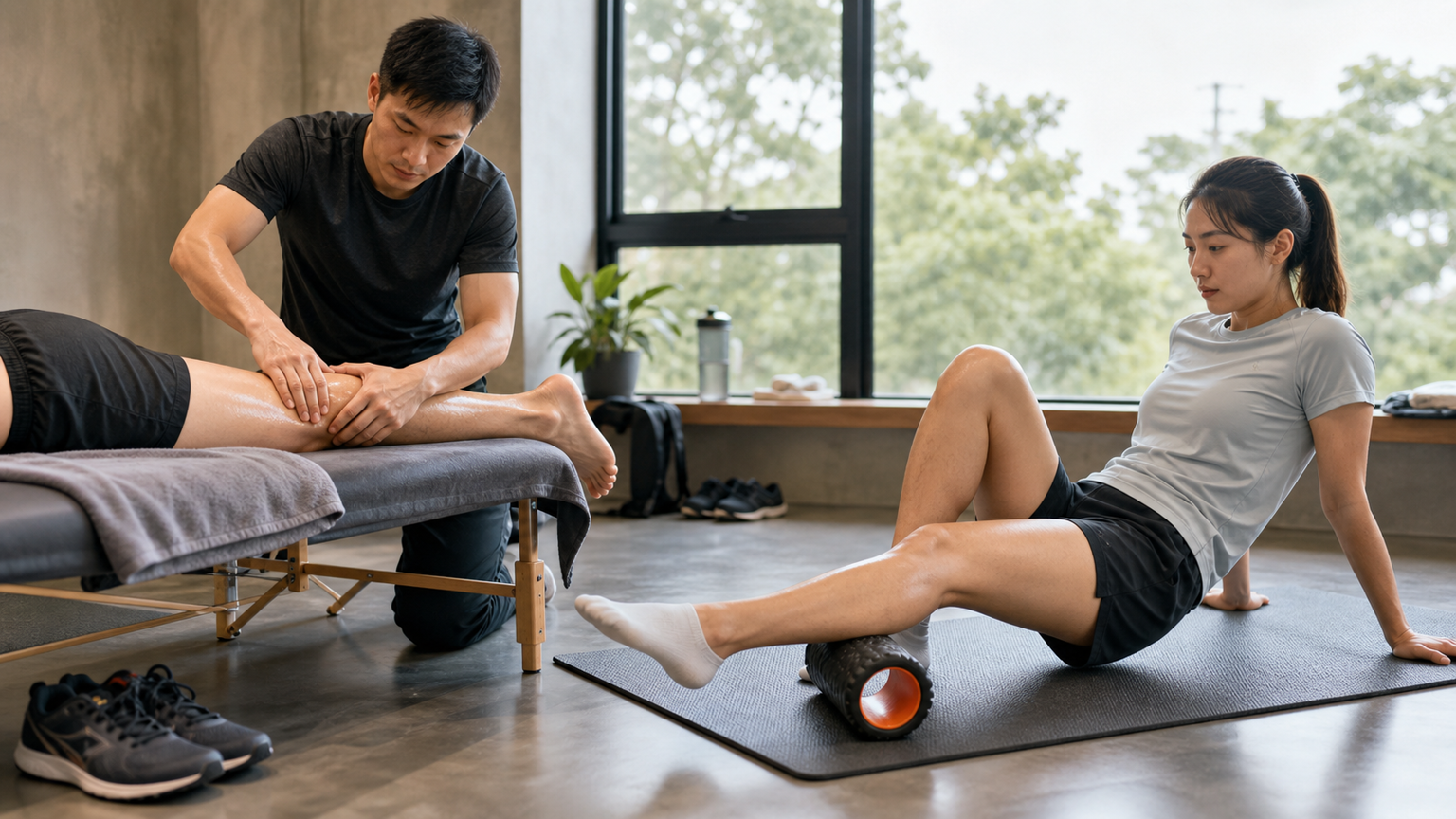
After finishing a long run, the heavy, sore feeling in your legs often makes you want to seek immediate massage relief. Taiwan’s road-running community has two mainstream options: booking a sports massage therapist, or rolling at home with a foam roller. Both methods are supported by relevant sports science literature, but their mechanisms of benefit, optimal timing, and cost-effectiveness differ significantly.
Sports Massage
Definition and Techniques:
Sports massage is a manual therapy performed by trained massage therapists on post-exercise muscles. Techniques include Swedish massage, deep tissue massage, myofascial release, and lymphatic drainage.
Scientific Benefits:
- Systematic review studies (meta-analyses) show that a 30-minute sports massage performed 24–48 hours post-race can significantly reduce DOMS intensity (moderate to large effect size)
- Massage stimulates the parasympathetic nervous system, lowering cortisol levels and aiding psychological relaxation
- Lymphatic drainage techniques help reduce lower-limb edema
- Deep tissue massage can address myofascial adhesions and restore smoothness of muscle sliding surfaces
Optimal Timing:
- 24–48 hours post-race: gentle massage, focusing on promoting circulation and relaxation
- 48–72 hours after training (when muscles are less sensitive): deep massage is more effective
- Avoid: deep massage immediately after a race (excessive pressure during the acute inflammatory phase may worsen damage)
Foam Rolling
Definition and Techniques:
A foam roller is a self-myofascial release (SMR) tool. The user applies body weight pressure onto the roller to perform slow rolling and pressing on target muscle groups.
Scientific Benefits:
- Research shows that 10–20 minutes of foam rolling after training can reduce DOMS levels and accelerate recovery of joint range of motion
- Provides some relief for myofascial tightness
- Short-term increases in joint range of motion (flexibility), though the mechanism may be more about neural-reflexive relaxation than actually changing fascial structure
- Psychological aspect: the sense of “having done something” from foam rolling helps boost recovery motivation
Limitations:
- Self-applied pressure is difficult to control precisely; excessive compression may irritate nerves
- Limited effectiveness in reaching deep muscles (such as hip flexors and piriformis)
- Technique depends on movement quality; beginners often roll the wrong areas or use incorrect form
| Comparison Aspect | Sports Massage | Foam Rolling |
|---|---|---|
| Cost | High (NT$800–2000/session) | Low (one-time investment) |
| DOMS Relief Effectiveness | Better | Moderate |
| Deep Tissue Treatment | Excellent | Limited |
| Accessibility | Requires appointment | Available anytime |
| Psychological Relaxation Benefit | High | Moderate |
| Technical Requirement | Relies on therapist | Requires self-learning |
Best Ways to Integrate Both Methods
Daily Training Recovery (Non-race Period):
- 10–15 minutes of foam rolling after training (hamstrings, quadriceps, calves, IT band)
- One 30–45 minute sports massage per week (if budget allows)
Post-race Recovery:
- 24 hours post-race: gentle foam rolling (avoid firm pressure)
- 48–72 hours post-race: schedule a sports massage session
Foam Rolling Key Points:
- Roll each area for 30–60 seconds at a slow pace (approximately 2.5 cm per second)
- When you find a tender point, hold on that spot for 20–30 seconds and wait for the muscle to “release”
- The core muscles are not suitable for foam rolling (avoid rolling over the spine)
Practical Recommendations
- In Taiwan, look for massage therapists with “sports massage” or “CSCS” credentials, which are more targeted than regular foot massage
- Choose a medium-density foam roller; too soft is ineffective, while too hard can easily cause bruising for beginners
- Consistent weekly self-maintenance with a foam roller is far more effective than cramming right before a race
- Drink plenty of water after massage to help flush out metabolic waste
Conclusion
Sports massage and foam rolling are not in competition—they are complementary recovery tools. The former is suitable for scheduling around important race cycles, while the latter is a high-CP-value choice for daily maintenance. Flexibly integrating both strategies based on your training volume, budget, and time is the smart runner’s approach.
Related Reading
- Foam Rollers vs. Massage Balls: A Complete Comparison of Essential Recovery Tools for Runners
- Comparing Recovery Tools for Road Running: When to Use Foam Rollers, Massage Guns, and Compression Socks
- The Effects of Massage on Road Running Recovery: Self-Massage vs. Professional Sports Massage Therapists
- Post-Run Muscle Massage: When to Use Foam Rollers, Massage Guns, and Manual Massage
西進武嶺 免費訓練分析服務 Intervals | 練不夠還是練過頭?你哪一種類型選手?AI模型告訴你! | 備戰神器 | 公路車 訓練 | CT Yeh
4 年前
詳測) 小米 電動打氣筒 公路車胎要充多久? 值得買嗎? 米家充氣寶 小心燙手!
7 年前
一起升級!海鷗盃LSD團練...JJSC Zone2招待 騎到手抖 / 公路車 / CT Yeh
2 天前
CT 喇低賽) 武嶺牽車 才是王道 西進牽車四小時內秘訣 攝手位置 如何判斷 防抽筋小秘訣
7 年前
實景訓練台) 彰化經典百K 高強度喵團 90分鐘 跟著一起練功 2019 Indoor workout Changhua Classic 100 Taiwan
7 年前
一日北高常見問題大集合 | 攻略 | 路線 | 訓練 | 補給 | 自行車 單車 | 一日雙城 | 雙塔 | TWB北高360 | 屁股痛
6 年前
[教學] Premiere 影片 手震 修正 教學 防抖 單眼 影像 GoPro 穩定 Video Stabilization
8 年前
Never Stop 西進武嶺 前後雙機 完整全程錄影 訓練台 實境
8 年前