Introduction
Many swimming pools in Taiwan only have 25-meter lanes due to space constraints, making “short course” the primary training environment for many local athletes. However, top international events (including the Olympics) are held in 50-meter long course pools. Although the World Swimming Championships in 25m pool is also organized by World Aquatics, its status is slightly lower. Why are short course records generally faster than long course ones? How big is the difference? This article explains it all.
Record Comparison: Key Events as Examples
| Event | Long Course World Record (50m) | Short Course World Record (25m) | Difference |
|---|---|---|---|
| Men’s 100m Freestyle | 46.86 sec | 44.84 sec | Approx. 2.0 sec |
| Men’s 200m Freestyle | 1:42.00 | 1:39.37 | Approx. 2.6 sec |
| Men’s 100m Breaststroke | 56.88 sec | 55.28 sec | Approx. 1.6 sec |
| Women’s 200m Individual Medley | 2:06.12 | 2:01.86 | Approx. 4.3 sec |
As shown in the table, the longer the distance and the higher the technical demands of the stroke, the greater the short course advantage.
The Scientific Reasons Behind the Short Course Advantage
1. More Turns
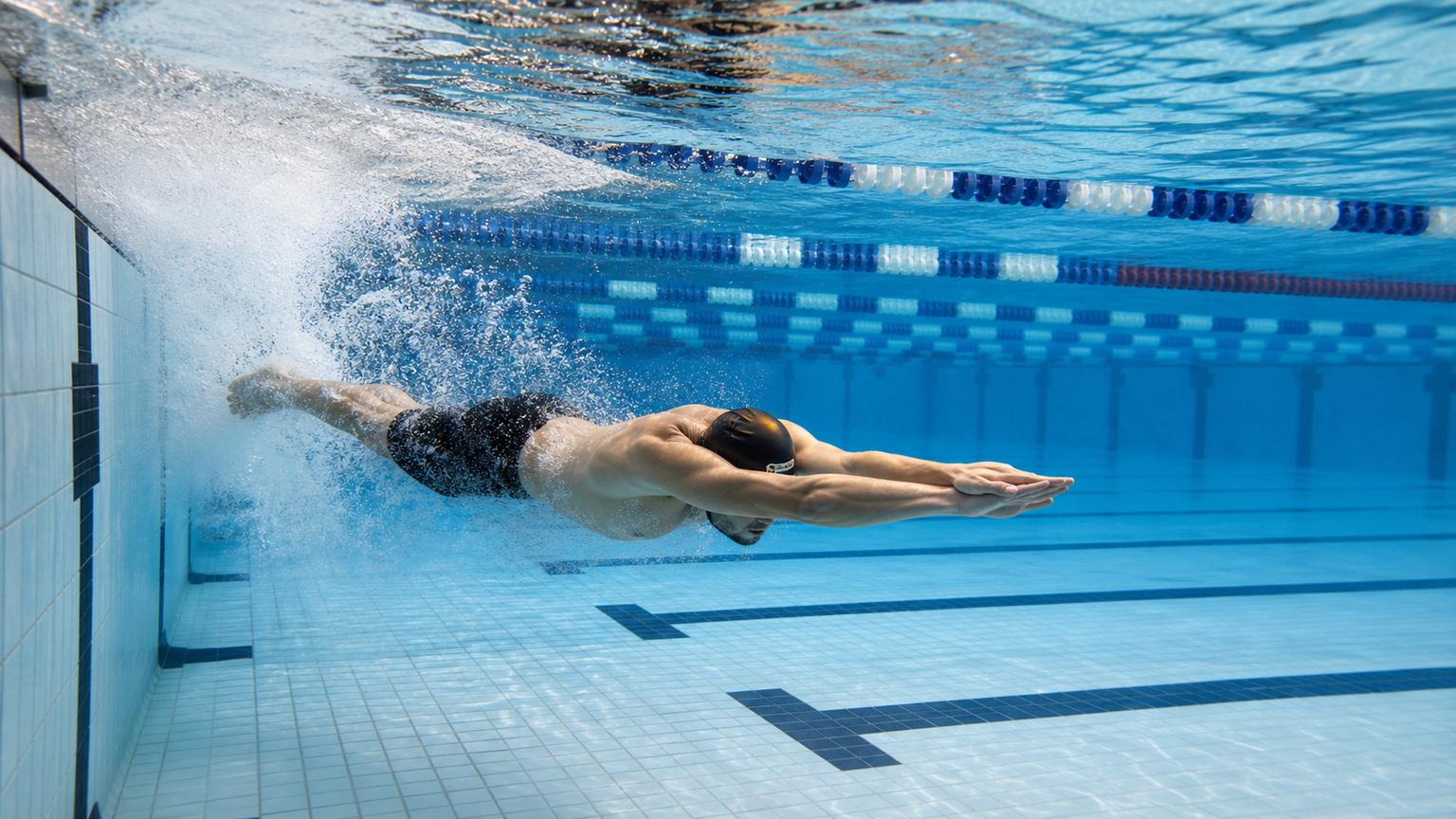
In a 200m event, the long course requires only 3 turns, while the short course requires 7 turns. Each turn includes “push-off + underwater dolphin kick,” and this phase is generally 20–30% faster than swimming on the surface. The more turns there are, the more high-efficiency propulsion segments athletes can utilize.
2. The Scientific Advantage of Underwater Dolphin Kicking
Top modern athletes can reach speeds of 2.2–2.5 m/s during the underwater dolphin kick phase (streamline kick-out), higher than the 1.9–2.1 m/s of surface swimming. The high frequency of turns in short course allows athletes to maintain this high-speed state for a greater proportion of time.
3. Differences in Surface Resistance
In long course, athletes are affected by waves and surface turbulence for longer periods. Especially when multiple lanes race simultaneously, surface disturbance in the middle section of a long course pool is significantly greater than in a short course pool.
Limitations of Short Course Events
Although short course records are faster, short course competitions do not receive the same level of public attention:
- Not used in the Olympics: All Olympic swimming events are held in long course, giving long course results greater public credibility
- High dependence on turns: Some believe short course results rely too heavily on turn technique and do not fully reflect an athlete’s swimming ability
- Different spectator experience: The high frequency of turns in 25m lanes provides a poorer visual experience for live audiences
World Aquatics manages records for the two pool types separately, and the official ranking system clearly labels “LCM (Long Course Metres)” and “SCM (Short Course Metres).”
Taiwan’s Short Course Ecosystem
Most community swimming pools in Taiwan are 25m short course, and the National Intercollegiate Athletic Games and some county/city championships are also held in short course. Therefore, Taiwanese youth athletes often build racing confidence in short course first, then move to long course to challenge higher stages.
It is worth noting: Athletes with good short course turn technique who lack sufficient aerobic base training when transitioning to long course often underperform expectations.
How to Use Short Course Effectively for Long Course Preparation
- Strengthen underwater dolphin kick quality: The high frequency of turns in short course training is an excellent opportunity to practice underwater dolphin kicks, but ensure each underwater phase after push-off reaches at least 10m
- Deliberately simulate long course pacing: In short course training, require yourself not to rely on turns but to maintain stroke rhythm, avoiding over-dependence on wall push-offs
- Mixed training cycles: It is recommended to train in long course for at least 3 months each year, especially before preparing for long course competitions
Practical Advice
- When checking the World Aquatics official website, be sure to distinguish between LCM and SCM categories when comparing results
- Events organized by swimming associations in Taiwan’s counties and cities usually indicate the pool specification; always confirm before registering
- If you compete in a 50m long course event after training in a 25m pool, expect your results to be 2–5% slower than short course—don’t be overly discouraged
Conclusion
Short course and long course each have their own training and competitive value; they are not opposites but complementary. Short course is the starting point for most Taiwanese swimmers. Making good use of the turn advantage in short course to build technical confidence, then using long course training to develop aerobic foundation, is the most complete development path.
Related Reading
- 25m Short Course vs 50m Long Course: What’s the Real Difference in Training Strategy?
- Technical Differences Between 50m Short Course and Long Course Swimming: Turn Ratio and Pacing Strategy
- Race Strategy Differences Between Short Course (25m) and Long Course (50m) Pools
- Training Differences Between 50m and 25m Pools in Taiwan: A Complete Guide to Workout Adjustments
Live) 備戰2019彰化經典百K 賽前攻略 (已完賽請看新影片
7 年前
實景訓練台) 彰化經典百K 高強度喵團 90分鐘 跟著一起練功 2019 Indoor workout Changhua Classic 100 Taiwan
7 年前
崇越盃武嶺冠軍高手 賽前JJSC 群峰會精華!對應大數據分析,會有落差嗎?/ feat. JJSC中部公路車約騎 /公路車 / CT Yeh
2 年前
CT Talk) 數據面窺看 武嶺大神們 平時的備戰 共通點 (娛樂性質XD)
7 年前
抖肩舞 台灣x日本交流版 (台灣 vs 前橋) 赤城山登山賽 coincidance
8 年前
2019 夏季KOM 5小 完賽心得 準備攻略 東進武嶺 夏季登山王之路 Taiwan KOM Challenge
7 年前
Zwift跨國線上追逐賽 第二站 台灣 TTR vs. 日本 JETT 第二場 (台灣追日本) | 數百位國內外公路車高手,同場較勁 | 多視角賽事直播
4 年前
RAMP FTP Test 直播 究竟能撐到幾瓦 訓練台 Gravat Zwift
6 年前