Introduction
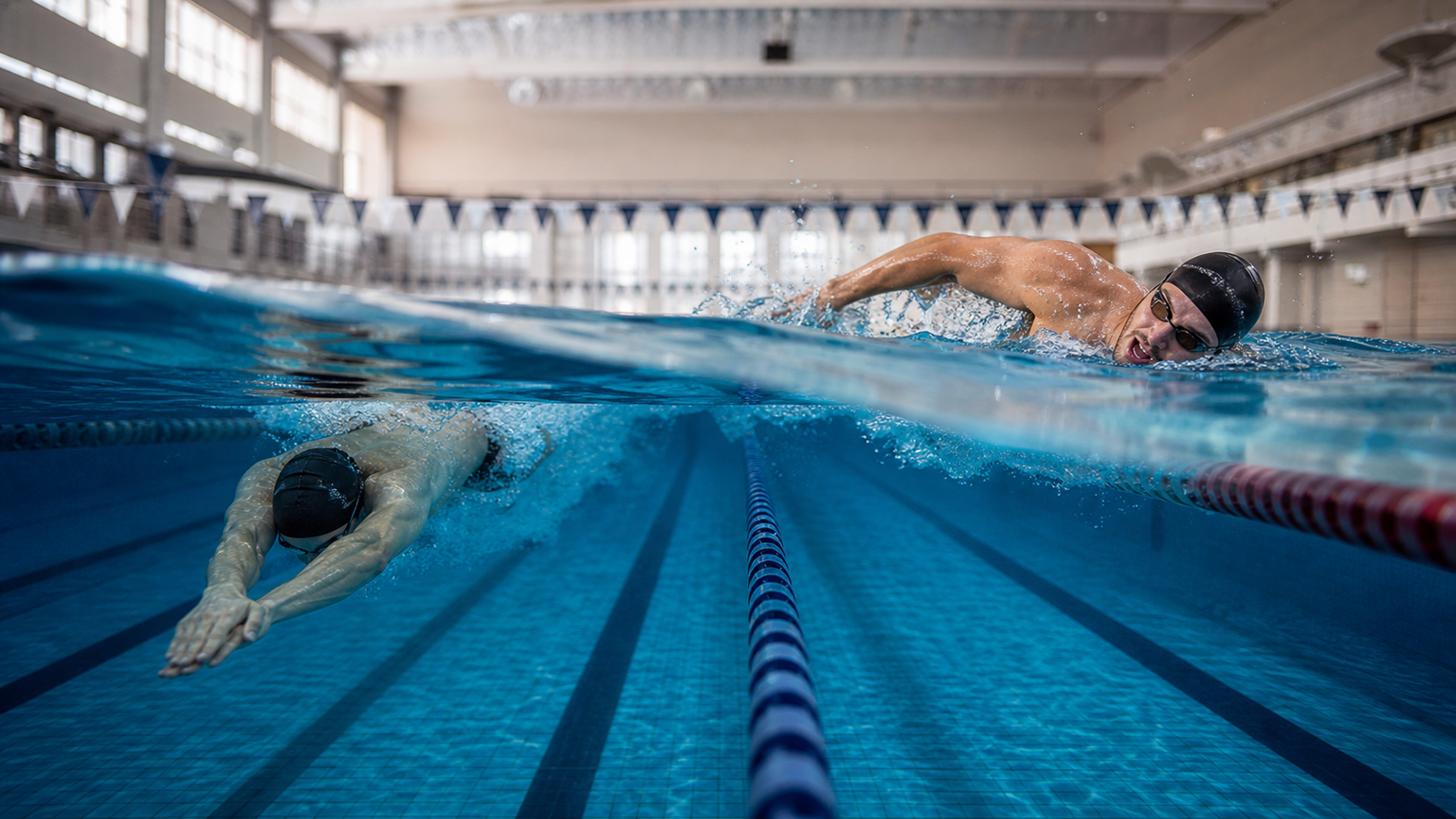
In swimming training, “when to breathe and how often” may seem like a minor detail, but it is actually a key variable that determines speed and energy distribution. The two greatest swimmers in the world—American legend Michael Phelps and China’s renowned Sun Yang—exhibit completely different philosophies in breathing rhythm, backed by profound physiological and tactical logic.
The Physical Cost of Breathing
Every breath comes at a price:
- Head rotation/lift: Breaks the streamlined position, increasing water resistance by 8–12% (more pronounced when lifting the head to breathe)
- Stroke rhythm interruption: The arm on the breathing side often decelerates slightly, affecting stroke length
- Reduced core stability: Core rotation increases at the moment of breathing, affecting kick efficiency
Therefore, all else being equal, fewer breaths mean greater speed. But holding one’s breath also has a cost—carbon dioxide buildup and muscle hypoxia.
Phelps’ Breathing Philosophy: Less Is More
Phelps’ coach Bob Bowman has publicly noted that Phelps did extensive “hypoxic training” in practice. Specific strategies:
| Event | Phelps’ Breathing Rhythm |
|---|---|
| 100m Butterfly | Breathe every 2 strokes, no breathing in the final 15m |
| 200m Butterfly | Switches to breathing every 3 strokes from the third lap onward |
| 200m Individual Medley | Applies minimal-breathing principle across all strokes |
| 400m Individual Medley | Freestyle leg uses a 3:1 rhythm (breathe once every three strokes) |
Phelps’ physical attributes allowed him to execute this strategy: his wingspan reaches 201 cm (height 193 cm), giving him far greater propulsion per stroke than average swimmers, making the reduction in breathing frequency especially beneficial for his overall performance.
The Science of Breath-Holding Training
Hypoxic swimming promotes physiological adaptations:
- Improves red blood cells’ oxygen-carrying efficiency
- Enhances tolerance to carbon dioxide buildup
- Automates breathing decisions, reducing anxiety-driven over-breathing during competition
However, hypoxic training carries safety risks, particularly shallow water blackout, and must only be performed in a supervised environment.
Sun Yang’s Breathing Philosophy: Consistency Is the Foundation of Rhythm
Sun Yang dominated long-distance freestyle (400m, 800m, 1500m), and his breathing strategy is entirely different:
- 800m, 1500m: A steady 2:1 breathing rhythm (breathe once every two strokes), alternating sides
- 400m: 2:1 in the early stages, attempting a 3:1 rhythm in the latter stages when energy allows
- 200m sprint: Primarily 2:1, without forcing a 3:1 or breath-holding strategy
The core of Sun Yang’s strategy is “consistency first”: a stable breathing rhythm lets the brain predict the next breath point, reducing cognitive load and better maintaining technical stability. In long-distance events, insufficient breathing (carbon dioxide buildup) can actually lead to earlier muscle cramps and technical breakdown.
Comparing the Applicability of the Two Philosophies
| Scenario | Recommended Strategy | Rationale |
|---|---|---|
| 100m short sprint | Phelps-style minimal breathing | Maintain maximum speed; short breath-holding duration is acceptable |
| 200m middle distance | Hybrid strategy (fewer breaths early, moderate breathing later) | Balance speed and energy conservation |
| 400m and above long distance | Sun Yang-style consistent breathing | Aerobic energy system dominates; steady oxygen intake is required |
| Beginners | Consistent breathing | Prioritize technical stability first, then gradually practice restricted breathing |
Perspectives from Taiwanese Coaches
The prevailing recommendation among most Taiwanese swimming coaches leans toward “building a foundation with consistent breathing, then gradually introducing restricted breathing before competitions.” For young athletes, forcing excessive breath-holding carries not only safety risks but may also cause technical breakdown due to hypoxia, which is counterproductive.
Practical Advice
- Assess your breathing habits: on your next practice, have a training partner count how many times you breathe every 50m
- If you breathe more than 20 times per 100m (i.e., once every 5m), your breathing is too frequent—try increasing the interval between breaths
- Hypoxic training sets (e.g., 6×50m, restricted to breathing once every 3 strokes) should only be performed with a lifeguard or partner present
- Bilateral breathing training helps with technical balance, preventing stroke asymmetry from over-reliance on one side
Conclusion
Phelps’ minimal-breathing philosophy and Sun Yang’s consistent-breathing strategy reflect the optimal solutions for different distances and different physiological conditions. For Taiwanese swimmers, understanding the applicable boundaries of both philosophies and systematically experimenting and adjusting during training is the key to finding the breathing rhythm that works best for you.
Related Reading
- Breathing Rhythm in Long-Distance Swimming: Endurance Benefits of 3-Stroke, 5-Stroke, and 7-Stroke Breathing
- Breathing Rhythm in Open Water: Maintaining Technique Over Long Distances
- Swimming Breathing Pattern Training: Building Tolerance with 3-Stroke and 5-Stroke Breathing
- Research on Breathing Deceleration: Speed Differences Between Breathing and Non-Breathing, and Training Strategies
西進武嶺 免費訓練分析服務 Intervals | 練不夠還是練過頭?你哪一種類型選手?AI模型告訴你! | 備戰神器 | 公路車 訓練 | CT Yeh
4 年前
#公路車 #Vo2Max #最大攝氧量 測驗 體驗 | 心肺測試
6 年前
FTL 與 SYB 車隊專訪 西進武嶺 實用攻略分享! 2小時 如何練?!你不知道的眉角!新手準備武嶺必看 EP1 | 實力派女車友 | 精華版 | 公路車 | CTYeh
4 年前
風櫃嘴 衝刺慢動作回放!
8 年前
Live) 備戰2019彰化經典百K 賽前攻略 (已完賽請看新影片
7 年前
CT 喇低賽) 武嶺牽車 才是王道 西進牽車四小時內秘訣 攝手位置 如何判斷 防抽筋小秘訣
7 年前
一日北高前的西濱集訓 | 跟著11小時軍團 | 300W踩不動的大逆風 | 輪車破風差幾瓦?
6 年前
2025 海鷗團體繞圈賽 網路直播 超激烈裁判長視角 / EIPC 李廷威、Waypoint 等眾多高手競爭 / feat. 卡密兒主持 / 海鷗繞圈賽
9 個月前