Introduction
The Tour de France is the world’s largest and most widely covered cycling event. Held every July in France, it covers over 3,400 kilometers across 21 stages spanning three weeks. For professional riders, wearing the yellow jersey (Maillot Jaune) is one of the highest honors of a career; for Taiwanese cycling fans, understanding the Tour’s tactical logic is the best gateway to appreciating elite cycling.
This article breaks down the core competitive structure of the Tour from a tactical perspective—from team composition to mountain showdowns, from time trial strategy to flat-stage protection—helping you read every move in this three-week chess game.
Team Composition and Role Division
Each team at the Tour de France fields 8 riders, with highly specialized roles:
| Role | Function | Key Traits |
|---|---|---|
| GC Leader (General Classification Leader) | Contends for the overall yellow jersey | All-rounder, balanced climbing + time trialing |
| Mountain Domestique (Mountain Train Engine) | Protects the leader before climbs, sets a high pace to drop rivals | High W/kg, high lactate tolerance |
| Flat-stage Domestique | Maintains high speed on flats, delivers bidons | High anaerobic power, good wind resistance |
| Breakaway Rider | Joins long-range breakaways to fight for stage wins | Strong endurance, self-sufficient |
| Time Trial Specialist | Maximizes time gains in individual time trials | High CdA control, strong sustained power |
The core tactic of a top team is to have all 8 riders serve the leader at the right moments, allowing him to arrive “fresh” for the final mountain attacks while rivals’ domestiques are already exhausted.
The Calculation Logic of the Breakaway
After each stage begins, riders attempt to form a “breakaway” to escape the peloton. The breakaway may seem random, but it follows strict calculations:
- Whether the peloton lets it go: The breakaway is allowed only if it contains no general classification threat (usually riders more than 10 minutes behind the yellow jersey).
- Time gap management: The peloton deliberately maintains a gap to the breakaway, usually controlled at 5–8 minutes—not making the stage win too easy, but not rushing to reel them in either.
- Catch before the final sprint: On flat stages, sprint teams (such as Jumbo-Visma, Lidl-Trek) typically launch the chase in the final 30 kilometers, catching the breakaway before the line.
For Taiwanese fans, the breakaway is the most romantic part of the Tour—a handful of “misfits” fighting alone in front of world television cameras for up to 150 kilometers, testing individual pacing discipline and cooperative drafting skills.
Attack Timing on Mountain Stages
The Tour’s most thrilling battles take place in the Alps and the Pyrenees. The tactical logic of mountain stages:
The Mountain Train Tactic
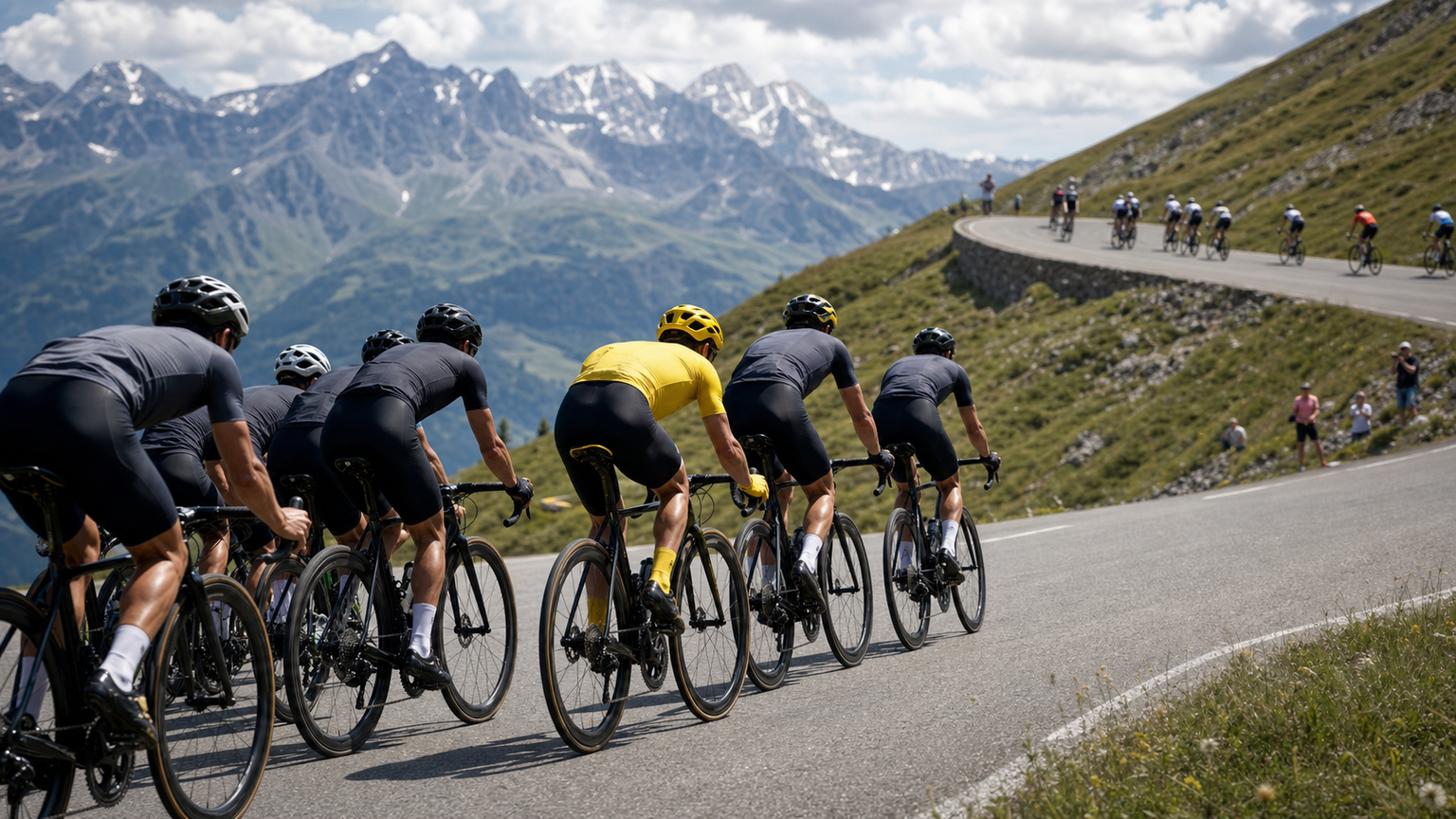
Before the peloton enters the climb, the GC leader’s team launches the “train”—domestiques line up in single file, setting a pace slightly faster than the peloton to force rivals to burn energy early. The typical approach:
- 5 kilometers before the climb, domestiques take turns raising the pace
- Each domestique hands over before exhaustion, leaving the leader to face rivals
- If a rival attacks at this point, the leader reacts as needed or holds the pace
Choosing the Attack Moment
- Feint attack: Tests rivals’ legs; if they react slowly, accelerate
- Attack in the final 3 kilometers: With enough distance to the summit, seconds can be accumulated
- Descent attack: High risk, high reward—Nibali’s aggressive descent on the Stelvio in 2015 is still talked about today
Time Trial Strategy
The individual time trial (ITT) is a key decider in the Tour’s yellow jersey battle. GC riders typically “save energy” on flat stages and go all-out in the time trial.
Key tactical considerations:
- Start order: Those higher on GC start later, allowing them to adjust pacing after knowing rivals’ times
- Pacing strategy: A slightly even pace is better than starting fast and fading; but if the route has more climbing in the second half, energy must be saved early
- Equipment choice: Depending on wind and gradient, decide between a time trial bike or a road bike (the latter has an advantage on steeper climbs)
Practical Advice
For Taiwanese riders, the tactical wisdom from the Tour applies equally to local racing:
- Teamwork: Even in amateur races, 2–3 riders rotating through the wind is far more efficient than going solo, saving 20–30% of energy
- Save your attack: Don’t burn out in the first half of a climb; saving energy for the final 500 meters is the right rhythm
- Read your rivals: Watch competitors’ breathing rhythm and cadence changes to gauge their remaining energy
- Timing your fueling: Eat on flats or descents, finish hydrating before climbs, and avoid stomach issues
Conclusion
The tactical complexity of the Tour de France rivals a chess game: every attack decision affects the entire team’s resource allocation, and every refusal to chase is a precise calculation of one’s own energy. For Taiwanese fans, following the Tour broadcast every July is not just about admiring elite athletes’ physical abilities—it’s a vivid tactical lesson. Understanding the tactics is the key to truly appreciating the beauty of the Tour.
Related Reading
- Tour de France Tactical Analysis: How Teams Strategize to Win the Yellow Jersey?
- Tour de France Race Tactics: Team Strategy from the Lead to the Final Sprint
- In-Depth Analysis of Mountain Stage Strategy at the Tour de France
- The Complete Guide to the Tour de France: Format, Four Jerseys, and a Viewing Guide for Taiwanese Fans
2024 春季KOM 賽事精華版 / 太魯閣 / 貓捉老鼠精彩追擊 / 錄影剪輯版 / 東進武嶺 / 公路車 (請開啟字幕)
2 年前
2025 海鷗團體繞圈賽 / 前八強賽事精華!/ 環台賽等級拍攝 / 國手菁英隊伍較勁 / CT Yeh #公路車
8 個月前
2023自行車展!與環台賽選手一同表演賽 / 全自動AI Fitting?/ TIME新車發表/神秘充電桌等 精華分享 VLOG | CT Yeh | 公路車
3 年前
單車實況) 車測中心高速賽道 96 彰化讚 挑戰組一圈實錄 | ARTC
6 年前
超激烈!2025 南庄仙山KOM 賽事精華 / 男菁英A x 女菁英A / 公路車 / CT Yeh
9 個月前
公路車 | DanCup 繞圈賽 | 馮俊凱 151 林彥君 等大咖同場交流 | 卡丁車場也可以繞!| 4K超高畫質
5 年前
2024桃園團體自由車邀請賽!4K環台賽等級拍攝 全賽事精華!/ 集團大摔車 / 60隊菁英好手衝線 / 公路車 CT Yeh
1 年前
2025 紫南宮99.9K環縣自行車挑戰賽 直播 / 第一集團跟了20K / CT動態數據直播系統 / 公路車 / CT Yeh
1 年前