Introduction
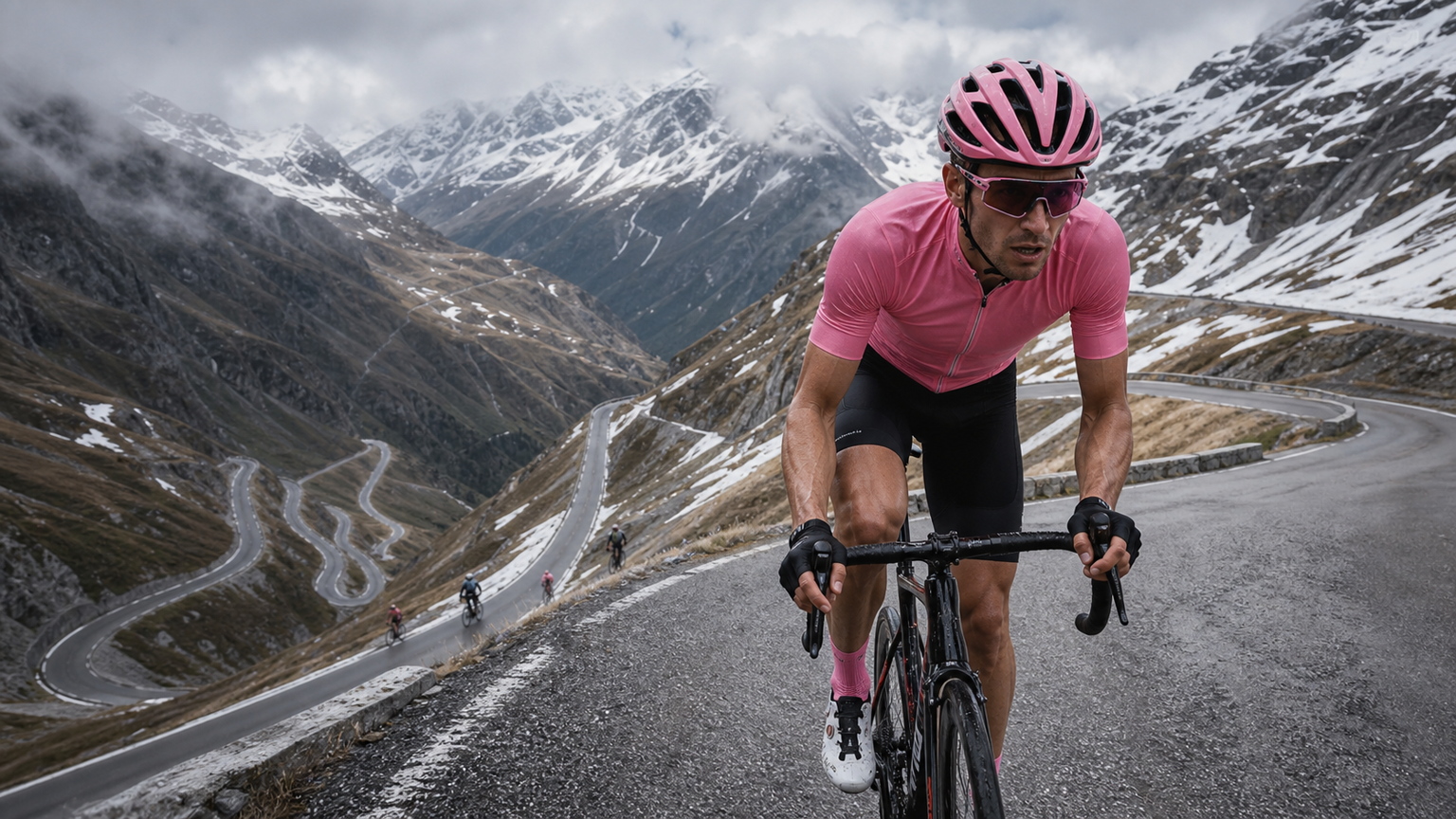
The Giro d’Italia, held every May, is the Grand Tour most renowned for its extreme mountain stages. Compared to the Tour de France’s balanced design, the Giro places greater emphasis on high-altitude climbs, with summit finishes above 2,000 meters being commonplace—Stelvio (2,758m), Mortirolo, Zoncolan—each name a nightmare for professional riders.
The pink leader’s jersey (Maglia Rosa) symbolizes the glory of conquering Italy’s mountains. This article delves into the Giro’s mountain competition structure and how it has become one of the world’s most “brutal” cycling events.
The Mountain Characteristics of the Giro
High Density, Little Recovery
The Giro’s stage design typically concentrates the hardest mountain stages in the third week, sometimes featuring three consecutive high-mountain stages that leave riders almost no chance to recover. A typical “Hell Week” might include:
| Stage | Major Climbs | Total Elevation Gain | Features |
|---|---|---|---|
| Stage 16 | Mortirolo + Aprica | 4,800m | Legendary brutal slope, gradients up to 18% |
| Stage 19 | Stelvio or Gavia | 5,200m | High altitude, possible snow |
| Stage 20 | Summit Finish ITT | 3,100m | Individual time trial climb, decides the Pink Jersey |
Weather Uncertainty
In May, weather in northern Italy’s mountain regions can change dramatically, and Giro history is filled with legendary tales of finishing amid blizzards, hail, and heavy rain. In 1988, Andy Hampsten battled through a snowbound Gavia Pass in a thin jacket, creating one of the Giro’s most iconic images. This weather unpredictability makes the Giro’s mountain showdowns even more intense and unpredictable.
Tactical Analysis of Key Climbs
Zoncolan — “The Mountain of Hell”
Zoncolan averages over 11% gradient, with the steepest sections reaching 22%, spanning roughly 10 kilometers—the Giro’s most iconic brutal climb. Tactical characteristics:
- Extremely slow pace: Top riders take approximately 45–50 minutes to climb it, averaging just 12–14 km/h
- No drafting possible: The gradient is so steep that team “train” tactics become completely ineffective; every rider must follow their own rhythm
- Pacing is everything: Going out too hard in the early section guarantees a blow-up later; riders must precisely calculate their average pace based on W/kg
Stelvio — The Highest Road Race in History
At 2,758 meters, the Stelvio is one of the Giro’s highest points, featuring 48 hairpin turns. Characteristics:
- High altitude and low air pressure reduce maximal oxygen uptake (VO2max) by approximately 10–12%
- A 24-kilometer climb demands extremely conservative pacing
- If a descent follows the summit, riders must watch for a rapid drop in body temperature
The Giro’s GC Competition Model
Compared to the Tour de France, the Giro’s GC competition is more “chaotic,” for the following reasons:
- Higher proportion of mountain stages: Time trial distances are usually shorter, making time gaps in the mountains more decisive for the overall classification
- Italian home advantage: Italian riders (boosted by the Tifosi) often attack aggressively on key mountain stages, creating chaos
- Large variance in rider condition: Over the three-week race, minor injuries or small incidents in the first week can have a profound impact on the third-week outcome
Among past Pink Jersey winners, Eddy Merckx (5 times), Fausto Coppi (5 times), Bernard Hinault (3 times), and modern-era riders Chris Froome, Egan Bernal, and Tadej Pogačar are all all-round climber-time trialists.
A Taiwanese Perspective: Training Lessons from the Giro
The Giro’s mountain characteristics offer direct reference value for Taiwan’s climbing enthusiasts:
- Long-climb pacing practice: Taiwan’s Wuling (50+ km) and the Stelvio (24 km) are similar in duration, both requiring a conservative start
- High-altitude adaptation: Wuling’s summit at 3,275 meters is even higher than the Stelvio, so the effects of high-altitude hypoxia are worth adapting to in advance
- Bad-weather preparation: Taiwan’s mountain weather is equally changeable; rain gear and thermal layers are essential equipment
Practical Advice
- Reference the Giro climbers’ W/kg metrics: GC-level climbing power typically ranges from 6.0–6.5 W/kg; amateur riders can effectively improve by training long climbs at 75–80% of their own maximum power
- Recovery strategy for consecutive days of climbing: consume carbohydrates (1–1.2g/kg) within 30 minutes after finishing, and get no less than 8 hours of sleep
- The night before a mountain stage, do “carb loading” to ensure adequate glycogen stores
Conclusion
The Giro d’Italia’s mountain narrative is one of the most compelling chapters in professional cycling. On snow-capped summits and switchback roads beside monasteries, human endurance and will are pushed to their limits. For Taiwanese riders, every conquest of Wuling or Taiping Mountain is, in essence, a reenactment of the same reverence for and desire to conquer the mountains—only the stage has shifted from Italy to Taiwan’s Central Mountain Range.
Related Reading
- Giro d’Italia: The Romance and Brutality of the Pink Jersey
- In-Depth Analysis of the Giro d’Italia: Mountain Trials, the Pink Jersey, and Taiwanese Riders’ European Dreams
- Giro d’Italia Tactical Analysis: The Battle for the Pink Jersey
- Giro d’Italia 2026 Preview: Key Mountain Stages in the Pink Jersey Battle
台北闊瀨陡坡 騎旅 / 日本單車雜誌編輯車友臨時加入!/ 髮香才是最強的 / feat. 北迴歸線小隊 / 公路車 CT Yeh
6 個月前
大武山後門26%歡樂陡坡!JJSC南台灣單車行Day2 / 被颱風追著跑 / 公路車 / CT Yeh
2 年前
2025 乘鞍 KOM 登山賽挑戰實錄 / 日本公路最高 ! 賽前探路篇 / 比富士山厲害,無敵絕景!/ 40週年 / 中文YT首發 / 公路車 / CT Yeh #乘鞍ヒルクライム
11 個月前
萬年峽谷! 30% 超激陡坡 里佳部落DAY2 還是很硬! | 公路車 | CT Yeh
3 年前
微雨戰! 2022桃園市長盃錦標賽 無敵交管 沒來玩太可惜了! 羅馬公路太可怕 差點成佛! 公路車 | CT Yeh
4 年前
小野田真的存在!日本赤城山爬坡公路賽 台灣首發團完全實錄 | 頭文字D真實賽道! | 看完東奧自行車賽後好想再去騎一次啊! | 公路車 | CT Yeh
4 年前
#北橫 + #北進武嶺 最硬的員工旅遊 EP1 | #公路車 #拉拉山 | 明池 | 武嶺 | 武陵農場 | 雲海 | Taiwan Cycling Route Wulin
6 年前
單車實況) 車測中心高速賽道 96 彰化讚 挑戰組一圈實錄 | ARTC
6 年前