Introduction
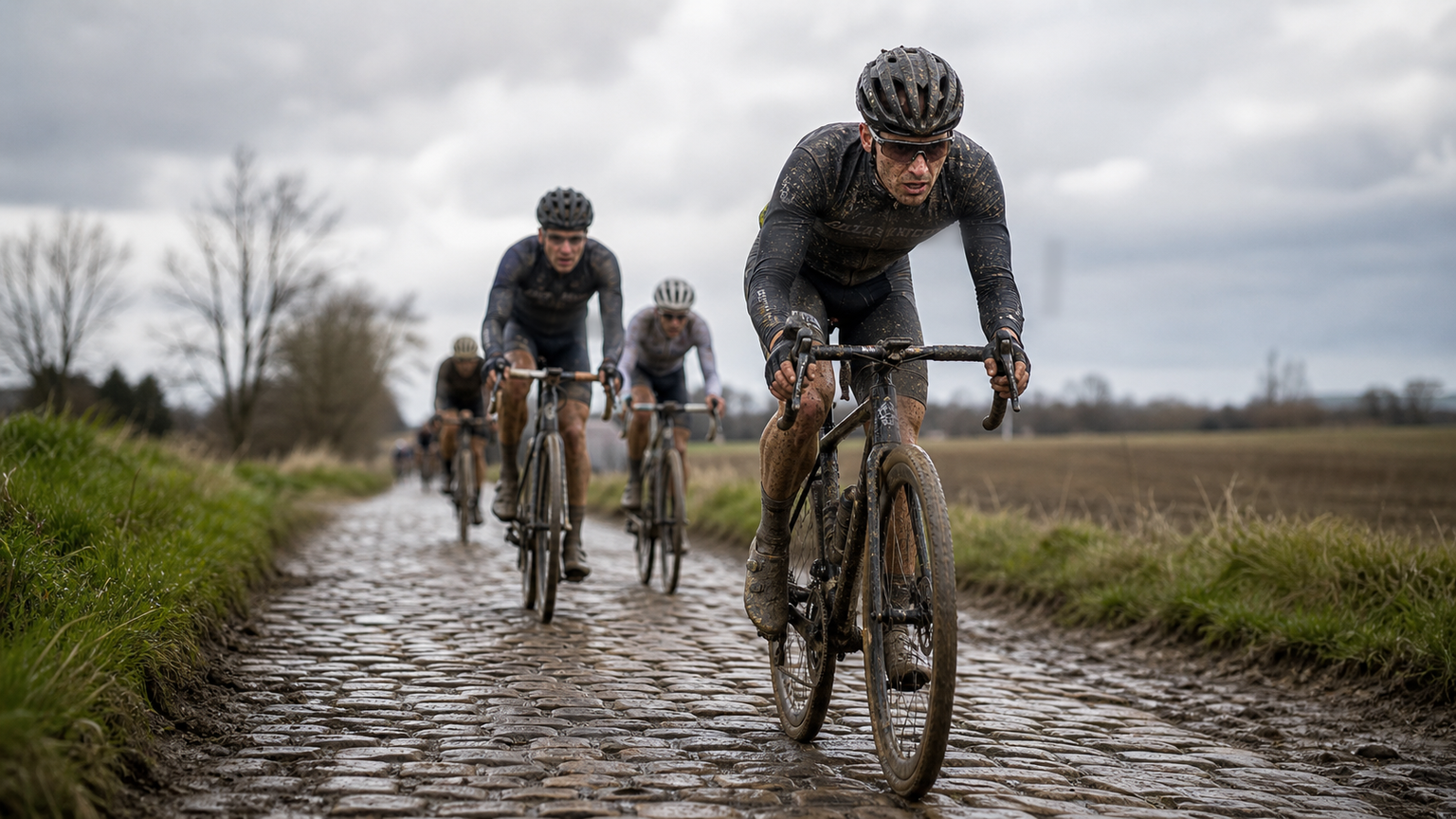
“Hell of the North (L’Enfer du Nord)” — this title alone says enough about the status of Paris-Roubaix in the world of professional cycling. Held every April, this one-day spring classic stands out among all cycling races for its unique cobblestone sections (Pavé Sections), making it the most visually striking and the toughest test of equipment and technique.
Over the roughly 260 km course, there are 55–58 cobblestone sections totaling 52–55 km, each rated one to five stars by difficulty. The five-star hellish sections, such as the Trouée d’Arenberg and the Carrefour de l’Arbre, force riders to fight for survival amid violent vibrations. Finishing the race and winning the granite paving stone trophy at the finish line is one of the most cherished achievements for a professional rider.
The Physical Challenges of the Cobblestones
Vibration and Energy Expenditure
The uneven surface of the cobblestones keeps the bike bouncing continuously, with dozens of tiny impacts transmitted to the rider’s body every second. This creates several physical issues:
- Energy loss: Vibration absorbs a large amount of forward propulsion energy; at the same speed, power demand on cobblestones is 15–25% higher than on asphalt
- Arm fatigue: Grip strength must be maintained constantly, and the forearm and shoulder muscles are pushed to their limits after dozens of kilometers on the cobbles
- Mental drain: Riders must continuously assess their line choice (the middle of the cobblestone sections is usually smoother) and cannot “zone out” while riding
Risk of Mechanical Failure
The cobblestones put enormous strain on equipment:
| Type of Failure | Cause | Response |
|---|---|---|
| Flat tire | Cut or pinched by cobblestone edges | Low tire pressure (tubulars 5–5.5 bar) + quick wheel change |
| Wheel rim deformation | Impact forces exceed carbon fiber tolerance | Switch to deep-section aluminum rims or reinforced carbon fiber |
| Drivetrain drop | Violent vibration loosens derailleur cables | Verify tension before the race; use electronic shifting |
| Frame breakage | Cumulative impact fatigue | Use a vibration-damping frame designed specifically for Paris-Roubaix |
The Unique Logic of Equipment Selection
Paris-Roubaix’s equipment strategy is completely different from a normal road race:
Tire Selection
- Tubular tires are the traditional first choice: after a flat, you can still ride a short distance while waiting for the team car; however, tubeless technology has improved in recent years, and more and more riders are adopting it
- Tire width is typically 28–30mm, much wider than the 25mm used in standard road races, increasing contact patch and vibration absorption
- Tire pressure is deliberately low (around 5–5.5 bar for tubulars, 4–4.5 bar for tubeless) to add cushioning
Frame and Handlebars
- Special “Paris-Roubaix edition” frames (such as the Specialized S-Works Roubaix) feature rear-end vibration-damping designs that reduce shock transmitted to the hips
- Handlebars sometimes use thicker bar tape or gel bar tape to reduce hand numbness
- Some riders switch to spare race wheels (pre-inflated wheel sets) before entering the cobblestone sections to save time
Cobblestone Riding Technique
Line Choice
The center of the cobblestone sections is usually smoother than the edges (due to years of vehicle traffic), so the closer to the middle, the better the ride. But other riders are also competing for position, so you need to claim your spot early.
Maintaining Speed
Counterintuitively, the faster you go, the less vibration you feel — because at high speed, the contact time between the wheel and each stone is shorter, and the impact forces are spread out. Riding slowly actually makes it rougher. Pro riders can reach 45–50 km/h through the Arenberg.
Light Grip on the Handlebars
Gripping too tightly transmits all the vibration into your upper body; the ideal approach is a “soft grip,” keeping your elbows slightly bent as natural shock absorbers, letting your arms absorb some of the impact.
Race Tactical Considerations
Position Is Everything
Position before entering the cobblestone sections is crucial: the entrances are often bottlenecks, and riders at the back are forced to wait, potentially losing several minutes. Top riders fight for the front positions within the first 20 kilometers.
The Elite Breakaway
Unlike most one-day races, the final winner of Paris-Roubaix usually comes from a small breakaway group (2–5 riders) rather than a bunch sprint. Reason: the chaos of the cobblestone sections constantly splits the peloton, and the strongest riders naturally get filtered out to form the leading group.
The Strategic Role of the Team Car
Each rider can change wheels or bikes before entering the cobblestone sections, and the team car driver’s (usually a retired rider) ability to read the cobblestones and judge positioning is crucial.
What It Means for Taiwanese Riders
Taiwan rarely has cobblestone roads, but the equipment and technique logic of Paris-Roubaix still offers valuable reference:
- The riding logic on gravel roads and rough climbs (such as Caoling Historic Trail or the Hehuan North Peak access road) is similar: wider tires, lower pressure, soft grip on the bars
- The design philosophy of gravel bikes comes directly from the extreme demands of Paris-Roubaix
Practical Advice
- When riding on gravel or rough surfaces, lower tire pressure by 0.5–1 bar compared to asphalt; the increased contact patch significantly improves grip
- After long rough sections, pay attention to whether your wrists or elbows feel overly fatigued — it’s an often-overlooked source of injury
- Before entering a hazardous section, slow down in advance and pick your line; do not brake hard in the middle of the cobblestones
Conclusion
Paris-Roubaix is the event in cycling that comes closest to the “primitive” form of the sport — it doesn’t rely on lightweight carbon or precision aerodynamics; it relies on the will and technique to keep going through a bumpy hell. Every April, when the TV cameras capture the top riders sprinting desperately over the cobblestones of the Arenberg forest, it is the purest human response to a hostile environment — keep pedaling, and keep pedaling.
Related Reading
一日北高常見問題大集合 | 攻略 | 路線 | 訓練 | 補給 | 自行車 單車 | 一日雙城 | 雙塔 | TWB北高360 | 屁股痛
6 年前
萬年峽谷! 30% 超激陡坡 里佳部落DAY2 還是很硬! | 公路車 | CT Yeh
3 年前
2024 如來神掌 百人約騎挑戰!feat. 秘境單車社團 / 神人們太可怕 / 全程錄影 x 完整坡度解析 / 公路車 / CT Yeh
2 年前
水金九不厭五分 10度寒流冷到不願停!feat. 卡卡 / 公路車 / CT Yeh
6 個月前
台北闊瀨陡坡 騎旅 / 日本單車雜誌編輯車友臨時加入!/ 髮香才是最強的 / feat. 北迴歸線小隊 / 公路車 CT Yeh
6 個月前
大武山後門26%歡樂陡坡!JJSC南台灣單車行Day2 / 被颱風追著跑 / 公路車 / CT Yeh
2 年前
司馬庫斯 | 單車員工旅遊 | 比武嶺還接近上帝的路 | 2021 全面實況 路況解析 | 空拍 櫻花炸開超濃密 | 財伯觀光果園 | CT Yeh
5 年前
大武山20%魔王陡坡【JJSC南台灣遊騎Day2】!屁股真的要裂開了...凡士林抹滿也沒用?神秘金教堂還有超便宜夜市
3 個月前