Introduction
In Taiwan’s swimming pools, breaststroke is one of the most popular strokes, prized for its elegant posture and easy breathing, and especially loved by older swimmers and beginners. However, the breaststroke’s distinctive kicking motion (the whip kick) places the knee under a stress pattern rarely seen in land-based sports. With incorrect technique or excessive training volume over time, this can easily lead to “swimmer’s knee” (breaststroker’s knee).
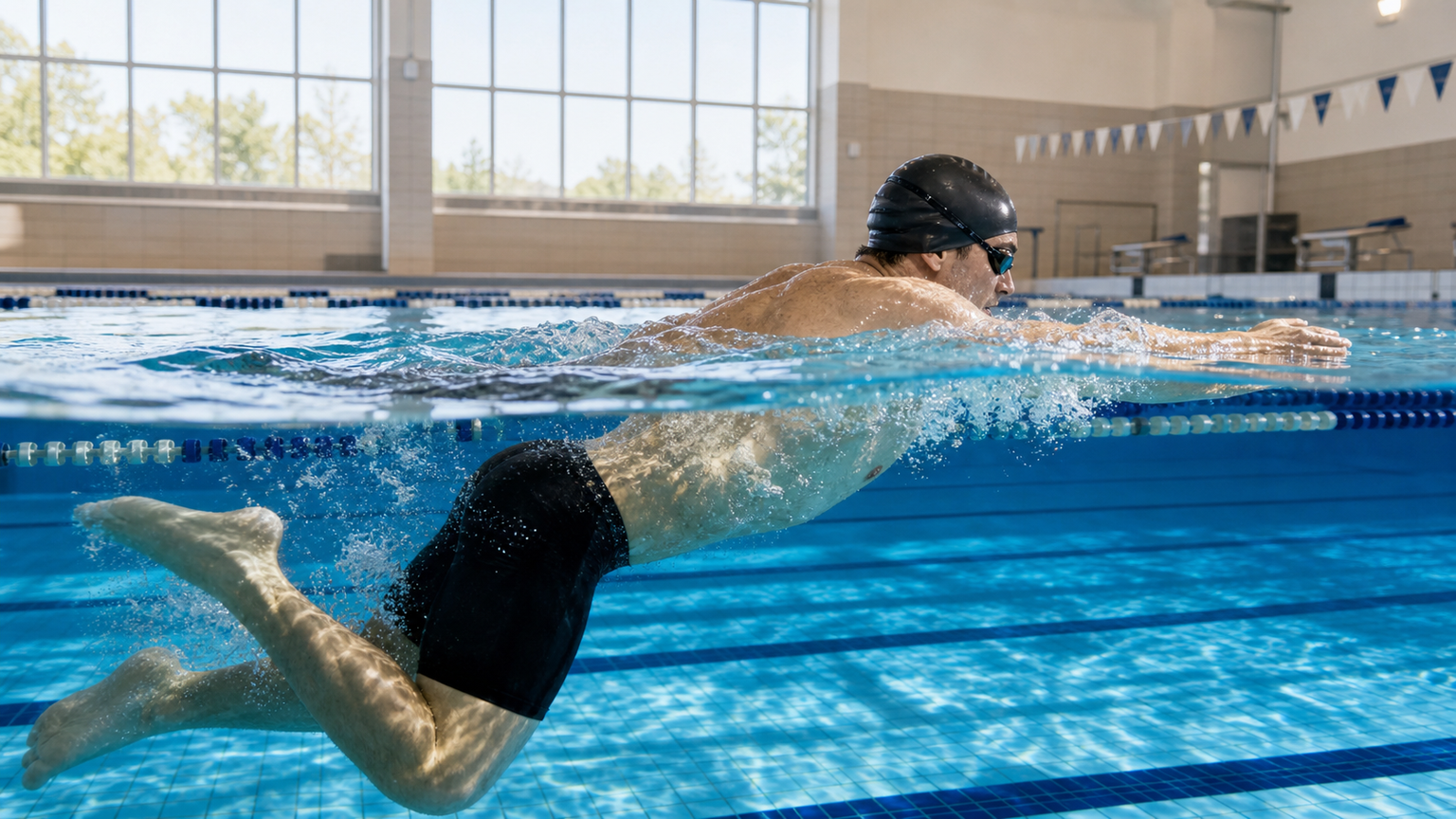
The Biomechanics of the Breaststroke Kick
The breaststroke kick unfolds in three phases:
- Recovery: The hip and knee flex, drawing the heels toward the buttocks
- Turning out: The ankle dorsiflexes and everts, preparing to kick
- Propulsion: The knee rapidly extends while the feet sweep backward through the water
The problem occurs in the late stage of phase 3: as the knee approaches full extension, the lower leg experiences pronounced external rotation and valgus stress, which directly compresses:
- The medial collateral ligament (MCL)
- The medial meniscus
- The patellar cartilage surface (patellofemoral joint)
Common Swimmer’s Knee Diagnoses
| Diagnosis | Pain Location | Characteristics |
|---|---|---|
| MCL sprain | Medial knee | Sharp pain in the late kick phase, tender to touch |
| Medial meniscus tear | Deep medial knee | A “catching” sensation in the knee, swelling |
| Chondromalacia patellae | Beneath the kneecap | Pain when climbing stairs or after prolonged sitting |
| Pes anserine bursitis | Lower medial knee | Swelling, tenderness on palpation |
| Patellar tendinitis | Directly below the kneecap | Pain during jumping and kicking |
Who Is Especially at Risk?
- Beginners with underdeveloped technique: Kicking with the knees opening too far outward places greater tensile force on the medial ligament.
- Swimmers with limited hip mobility: When the hip cannot externally rotate sufficiently, the compensatory stress shifts to the knee.
- Swimmers with a larger Q-angle (more common in women): A wider pelvis skews the femur, making the patellar tracking path more prone to deviation during the kick.
- Swimmers who suddenly increase breaststroke volume: Jumping from 2,000m of breaststroke per week to 5,000m sharply raises the risk.
- Swimmers with prior knee injuries: Those returning to swimming after ACL reconstruction should approach the breaststroke kick with particular caution.
Technique Correction Is the Most Fundamental Prevention
Key Points for a Correct Breaststroke Kick
- Don’t let the knees open too wide: During the kick, the distance between the knees should be kept within shoulder width, avoiding the knees moving outward past the toes.
- Drive from the hips: The power of the kick should come from the glutes and thighs, not a whipping motion at the knee.
- Fully evert and dorsiflex the ankles: Sufficient ankle flexibility allows the propulsive force to be distributed evenly, sparing the knee from compensating.
- Snap the legs together quickly after the kick: Bring the legs together into a streamlined position promptly after kicking, reducing the time the knee spends in an unstable position.
Self-Assessment Method
Stand in front of a mirror and perform the breaststroke kicking motion: observe whether the knee tracks past the outside edge of the foot, and whether the ankle achieves full dorsiflexion. You can also ask a coach to observe your kick trajectory in the water.
Managing an Injury
Acute Phase (Redness, Swelling, Pain)
- Stop breaststroke and switch to freestyle or backstroke to maintain training
- Ice the medial knee for 15 minutes, 3–4 times per day
- Nonsteroidal anti-inflammatory drugs (NSAIDs) may be used short-term under a doctor’s guidance
Rehabilitation Phase
- Strengthen the quadriceps and gluteus medius (side-lying leg raises, resistance band frog kicks, etc.)
- Practice with a kickboard in the water (freestyle flutter kick only, no breaststroke kicking)
- Have a physical therapist assess ankle mobility and mobilize any areas of restriction
Step-by-Step Plan for Returning to Breaststroke
| Week | Content |
|---|---|
| Weeks 1–2 | Freestyle and backstroke only, no breaststroke kicking |
| Week 3 | Introduce slow breaststroke, no more than 200m per session |
| Weeks 4–5 | Gradually increase breaststroke to 500m per session, monitoring symptoms |
| After week 6 | Resume normal training volume, increasing by 10% every 2 weeks |
Practical Tips
- Stretch the hip external rotators after every breaststroke session: Perform the seated “figure-4” stretch, holding for 30 seconds × 3 sets, to improve hip mobility.
- Train ankle flexibility: Daily ankle circles and dorsiflexion stretches increase kicking efficiency and reduce compensation at the knee.
- Distinguishing swimmer’s knee from runner’s knee: Both involve knee pain, but swimmer’s knee hurts during swimming with fewer symptoms during land activities, while runner’s knee is the reverse. Identifying which one you have makes targeted training far more effective.
- Don’t train through the pain: If knee pain exceeds 2 out of 10 on the pain scale, adjust intensity immediately rather than pushing through the full workout.
Conclusion
Behind the graceful motion of the breaststroke lies a real challenge for the knee. Correct technique, sensible training loads, and balanced strength are the best prevention for swimmer’s knee. With Taiwan’s abundance of swimming pools, every breaststroke enthusiast is encouraged to take regular technique lessons, so breaststroke can remain a stroke you enjoy in the water for years to come.
Related Reading
一日北高常見問題大集合 | 攻略 | 路線 | 訓練 | 補給 | 自行車 單車 | 一日雙城 | 雙塔 | TWB北高360 | 屁股痛
6 年前
滑雪新手們慘摔學習全紀錄(請開字幕),滑雪好好玩 | Snowboard + Ski | 岩原 スキー場 | 滑雪APP使用 | GoPro Max
6 年前
抖肩舞 台灣x日本交流版 (台灣 vs 前橋) 赤城山登山賽 coincidance
8 年前
[防寒衣體驗] 鐵人魂 三鐵 防寒衣試穿會 於松運 深水游泳池 鯨魚池
8 年前
一日北高/長距離團騎 常見問題補充篇 / 組團或跟團的眉角 / 壯車友容易被瘦車友慢性拉爆 / 原來屁股痛可能是這個原因...? / 風場配速法 / 公路車 / CT Yeh
2 年前
[教學] Premiere 影片 手震 修正 教學 防抖 單眼 影像 GoPro 穩定 Video Stabilization
8 年前
碟煞公路車 銑面器 !? 原來銑完差這麼多! 降低蹭碟機率! | TIME 公路車 保養小記錄 | CT Yeh
3 年前
CT 喇低賽) 武嶺牽車 才是王道 西進牽車四小時內秘訣 攝手位置 如何判斷 防抽筋小秘訣
7 年前