Introduction
Breaststroke has the strictest rules among the four competitive swimming strokes. On the turn, swimmers must touch the wall with both hands simultaneously and at the same height, and the body must not roll over, or the referee will call a disqualification. This is completely different from the flip turns used in freestyle and backstroke. Many beginners, eager to go fast, unconsciously let one hand touch the wall first, leading to unnecessary mistakes in training and competition. This article starts from understanding the rules and fully explains the correct technique and acceleration tips for the breaststroke turn.
Detailed Touch Rules: What Counts as a Violation
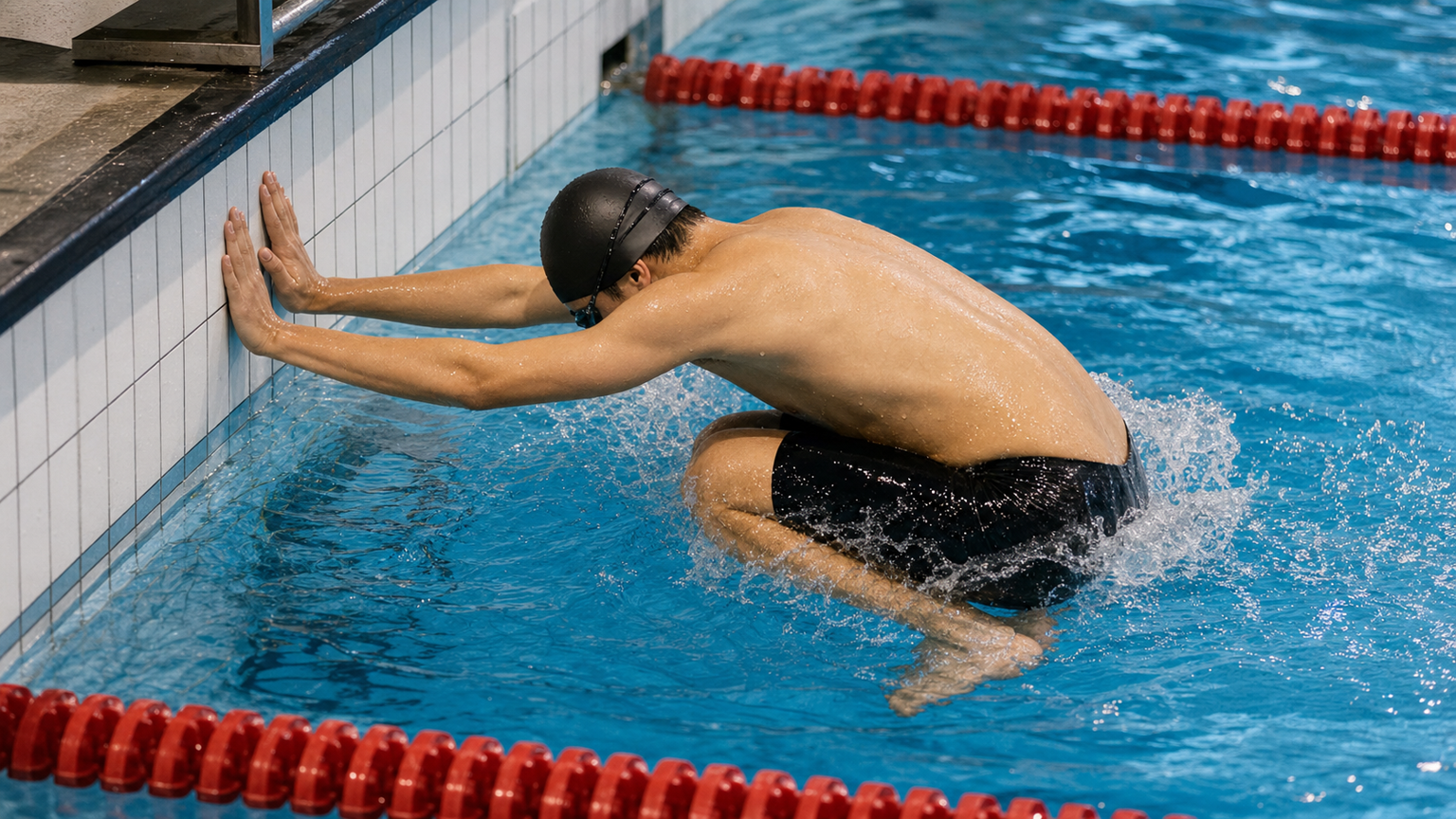
According to FINA (now World Aquatics) rules, the wall-touch requirement for the breaststroke turn is as follows: the swimmer must touch the wall with both hands simultaneously on the same horizontal plane, and the body must remain in a chest-down (prone) position when touching. After touching, the swimmer may rotate the body, but from the start until the final touch before the turn, the body must remain in the prone position.
Common violations:
- One hand touches the wall first, the other hand touches late
- Touching the wall sideways (body already rotated more than 90 degrees)
- Fingers pointing in different directions at the touch, with an obvious height difference
- Body already on the back when pushing off the wall after the turn
A good rule of thumb is: during the last arm pull before reaching the wall, bring both hands together in front, approaching the wall in an “open prayer hands” position, ensuring both hands touch almost simultaneously. Advanced swimmers practice pressing their palms almost flat against the wall before pushing, reducing energy lost to slapping.
Footwork for the Fast Turnaround
The speed of the breaststroke turn depends largely on how quickly the feet are positioned after touching the wall. Since rolling over is not allowed, swimmers must use a lateral rotation to bring both feet to the wall.
The standard sequence is as follows:
- After both hands touch the wall, immediately bend the elbows to bring the body closer to the wall
- At the same time, rotate the body toward the preferred side (usually the right), drawing both feet toward the chest from the side
- Plant both feet on the wall, with the body now in a transitional position between side-lying and prone
- Release the hands and extend them forward; at the moment of pushing off, fully rotate to prone, with hands stacked in front of the head in a streamlined position
- After pushing off, perform one underwater breaststroke kick (the rules allow one underwater breaststroke kick after the turn), then surface and begin pulling
| Movement Phase | Key Points | Common Mistakes |
|---|---|---|
| Wall touch | Both hands simultaneous, same height | One hand reaches first |
| Tucking feet | Lateral rotation, ankles to hips | Feet take a long path, slow |
| Push-off | Both feet push simultaneously | One foot pushes first |
| Streamline glide | Hands stacked, body straight | Lifting head to check direction |
Underwater Breaststroke Kick: Rules and Application
The rules clearly state that after the turn, the swimmer may perform one complete arm pull (pull-out) underwater, including one arm stroke and one breaststroke kick, before surfacing. Many beginners do not know they can take one pull underwater first, wasting this acceleration opportunity.
The correct underwater sequence after the start or turn:
- After pushing off, glide in a streamline until speed approaches swimming speed
- Sweep both hands from the front downward and backward to the sides of the thighs (underwater pull)
- While recovering the hands together in front of the chest, perform one full breaststroke kick
- After the kick extends, extend the arms forward and surface naturally to begin pulling
If executed well, this underwater sequence can maintain very high speed and is more efficient than surfacing immediately to pull.
Practical Tips
- Practice your approach rhythm: Starting 5–7 meters from the wall, deliberately adjust your stroke rate so that when your last full pull ends, both hands can close together in front to touch the wall, avoiding the awkward “half pull” caused by poor distance judgment.
- Use a mirror or video to confirm simultaneous hand touch: What feels simultaneous to you may not look simultaneous from the referee’s angle. Have someone record you from the side or front to confirm.
- Practice in segments: The touch-and-turnaround action can be practiced repeatedly in place without swimming from the far end each time.
- Don’t skip the underwater pull: Perform the full underwater pull-out on every turn in practice so the movement becomes muscle memory.
Conclusion
Although the breaststroke turn has many restrictions, as long as you understand the logic of the rules and use the correct lateral rotation to turn around, you can still achieve a fast and efficient turn. Rather than chasing speed while ignoring the rules, a stable and compliant turn is the real competitive advantage. We recommend making the breaststroke turn a regular part of every training session, not something you only practice right before a race.
Related Reading
- Open Turn Two-Hand Touch Rhythm: The Science of Breaststroke and Butterfly Turns
- A Comprehensive Comparison of Turn Techniques Across Four Strokes: The Art of Touch, Flip, and Rhythm
- Refining Turn Technique: Hand-Foot Coordination and Wall Push-Off Power in Flip Turns
- Swimming Turns Fully Explained: Flip vs. Touch — Which Is Really Faster?
如何把 GoPro 影片 翻轉 批次 轉正?
6 年前
CT 喇低賽) 武嶺牽車 才是王道 西進牽車四小時內秘訣 攝手位置 如何判斷 防抽筋小秘訣
7 年前
抖肩舞 台灣x日本交流版 (台灣 vs 前橋) 赤城山登山賽 coincidance
8 年前
[教學] Premiere 影片 手震 修正 教學 防抖 單眼 影像 GoPro 穩定 Video Stabilization
8 年前
Insta 360 One 超級防手震技術實測
7 年前
戰略) Zwift Race 如何咬在第一集團 如何評估自己要開多少推力 (請開1.5倍速看)
7 年前
下次拍照前要查清楚啦🤣 #cycling
7 個月前
Never Stop 西進武嶺 前後雙機 完整全程錄影 訓練台 實境
8 年前