Introduction
Many swimmers spend most of their training time in the pool, believing that only in-water practice can improve performance. However, international research and the practical experience of top coaches consistently show that systematic land-based strength training can significantly enhance in-water propulsion, improve body stability, and reduce the risk of overuse injuries. The question is not “whether to train,” but “which movements offer a genuine transfer effect.”
Why Land-Based Training Helps Swimming
Swimming propulsion comes from the upper body’s pulling motion, but core stability determines whether that force can be transmitted effectively. In the water, the body is in a horizontal position, and gravity places almost no compressive load on the spine, leaving many stabilizing muscles in a chronically under-stimulated state. Land-based training can strengthen these muscle groups from a functional perspective, helping swimmers maintain a more streamlined body position in the water and reduce drag.
Additionally, water resistance is non-linear—the faster you go, the greater the resistance grows (squared)—so the final phase of propulsion (explosive power) is especially critical. Land-based power training can directly enhance neuromuscular recruitment efficiency, making every stroke more effective.
Key Movements with High Transfer Effect
Upper Body Push-Pull Series
The swimming stroke can be broken down into two phases: the “pull” (from catch to the end of the pull) and the “push” (the exit phase of the stroke). The following movements target these two phases:
| Movement | Primary Muscles | Swimming Transfer |
|---|---|---|
| Single-Arm Dumbbell Row | Latissimus dorsi, rhomboids | Simulates catch to pull |
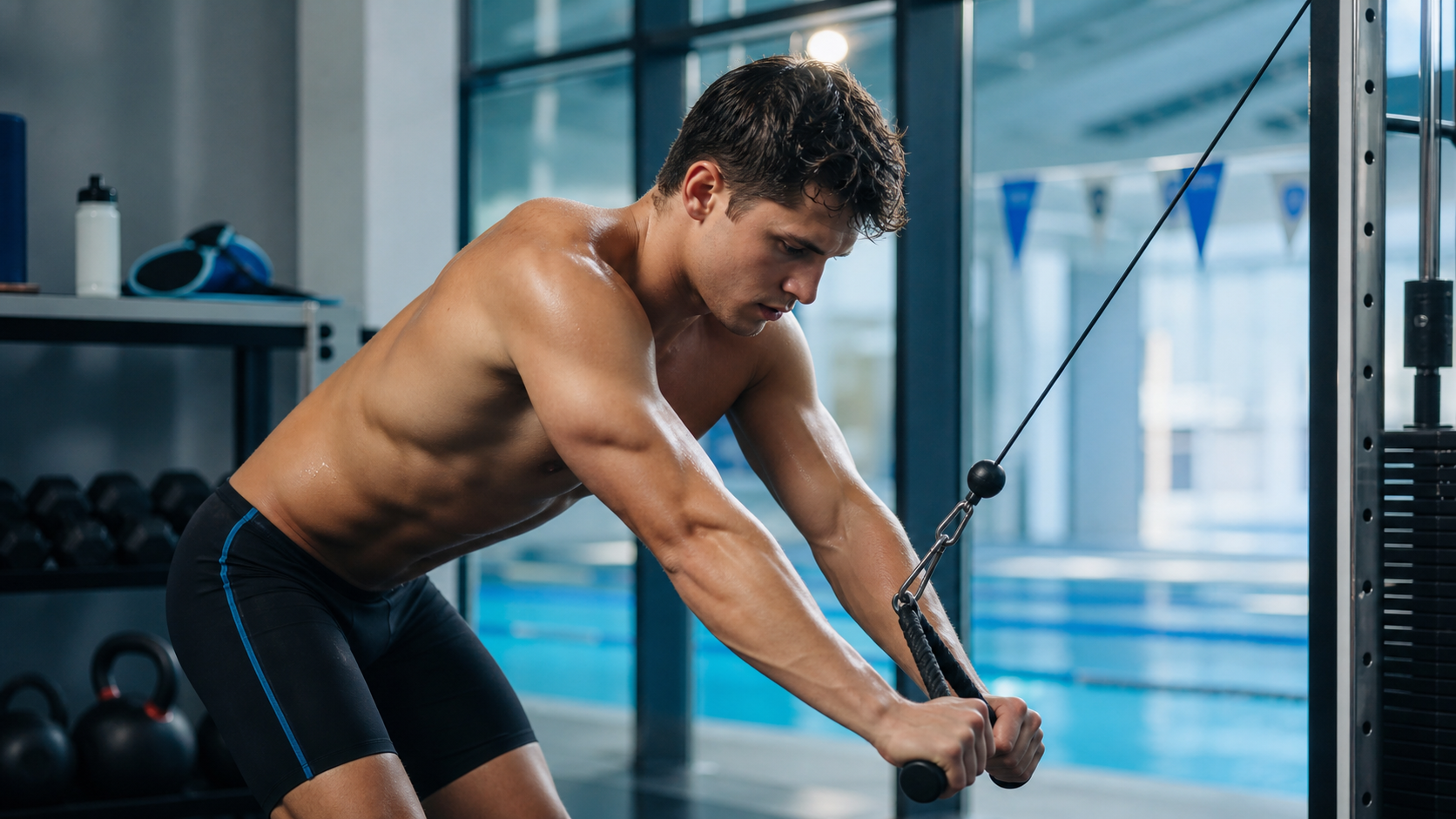
| Straight-Arm Pulldown | Latissimus dorsi, core | Closest to stroke path |
| TRX Row | Rear deltoids, middle trapezius | Maintains high-elbow position during the pull |
| Push-Up Variations | Pectorals, triceps | Power in the push/exit phase |
| Band External Rotation | Infraspinatus, teres minor | Rotator cuff stability, injury prevention |
Note: The Straight-Arm Pulldown is currently the single movement most consistently identified by research as having high transfer value, because its movement path is nearly identical to the freestyle stroke trajectory.
Core and Rotational Power
- Reverse Crunch: Strengthens the lower abdomen, maintaining lower-body stability during the kick
- Side Plank with Hip Lift: Trains the lateral core, especially important for backstroke swimmers
- Medicine Ball Rotational Wall Throw: Simulates the rotational power in the flip-turn motion
- Anti-Rotation Training (Pallof Press): Builds torso anti-rotational rigidity, allowing force to be transmitted effectively
Lower Body Explosive Power
Although swimming is primarily upper-body dominant, butterfly and breaststroke swimmers require strong hip flexor and quadriceps strength for their kicking motions. Recommended additions:
- Squat Jump: For flip turns and explosive starts
- Nordic Curl: Strengthens the hamstrings, preventing hamstring strains
- Single-Leg Glute Bridge: Hip extension strength, supporting the butterfly kick
Training Program Recommendations
- Frequency: 2–3 times per week, with at least 6 hours between land training and water sessions
- Intensity: During the base phase, focus on 3 sets × 8–12 reps; during the competition phase, switch to 3 sets × 4–6 reps of high-intensity, low-rep work
- Order: Perform technical movements first (e.g., Straight-Arm Pulldown), then auxiliary movements
Practical Tips
- When starting land-based training, build movement quality with bodyweight or light loads first—don’t rush to add weight
- Before each session, perform 2 sets of band external rotation as activation to protect the shoulder joint
- Record the weight and reps for each movement, and set clear progressive goals over a 6–8 week period
- If you feel muscle soreness affecting your stroke in the water session the day after land training, reduce training volume (not intensity)
Conclusion
Land-based strength training is not an “extra burden” for swimmers, but a key piece of the puzzle for systematically improving in-water performance. Choose movements with movement patterns highly relevant to swimming, arrange an appropriate periodized program, and over the long term you will see significant improvements in stroke power, body stability, and injury prevention.
Related Reading
- Cross-Training for Swimming Fitness: The Transfer of Land-Based Power Training to Swimming Speed
- Land-Based Power for Swimmers: A Complete Guide to Band Stroke Simulation and Shoulder Power Training
- From Land Strength to Water Propulsion: The Science of Swimming-Specific Strength Training
- Dry-Land Training for Swimmers: Bridging Land Training and Water Performance
CT 喇低賽) 武嶺牽車 才是王道 西進牽車四小時內秘訣 攝手位置 如何判斷 防抽筋小秘訣
7 年前
多機位拍片神器 DJI Action 2 拍出速度張力感 | 類空拍機視角 4陣列麥克風超強降風噪 實測! | 公路車 | CT Yeh
3 年前
西進武嶺 免費訓練分析服務 Intervals | 練不夠還是練過頭?你哪一種類型選手?AI模型告訴你! | 備戰神器 | 公路車 訓練 | CT Yeh
4 年前
[教學] Premiere 影片 手震 修正 教學 防抖 單眼 影像 GoPro 穩定 Video Stabilization
8 年前
滑雪新手們慘摔學習全紀錄(請開字幕),滑雪好好玩 | Snowboard + Ski | 岩原 スキー場 | 滑雪APP使用 | GoPro Max
6 年前
實景訓練台) 彰化經典百K 高強度喵團 90分鐘 跟著一起練功 2019 Indoor workout Changhua Classic 100 Taiwan
7 年前
戰略) Zwift Race 如何咬在第一集團 如何評估自己要開多少推力 (請開1.5倍速看)
7 年前
福隆鐵人團練隨拍
8 年前