Introduction
The Achilles tendon connects the calf muscles (gastrocnemius and soleus) to the heel bone (calcaneus). It is the thickest and strongest tendon in the human body, bearing up to 6–8 times body weight during running. However, it is also the tissue most prone to chronic injury in runners. If Achilles Tendinopathy is not managed properly, it can progress to tendon degeneration or even complete rupture—the latter requiring surgical repair and a rehabilitation period of six months or more.
Tendinitis vs. Tendinopathy: An Important Distinction
The term “Achilles Tendinitis” is actually somewhat misleading—the pathological mechanism in chronic cases is not “inflammation” but “tendinopathy,” characterized by disorganized collagen fiber arrangement and tissue degeneration, lacking an effective inflammatory repair response.
| Type | Description |
|---|---|
| Acute Tendinitis | Early stage; true inflammation of the tendon sheath or tendon body; responsive to anti-inflammatory treatment |
| Chronic Tendinopathy | Collagen fiber degeneration and tissue thickening; requires eccentric training to stimulate repair |
| Partial Tear | Ultrasound reveals fissures within the tendon body; requires active treatment |
| Complete Rupture | Sudden “pop” sound; inability to stand on tiptoes; requires surgical evaluation |
Recognizing the Symptoms
Typical symptoms of Achilles tendon problems:
- Stiffness and pain above the heel upon waking in the morning, easing slightly after a few steps of movement.
- Pain at the start of a run, diminishing after warming up, then worsening again after training.
- Swelling and tenderness over the Achilles tendon; a nodular lump may sometimes be felt.
- Pain in the mid-portion of the tendon (approximately 2–6 cm from the heel bone) or pain at the insertion point (close to the heel bone); treatment approaches differ slightly between the two.
Signs Requiring Emergency Medical Attention: If you hear or feel a “pop” during running or jumping, followed by an inability to push up onto your toes, a complete rupture is highly suspected and you should seek immediate medical care.
Core Treatment: Eccentric Training
The most evidence-supported non-surgical treatment for Achilles tendinopathy is the Alfredson eccentric calf training protocol:
How to perform:
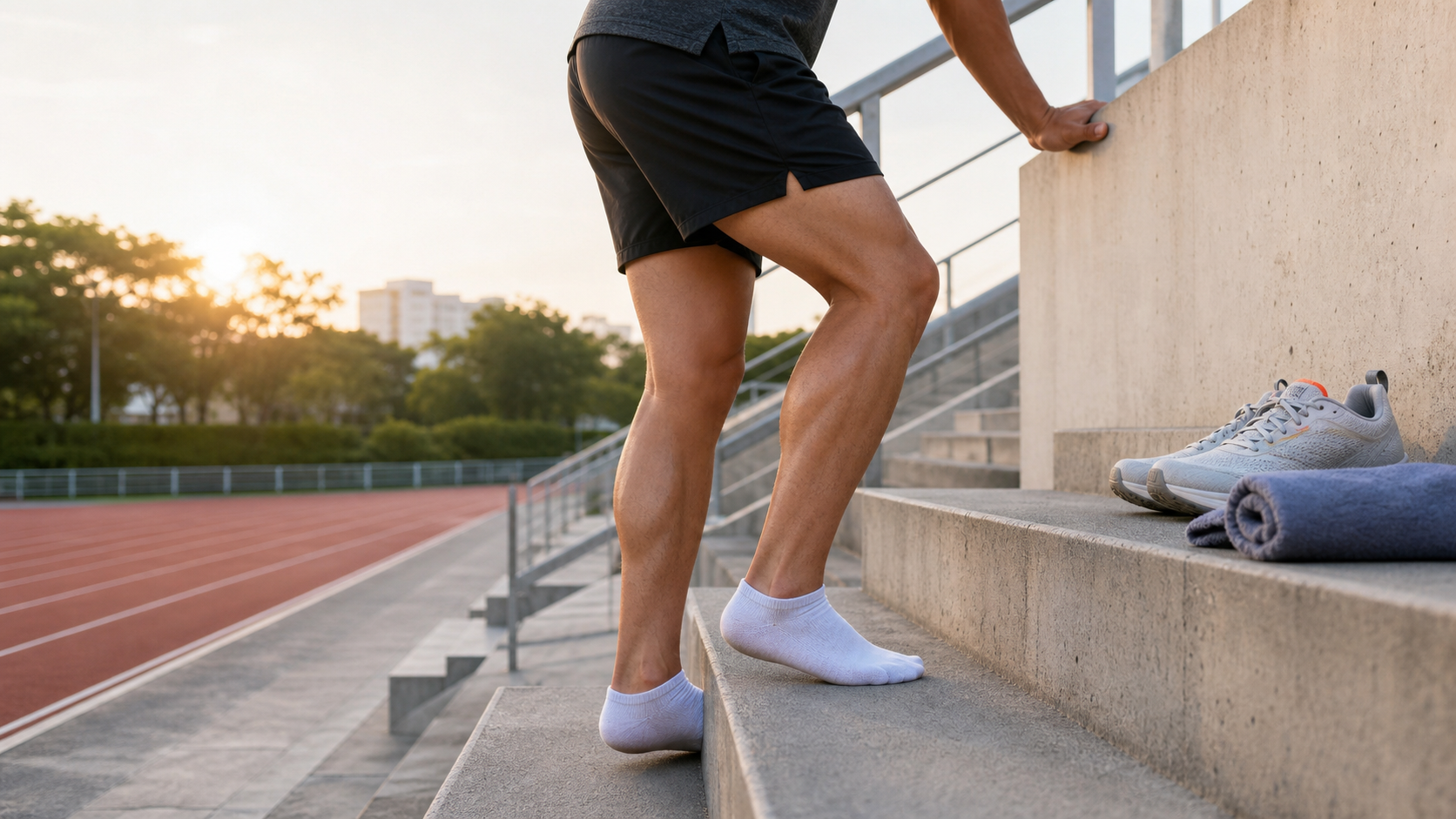
- Stand on the edge of a step, with the balls of both feet on the edge and heels hanging off.
- Use the healthy leg (or both legs) to rise up onto your toes as high as possible.
- Then, using only the affected leg, slowly (over about 3 seconds) lower the heel to its lowest point (below the step edge).
- Perform both the straight-knee version (targeting the gastrocnemius) and the bent-knee version (targeting the soleus), 3 sets × 15 repetitions each.
- Perform twice daily for 12 weeks.
Important: Continuing this training with mild pain (rated 4 or below on a 0–10 scale) is acceptable; if pain exceeds 5, you should stop.
The principle behind eccentric training is that controlled mechanical tension stimulates collagen reorganization and promotes tendon repair. Multiple clinical studies have shown significant improvement after 12 weeks.
Other Treatment Options
- Extracorporeal Shock Wave Therapy (ESWT): Highly effective for chronic tendinopathy; can be combined with eccentric training.
- PRP (Platelet-Rich Plasma) Injections: Ultrasound-guided injection into the degenerated area of the tendon to promote healing.
- Orthotic Heel Lifts: Elevating the heel by 6–12 mm can temporarily reduce tension on the Achilles tendon and alleviate acute pain.
- Avoid Direct Steroid Injections into the Tendon Body: These increase the risk of tendon rupture; injections should only be given around the tendon sheath.
Preventing Achilles Injuries
- Keep weekly mileage increases within 10%.
- Choose running shoes with an appropriate heel drop (8–12 mm); avoid transitioning to minimalist shoes too quickly.
- Perform static calf stretches after each training session (straight-knee and bent-knee, 30 seconds each).
- Incorporate regular heel-raise training to maintain the calf tendon’s load tolerance.
- Allow 24–48 hours of recovery after long runs on hard surfaces.
Practical Advice
- Early intervention is key: if you experience morning stiffness above the heel lasting more than 2 weeks, seek medical attention promptly rather than waiting until the pain becomes severe.
- Ice the Achilles tendon for 10–15 minutes after running to help suppress excessive inflammatory responses.
- Choose slippers with a slight heel when indoors to avoid keeping the Achilles tendon in a stretched position all day.
Conclusion
Achilles tendinitis is a “race between the runner and time”—the healing process is far slower than other soft tissues and requires months of sustained effort. By following an eccentric training protocol, avoiding the urge to return to running too quickly, and incorporating appropriate physical therapy, most runners can make a full recovery and end up with a stronger Achilles tendon than before the injury.
Related Reading
- Achilles Tendinitis in Runners: Causes, Diagnosis, and Progressive Rehabilitation
- Achilles Tendinitis: A Complete Management Guide for Cyclists and Runners
- Conservative Treatment of Achilles Tendinitis and Return-to-Running Criteria
- Calf and Ankle Strengthening for Runners: Preventing Achilles Problems
iPhone內建一秒變長腿🤣 車友必備#cycling
2 年前
一日北高/長距離團騎 常見問題補充篇 / 組團或跟團的眉角 / 壯車友容易被瘦車友慢性拉爆 / 原來屁股痛可能是這個原因...? / 風場配速法 / 公路車 / CT Yeh
2 年前
Never Stop 西進武嶺 前後雙機 完整全程錄影 訓練台 實境
8 年前
爬陡坡被爆胎的車友跑步超車 #cycling #里佳部落
9 個月前
CT 喇低賽) 武嶺牽車 才是王道 西進牽車四小時內秘訣 攝手位置 如何判斷 防抽筋小秘訣
7 年前
#公路車 #Fitting 靠人工智慧APP 幫你調整單車
6 年前
一日北高常見問題大集合 | 攻略 | 路線 | 訓練 | 補給 | 自行車 單車 | 一日雙城 | 雙塔 | TWB北高360 | 屁股痛
6 年前
摔車後補裝備: 好市多新款單車安全帽& Specialized Romin 北高整路屁股都不痛的坐墊 | 一千元居然有MIPS | CT Yeh | 公路車
4 年前