Introduction
Modern lifestyles have people sitting for over 8–10 hours a day, leaving the hip flexor group (especially the psoas major and iliopsoas) in a chronically shortened, tight state. For runners, tight hip flexors are not just a flexibility issue—they directly affect running gait, pelvic stability, and can even be the root cause of lower back pain, groin pain, and hip impingement. Understanding the anatomy and function of the hip flexors is essential for effective treatment.
Anatomy and Function of the Hip Flexor Group
The “hip flexor group” is not a single muscle; it mainly includes:
- Psoas Major: Originating from the lumbar spine (L1–L5) and inserting on the lesser trochanter of the femur, it is the primary hip flexor and deeply influences lumbar stability.
- Iliacus: Originating from the iliac fossa, it merges with the psoas major to form the “iliopsoas.”
- Rectus Femoris: One of the quadriceps muscles, it crosses both the hip and knee joints, acting as both a hip flexor and a knee extensor.
- Tensor Fasciae Latae (TFL): Assists with hip flexion and stabilizes the iliotibial band.
During the propulsion phase of running, the hip flexors swing the thigh forward; at the end of the stance phase, they must fully lengthen to allow the trailing leg to extend backward. If the hip flexors are tight, hip extension is limited, stride length shortens, and efficiency drops.
The Chain Reaction of Tight Hip Flexors
| Impact | Explanation |
|---|---|
| Anterior Pelvic Tilt (APT) | The psoas major pulls the lumbar spine forward, causing excessive lordosis and triggering lower back pain |
| Glute Inhibition | Tight hip flexors “switch off” activation of the opposing gluteus maximus, creating “lower crossed syndrome” |
| Shortened Stride | The trailing leg cannot fully extend backward, reducing propulsion and limiting pace |
| Groin Pain | Over-contraction of the psoas major causes discomfort in the inguinal region, often misdiagnosed as a strain |
| Knee Problems | A tight rectus femoris increases patellar pressure, aggravating runner’s knee symptoms |
Assessing Your Hip Flexor Flexibility: The Thomas Test
How to perform it:
- Lie on the edge of a bed with both legs hanging off the side.
- Pull one knee toward your chest with both hands (keeping the pelvis flat).
- Observe the other thigh: if the thigh hangs naturally and the knee can bend to 90 degrees, hip flexor flexibility is good.
- If the hanging thigh lifts up (fails to stay near horizontal), the psoas major/iliacus is tight; if the knee cannot bend to 90 degrees, the rectus femoris is tight.
Targeted Stretching Protocol
Stretching the Psoas Major and Iliopsoas:
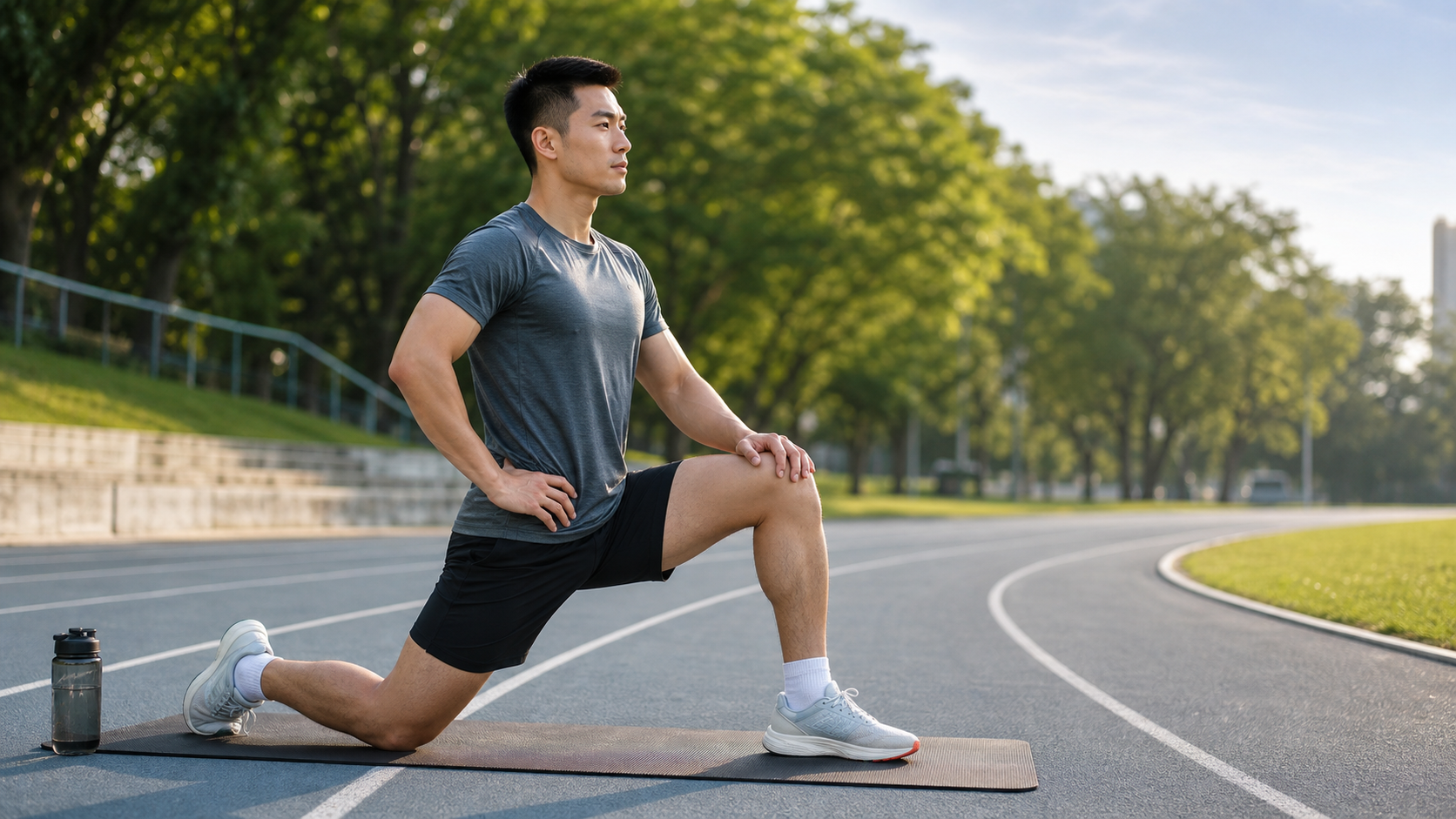
- Kneeling Hip Flexor Stretch: Kneel on one knee with the affected leg behind you, keeping your torso upright or leaning slightly back. Feel the stretch from the front of the groin into the lower back. Hold for 30–60 seconds, 3 sets daily.
- Advanced Version: From the kneeling lunge, lift the back foot (bringing the ankle toward the glutes) to simultaneously stretch the rectus femoris.
- Couch Stretch: Kneel facing a wall, with the back foot elevated against the wall (top of the foot against the wall), front foot planted in a lunge position. Hold for 60–90 seconds—this is one of the most effective deep psoas major stretches.
Stretching the Rectus Femoris:
- Standing, lift one foot and pull the ankle toward the glutes with your hand, keeping the knee pointing toward the ground (not backward). Hold for 30 seconds.
- Ensure the pelvis does not tilt forward (brace the core) so you truly stretch the rectus femoris rather than just compressing the lumbar spine.
Complementary Strengthening: Glute Training
While stretching the hip flexors, you must also strengthen the relatively weak glutes; otherwise, the anterior pelvic tilt issue will persist:
- Glute Bridge: Lie on your back with feet flat on the floor, drive the hips up with force, and hold at the top for 2 seconds. 15 reps × 3 sets.
- Single-Leg Glute Bridge: An advanced progression after mastering the basic bridge, providing better pelvic stability training.
- Hip Hinge / Romanian Deadlift: Strengthens the eccentric capacity of the gluteus maximus, improving the kinetic chain during the propulsion phase of running.
Practical Tips
- Get up and move for 5 minutes every hour of work to avoid keeping the hip flexors statically in a shortened position.
- Perform dynamic hip flexor warm-ups before running (walking lunges, high-knee marching in place) instead of static stretching.
- Do static kneeling lunge stretches immediately after running, when the tissues are warm for optimal effect.
Conclusion
Tight hip flexors are the “invisible runner’s killer”—they usually go unnoticed until the problem becomes severe. But with every step, they are stealing your efficiency and health. Spending 5–10 minutes a day on stretching and strengthening is the most cost-effective investment for a long-term running career.
Related Reading
- Runners with Tight Hip Flexors: Causes, Assessment, and Stretching Prescriptions
- The Impact of Tight Hip Flexors on Running Posture and Stretching Prescriptions
- Hip Flexor Training for Runners: The Key Muscle Group for Preventing Running Injuries
- Stretching and Strengthening Combinations for Overly Tight Hip Flexors: Unlocking the Invisible Shackles of Sedentary Runners
一日北高/長距離團騎 常見問題補充篇 / 組團或跟團的眉角 / 壯車友容易被瘦車友慢性拉爆 / 原來屁股痛可能是這個原因...? / 風場配速法 / 公路車 / CT Yeh
2 年前
一日北高常見問題大集合 | 攻略 | 路線 | 訓練 | 補給 | 自行車 單車 | 一日雙城 | 雙塔 | TWB北高360 | 屁股痛
6 年前
iPhone內建一秒變長腿🤣 車友必備#cycling
2 年前
Live) 備戰2019彰化經典百K 賽前攻略 (已完賽請看新影片
7 年前
西進武嶺 免費訓練分析服務 Intervals | 練不夠還是練過頭?你哪一種類型選手?AI模型告訴你! | 備戰神器 | 公路車 訓練 | CT Yeh
4 年前
實景訓練台) 彰化經典百K 高強度喵團 90分鐘 跟著一起練功 2019 Indoor workout Changhua Classic 100 Taiwan
7 年前
2019 柯P 超越北高 第一集團實錄 (11小時實錄請參考另一部影片) 一日雙城 一日北高 NeverStop Taiwan Long Distance Cycling Challenge
7 年前
CT 喇低賽) 武嶺牽車 才是王道 西進牽車四小時內秘訣 攝手位置 如何判斷 防抽筋小秘訣
7 年前