Introduction
In marathon finish-line photos, many runners’ expressions mix joy and pain—not just from muscle fatigue, but also from blisters on the soles or black toenails acting up. While these two issues aren’t serious injuries, they can turn every step into agony in the latter stages of a race, and in severe cases may even require medical attention. Understanding the causes and taking preventive measures is fundamental homework for enjoying the joy of running.
Black Toenails: Causes and Treatment
Why Do Toenails Turn Black?
Black toenail (Runner’s Toenail, medically known as Subungual Hematoma) is bleeding beneath the toenail, where accumulated blood forms a black-purple appearance. There are two main causes:
- Repeated toe impact against the shoe toe box: When running downhill, the foot slides forward, and the big toe (or second toe) continuously strikes the toe box, causing cumulative bleeding.
- Shoes too tight: Insufficient toe box space compresses the toenail, causing microvascular rupture in the nail bed.
Taiwanese runners typically have a second toe longer than the big toe (Morton’s toe type), making them more prone to black toenails on the second toe.
Treatment for Black Toenails
| Situation | Treatment |
|---|---|
| No pain, minimal hematoma | No treatment needed; wait for the nail to fall off naturally (usually 2–4 months) |
| Swelling and pain, significant hematoma | May visit an orthopedist or dermatologist for “drainage”: puncture a hole at the nail edge with a sterilized needle to release blood, providing immediate pressure relief |
| Nail completely detached | Keep clean and dry, apply antibacterial ointment, protect with non-adhesive dressing; a new nail grows back in about 6 months |
| Accompanied by signs of infection (redness, swelling, heat, pain, pus) | Seek medical attention immediately; antibiotics may be needed |
Preventing Black Toenails
- Leave enough room in the toe box: When choosing running shoes, there should be about one thumb’s width (approximately 1–1.5 cm) between the big toe (or longest toe) and the front of the shoe.
- Choose running shoes half to a full size larger than usual: Feet swell after long runs; it’s recommended to measure foot length in the afternoon or after running.
- Tighten the laces around the heel area: Prevents the foot from sliding forward inside the shoe (you can use the “Lock Lacing” method, creating a locking loop using the last eyelet of the shoe).
- Trim toenails: Keep toenails shorter than the tip of the toe, but don’t cut them too short to avoid ingrown toenails.
Blisters: Causes and Treatment
How Blisters Form
Blisters result from the epidermal layer of the skin separating due to friction or pressure, with tissue fluid accumulating in the separated space. When running, the foot’s micro-movements inside the shoe, repeated thousands of times, are sufficient to cause friction blisters.
Common locations: back of the heel, outer side of the little toe, inner side of the big toe, and the forefoot area of the sole.
Common triggers:
- Ill-fitting shoes (too large or too narrow).
- Moist environments: After sweating or encountering rain, the skin softens, increasing frictional resistance.
- Cotton socks: They remain wet after absorbing moisture, increasing friction; switch to wool or synthetic fiber performance running socks instead.
- New running shoes not yet broken in: It’s recommended to run at least 50–100 km in new shoes before a race.
Treating Blisters
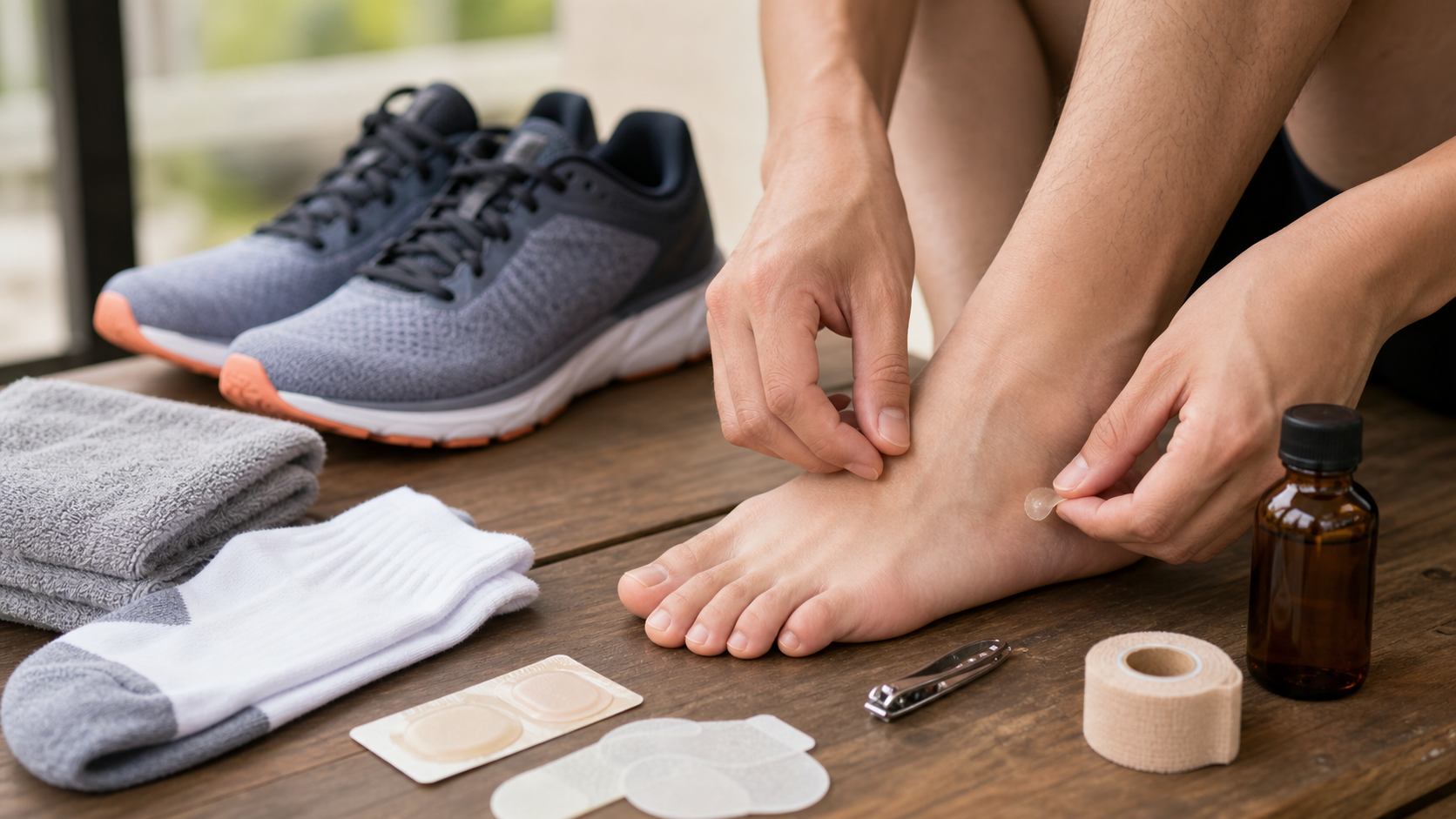
- Small blisters (diameter < 1 cm), painless: Clean the area, apply a blister plaster (such as Compeed), keep it intact, and allow the fluid to be absorbed naturally.
- Large blisters or those hindering walking: Disinfect a needle with alcohol, puncture and drain at the edge of the blister (do not remove the top skin; keep it as a natural barrier), and apply a sterile dressing.
- Already ruptured blisters: Clean the wound, apply a thin layer of antibacterial ointment, cover with a dressing, and avoid contamination and infection.
Key Points for Preventing Blisters
- Performance running socks: Choose running-specific socks made of wool (Merino Wool) or nylon blends; double-layer socks are also effective at reducing foot friction.
- Vaseline or lubricants: Apply Vaseline to high-friction areas (heel, between toes, forefoot) to significantly reduce friction.
- Preventive taping: Before long-distance races, apply kinesiology tape or blister plasters to known blister hot spots.
- Well-fitting running shoes: This is the fundamental solution; it’s recommended to have a gait analysis and fitting at a professional running shoe store.
Emergency Treatment During a Race
What to do if a blister appears mid-marathon?
- Use the needles and band-aids from the first-aid kits at aid stations.
- If the race is less than halfway done and the pain is severe, it’s better to drop out than to push through the entire race injured, to avoid compensatory movement patterns leading to other injuries.
Practical Advice
- When purchasing running shoes, be sure to try them on while wearing the running socks you’ll wear during the race.
- “Runner’s toe” doesn’t equal “runner’s glory”—prevention is smarter than toughing it out.
- Toenail infections (paronychia) are common in Taiwan’s humid summer environment; pay special attention to hygiene while a black toenail is shedding.
Conclusion
Black toenails and blisters are preventable “minor annoyances.” The key lies in choosing the right gear, breaking in your shoes, and taking good care of your feet. A well-fitting pair of running shoes plus a good pair of running socks can often solve most problems, allowing you to focus on enjoying the joy of running itself.
Related Reading
- The Complete Guide to Runner’s Black Toenails: Causes, Treatment, and Prevention
- Preventing Black Toenails in Road Running: Shoe Selection and Lacing Techniques
- The Complete Runner’s Blister Prevention and Treatment Manual: A Practical Guide from Prevention to Care
- Managing Foot Blisters and Friction Injuries in Trail Running: From Prevention to Emergency Bleeding Control
洗完單車整隻手黑的解決妙招🤣 #bike
1 年前
Never Stop 西進武嶺 前後雙機 完整全程錄影 訓練台 實境
8 年前
碟煞公路車 銑面器 !? 原來銑完差這麼多! 降低蹭碟機率! | TIME 公路車 保養小記錄 | CT Yeh
3 年前
CT 喇低賽) 單車 比賽總是沒照片? 攝影師的觀點大公開 姿勢就是力量! 請加速1.25倍收看
7 年前
單車 一日北高 ( 雙城 ) 肥宅雙人瘋狂行 紀錄片 REACTO
10 年前
下次拍照前要查清楚啦🤣 #cycling
7 個月前
一日北高/長距離團騎 常見問題補充篇 / 組團或跟團的眉角 / 壯車友容易被瘦車友慢性拉爆 / 原來屁股痛可能是這個原因...? / 風場配速法 / 公路車 / CT Yeh
2 年前
FTL 與 SYB 車隊專訪 西進武嶺 實用攻略分享! 2小時 如何練?!你不知道的眉角!新手準備武嶺必看 EP1 | 實力派女車友 | 精華版 | 公路車 | CTYeh
4 年前