Introduction
After crossing the finish line, many people immediately bend over to catch their breath, sit down to rest, or head straight home for a shower. This behavior of “stopping suddenly” is actually not safe from a physiological standpoint, nor is it conducive to recovery. During running, the heart pumps a large volume of blood to the leg muscles every minute; when you stop abruptly, the blood vessels in the lower limbs remain dilated. Without slow walking to help “squeeze” venous blood back to the heart, blood may temporarily pool in the legs, leading to insufficient venous return, which can cause dizziness or even fainting.
A proper cool-down is the final crucial component of a running workout and requires 10–15 minutes of deliberate effort.
Three Major Physiological Functions of Cool-Down
1. Maintains Venous Return, Prevents Blood Pooling
During running, the contraction of leg muscles acts like a “pump,” pushing venous blood upward back to the heart. When you stop running suddenly, this pump function disappears, but the dilation of blood vessels in the lower limbs has not yet recovered. Blood temporarily pools in the legs, cardiac output drops sharply, and blood flow to the brain becomes insufficient, which may cause dizziness. Walking lightly for 5–10 minutes keeps muscle contractions going to maintain venous return, allowing the cardiovascular system to decelerate smoothly.
2. Accelerates Clearance of Metabolic Waste
After intense running, a large amount of metabolic waste (such as lactic acid and hydrogen ions) accumulates in the muscles. A slow cool-down walk maintains local blood flow, speeding up the removal of waste, which helps reduce delayed onset muscle soreness (DOMS) the next day.
3. Creates the Optimal Window for Static Stretching
Muscle temperature is at its highest after running, making this the best time for static stretching. Tissue extensibility is at its peak, providing a golden window for improving flexibility. Research shows that stretching while muscles are warm immediately after a run is far more effective than stretching the next day.
Complete Cool-Down Protocol (10–15 Minutes)
Step 1: Slow Walking (5 Minutes)
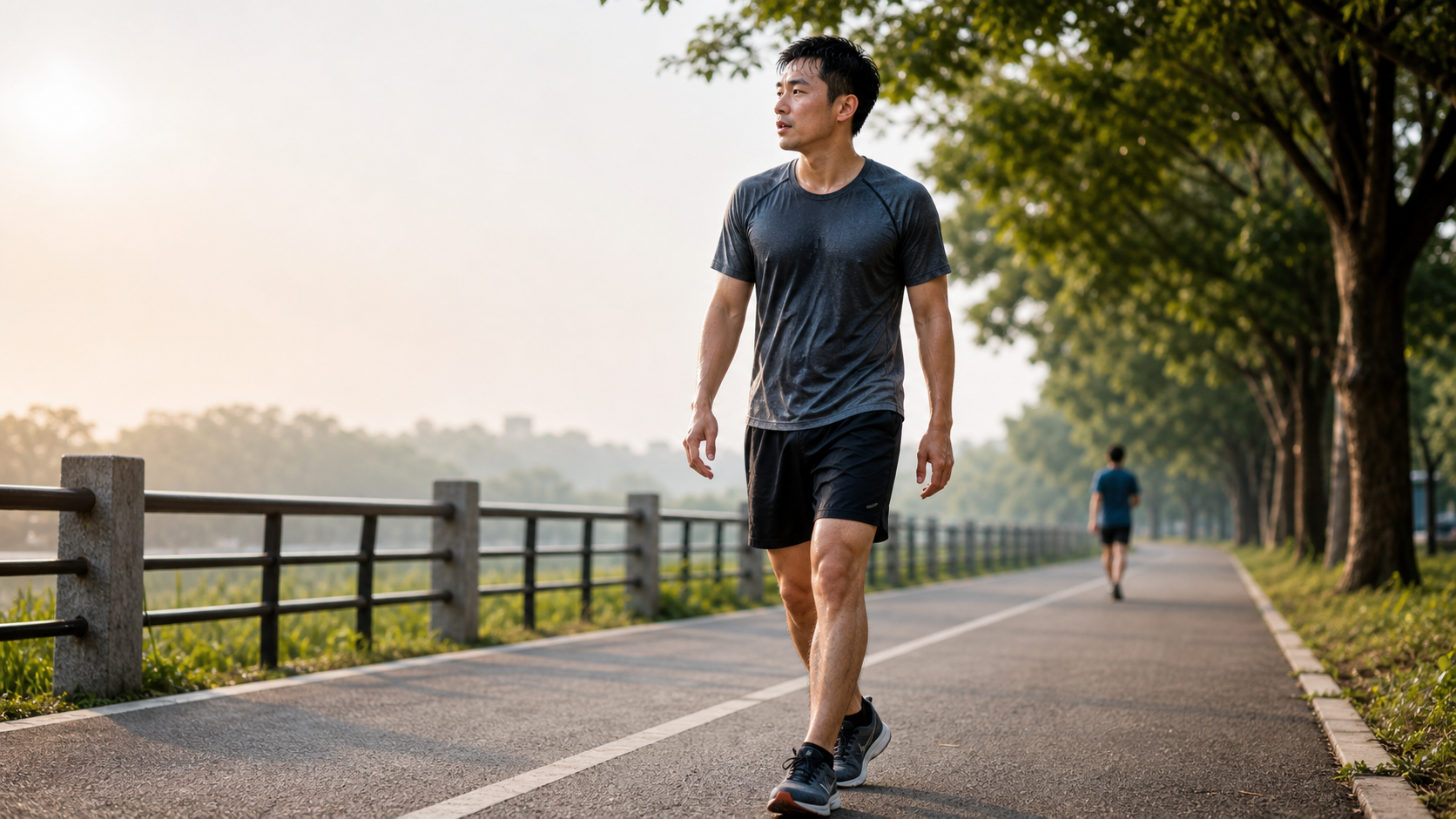
Transition to walking immediately after finishing your run, gradually slowing your pace to allow your heart rate to drop from the training range of 130–170 bpm to below 100 bpm. Notice your breathing gradually steadying and sweating decreasing. If you have a watch, monitor your heart rate and move to the next step once it drops below 100 bpm.
Step 2: Static Stretching (8–10 Minutes)
Hold each of the following key muscle group stretches for 30–60 seconds, performing 2 sets per side:
| Muscle Group | Stretch |
|---|---|
| Hamstrings | Standing or seated hamstring stretch (flex toes, lean forward) |
| Quadriceps | Standing, pull ankle toward glutes while keeping torso upright |
| Iliotibial (IT) band | Standing with legs crossed, lean torso to the side |
| Calves (gastrocnemius) | Facing a wall in a lunge position, back heel flat on the ground |
| Calves (soleus) | Same as above but with the back knee slightly bent |
| Hip flexors | Low lunge stretch, both knees at approximately 90 degrees |
| Glutes | Supine, pull knee toward chest |
Step 3: Replenish Fluids and Carbohydrates (Within 30 Minutes Post-Run)
The 30 minutes following a run are the “golden window” for muscles to replenish glycogen. Recommended intake:
- Carbohydrates: 0.5–1 gram per kilogram of body weight.
- Protein: 20–30 grams (high-quality sources such as eggs, soy milk, or whey).
- Fluids: Replace sweat lost during training (body weight difference before and after the run × 1.5, calculated in milliliters).
Special Case: Cool-Down After a Race
After a marathon or half marathon, extend the cool-down walk to 10–15 minutes, and keep static stretching intensity mild (when muscles are in a state of microtrauma, overly aggressive stretching may worsen damage). In the 24–48 hours following the race, light recovery walking or stationary cycling can promote blood circulation and accelerate repair.
Practical Tips
- Factor cool-down walking time into your overall running plan. For a 60-minute workout, add 10 minutes of warm-up + 10 minutes of cool-down, totaling 80 minutes.
- If the weather is hot (Taiwan summer), move to a shaded area for the cool-down walk to avoid prolonged sun exposure, which can cause body temperature to rise excessively.
- After long runs (over 25 km), consider a cold water bath or ice bath (15–20°C water temperature, 10 minutes) to speed up swelling reduction.
Conclusion
Cool-down is not an optional “nice-to-have” addition—it is an essential part of the complete training loop. Treat it as a final tribute to the day’s workout, allowing your body to end each run with dignity and preparing yourself in optimal condition for the next session.
Related Reading
- Cool-Down and Stretching After Running: A Complete 15-Minute Routine
- Cooling Down After Speed Work: A Recovery Protocol of Static Stretching and 10 Minutes of Jogging
- Post-Run Static Stretching SOP: Stretch the Right Areas, at the Right Time, for It to Work
- Active Recovery After Running: Comparing 10 Minutes of Jogging vs. Complete Rest
西進武嶺 免費訓練分析服務 Intervals | 練不夠還是練過頭?你哪一種類型選手?AI模型告訴你! | 備戰神器 | 公路車 訓練 | CT Yeh
4 年前
摔車後補裝備: 好市多新款單車安全帽& Specialized Romin 北高整路屁股都不痛的坐墊 | 一千元居然有MIPS | CT Yeh | 公路車
4 年前
CT暗黑廚房) 車友必備 宇宙無敵鮮蚵湯 幫助訓練恢復 天然食補 好市多 超肥鮮蚵 破PR
7 年前
2018 田中馬拉松 全程健跑 VR 360 環景錄影 體驗現場狂野加油氣氛! Insta 360
7 年前
水金九不厭五分 10度寒流冷到不願停!feat. 卡卡 / 公路車 / CT Yeh
6 個月前
西進武嶺 自製新版AI配速表產生器 x 賽前攻略 抱佛腳! 沒有功率計也可以產生配速表嗎?有什麼其他眉角賽前要注意的呢? | 西進武嶺 / 東進武嶺 KOM 攻略 | 公路車 | CT Yeh
4 年前
[教學] Premiere 影片 手震 修正 教學 防抖 單眼 影像 GoPro 穩定 Video Stabilization
8 年前
#公路車 #Fitting 靠人工智慧APP 幫你調整單車
6 年前