Heart Rate Strap vs Optical Heart Rate Watch: Accuracy Comparison and Sport-Specific Recommendations
Introduction
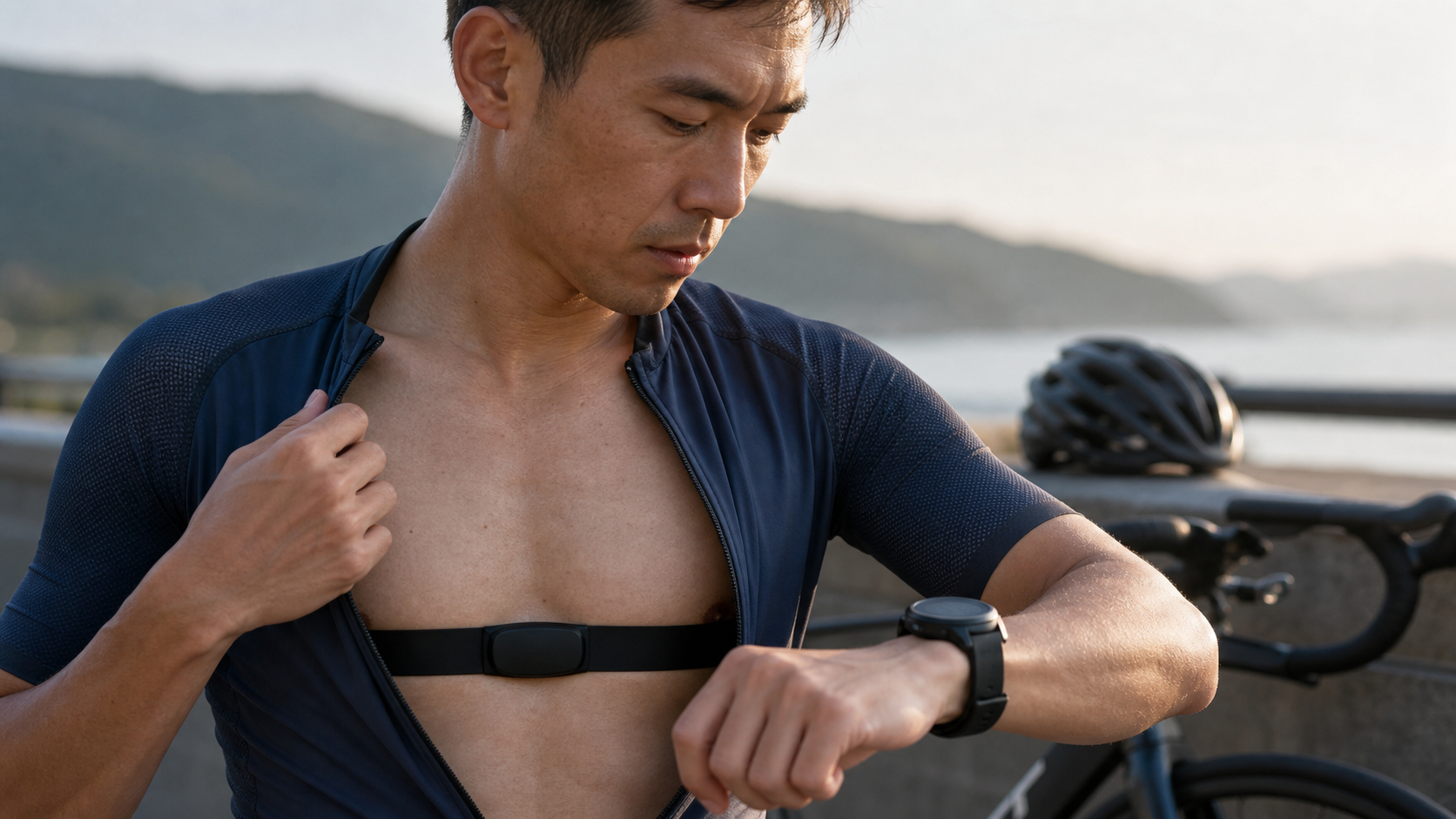
Heart rate is the most direct physiological indicator for assessing exercise intensity, and it’s especially important for cycling training. Modern heart rate monitoring devices fall into two main categories: traditional chest straps (ECG electrode sensing) and optical heart rate sensors (PPG) built into watches or armbands. The two differ considerably in accuracy, convenience, and suitable use cases.
How the Sensing Works
Chest Strap (Electrode-based ECG Sensing)
A chest strap uses electrodes pressed against the skin to directly detect the heart’s electrical signals (the same principle as an electrocardiogram). Each heartbeat’s electrical signal reaches the electrodes and is converted into an HR value. This is the same physical principle used in a hospital’s 12-lead ECG, so accuracy is extremely high.
Optical Heart Rate (PPG — Photoplethysmography)
An optical sensor shines LED light onto the skin and detects changes in blood flow within the blood vessels to estimate heartbeats. When the heart contracts, blood flow increases and the amount of reflected light changes accordingly; an algorithm then derives the HR from this signal. Smartwatches, fitness bands, and some wrist-worn devices all use this principle.
Accuracy Comparison
| Scenario | Chest Strap Accuracy | Optical HR Accuracy |
|---|---|---|
| Steady-state aerobic (60–75% max HR) | ★★★★★ | ★★★★☆ |
| High-intensity intervals (rapid changes) | ★★★★★ | ★★★☆☆ |
| Cycling (stable arm position) | ★★★★★ | ★★★★☆ |
| Swimming | ★★★★☆ (waterproof models) | ★★★☆☆ |
| Running (large arm swing) | ★★★★★ | ★★★☆☆ |
| Winter / cold-weather riding | ★★★★☆ | ★★☆☆☆ (poor peripheral circulation) |
The Key Gap: High-Intensity Interval Training
During high-intensity intervals (e.g., 5×5 minutes at FTP intensity), heart rate rises and falls rapidly in a short time. A chest strap reflects this change in real time (about a 1–2 second lag), but the smoothing effect of optical heart rate algorithms can make the displayed value lag behind the actual heart rate by 10–30 seconds, significantly reducing its value as a training reference.
Device Recommendations by Category
Top Chest Strap Picks:
- Garmin HRM-Pro Plus (approx. NT$4,500): Can store running dynamics data; offers the most complete feature set within the Garmin ecosystem
- Polar H10 (approx. NT$3,500): Widely regarded as the most accurate consumer-grade chest strap, with excellent cross-platform compatibility
- Wahoo TICKR X (approx. NT$2,800): Compatible across multiple platforms, with comprehensive training analysis features
Optical Heart Rate Devices (Wrist-worn):
- Garmin Fenix 7 (approx. NT$17,000–25,000): The most complete multi-sport training watch, with industry-leading optical HR accuracy
- Apple Watch Ultra 2 (approx. NT$28,000): The best choice for balancing everyday life and sports use
- Polar Vantage M2 (approx. NT$9,000): Designed specifically for training, with outstanding optical HR accuracy
Armband Optical Heart Rate (A Middle-Ground Choice):
- Polar Verity Sense (approx. NT$3,000): Optical HR worn on the upper arm, more accurate than wrist-worn devices; can be used standalone or paired with a bike computer
- Garmin HRM-Fit (approx. NT$3,800): A clip-on design worn on a sports bra, more comfortable than a chest strap while offering accuracy close to it
Recommendations for Taiwanese Cyclists
Pure Road Cycling Training
A chest strap heart rate monitor is the best choice, paired with a Garmin or Wahoo bike computer. Since the upper arm stays relatively stable while cycling, optical heart rate accuracy is acceptable, but the chest strap’s real-time responsiveness still has a clear advantage during interval training.
Balancing Daily Life and Cycling
A smartwatch (Garmin Fenix / Forerunner series) paired with a chest strap is the most practical combination. Use the watch day-to-day to monitor recovery status and sleep quality, and switch to the chest strap during high-intensity training to ensure accuracy.
Multi-Sport Athletes (Cycling + Swimming + Running)
The Polar H10 (waterproof, and can be paired with a waterproof watch while swimming) is the best single investment that covers multiple sports.
Practical Tips
- Make sure the chest strap fits snugly against the skin: The electrodes need to be moistened (with water or saliva) to make contact with the skin for stable detection
- Cleaning the chest strap is a habit worth building: Rinse it after every ride to extend electrode lifespan (replacement electrodes cost around NT$500–800)
- Optical heart rate accuracy drops in winter: When peripheral circulation is poor, switch to a chest strap to ensure data quality
- Don’t make in-ride decisions based on watching real-time optical HR alone: HRV and recovery assessment are where optical heart rate delivers its most valuable insights
Conclusion
Chest straps have an inherent physical advantage in accuracy, making them an essential tool for serious athletes. However, optical heart rate watches offer continuous monitoring value for everyday data (HRV, resting heart rate trends, sleep recovery) that a chest strap simply cannot replace. The ideal setup uses both together — wear the chest strap during training and the smartwatch throughout daily life — so that training data and life recovery data form a complete feedback loop. That is the foundation of scientific cycling training.
Related Reading
2022 前十五大自行車錶 !? 兩萬名車友大數據統計 | 你的上榜了嗎? | 菁英車友都用哪些錶? | Bryton Garmin 誰能拔得頭籌?| 車錶推薦 | 公路車 CT Yeh
4 年前
2026 車錶排行榜!誰是最多車友正在使用?練家子最愛哪款?🏆 (2萬名車友數據) / 公路車 / CT Yeh
5 個月前
Garmin Edge 1050 旗艦車錶 全台首測!/ 環法冠軍指定 / 對比Edge 1040改進哪些? / 公路車 / CT Yeh
2 年前
西進武嶺 免費訓練分析服務 Intervals | 練不夠還是練過頭?你哪一種類型選手?AI模型告訴你! | 備戰神器 | 公路車 訓練 | CT Yeh
4 年前
2025 自行車錶排行榜 兩萬車友大數據 / Garmin Bryton 排名會大洗牌嗎? / 全新的碼表前身分析 /公路車 / CT Yeh
1 年前
2024公路車車錶排行榜!2萬車友調查統計!今年黑馬是.../街頭車友民調/CT Yeh
2 年前
首發 Garmin Edge 850 車錶 深入開箱!? / 公路車 / CT Yeh
10 個月前
2023 自行車錶排名 大數據 23,000位車友用什麼錶? Garmin Edge 對決 Bryton Rider 誰市佔高? 你用的上榜了嗎? | 公路車 | CT Yeh
3 年前