Mountain Route from Guguan to Lishan in Taichung: A Cycling Journey on the Central Cross-Island Highway
Introduction
The Central Cross-Island Highway, carved out in 1960, was Taiwan’s first road to traverse the Central Mountain Range, and the difficulty of its construction left an indelible mark on the history of road building in Taiwan. The Taichung section runs from Guguan to Lishan, approximately 60 kilometers in total. The towering cliffs of the Dajia River Gorge, the azure surface of Deji Reservoir, and the apple and pear orchards of the Lishan highlands combine to create a cycling route that offers both geological grandeur and agricultural beauty.
Route Overview
| Section | Distance | Elevation Gain | Average Gradient | Difficulty | Highlights |
|---|---|---|---|---|---|
| Guguan → Dajian (Provincial Highway 8 entrance) | Approx. 10 km | Approx. 200 m | Approx. 2% | Easy | Dajia River Valley, Guguan Hot Springs |
| Dajian → Deji Reservoir | Approx. 25 km | Approx. 800 m | Approx. 3.2% | Moderate | Canyon terrain, the dam |
| Deji Reservoir → Tianlun | Approx. 10 km | Approx. 400 m | Approx. 4% | Moderately hard | Panoramic reservoir views, cliffside road |
| Tianlun → Lishan | Approx. 15 km | Approx. 500 m | Approx. 3.3% | Moderate | Apple and pear orchards |
| Full Route | Approx. 60 km | Approx. 1900 m | Approx. 3.2% | Moderately hard |
Guguan: Starting Base and Hot Spring Resupply
Guguan is a renowned hot spring resort within Taichung City. Here, the Dajia River has carved out a spectacular canyon landscape, with hot spring hotels lining the riverbank and drawing large crowds of bathers on weekends. For cyclists, Guguan is the last town-scale resupply point before entering the Central Cross-Island Highway route, with convenience stores, restaurants, and bike supply stops in the town center.
It is recommended to set off before 6:00 a.m. The full Guguan-to-Lishan route takes 7 to 10 hours, so an early start ensures you can descend or reach your accommodation in Lishan before dark.
Dajia River Gorge Section: A Miracle of Highway Engineering
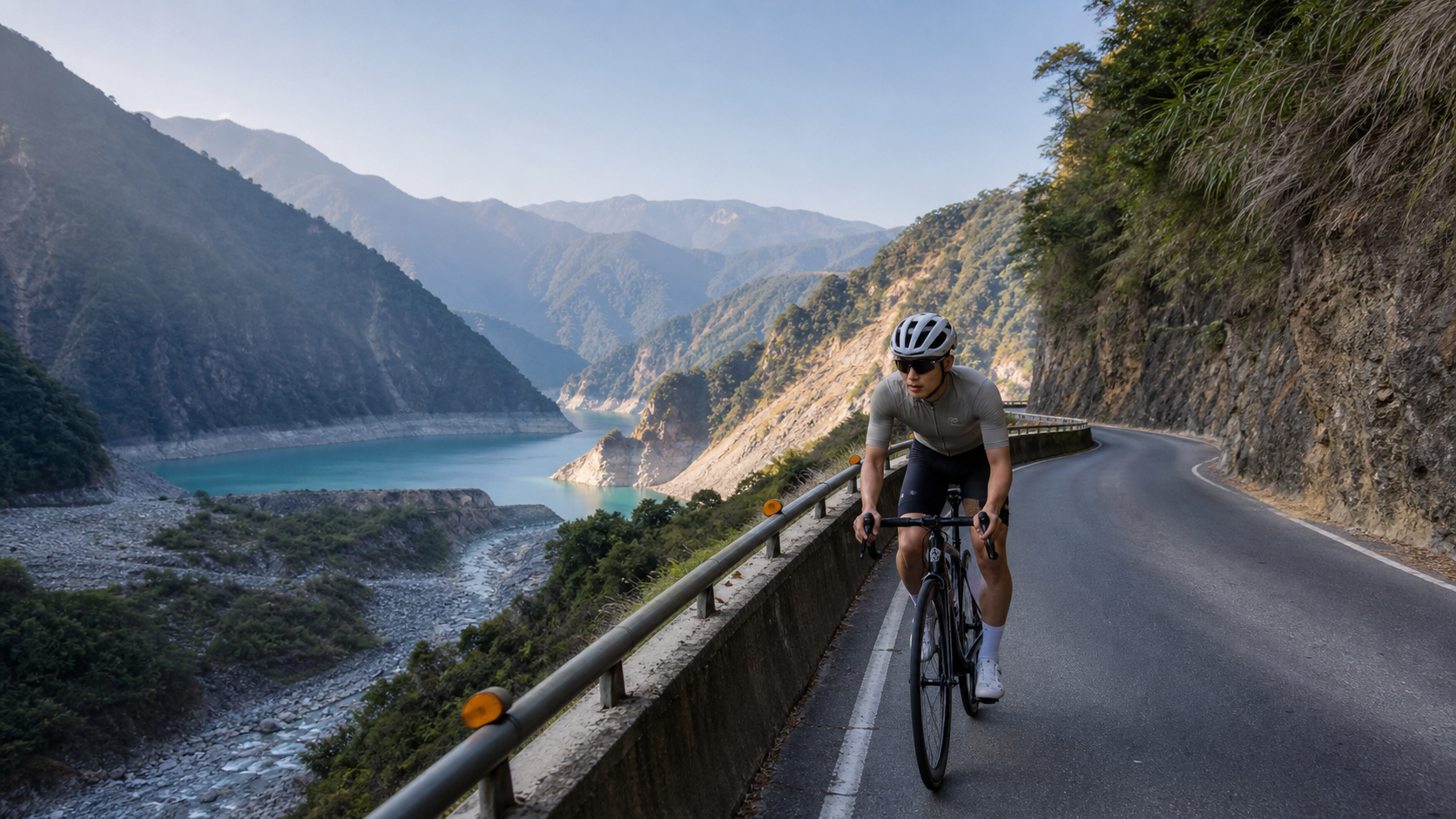
Starting from Guguan, Provincial Highway 8 cuts into the canyon along the left bank of the Dajia River. The road hugs the cliffside, with the rushing river far below on one side and near-vertical rock walls on the other. Some sections are hewn directly out of the rock, where occasional seepage forms small waterfalls cascading onto the pavement—one of the most awe-inspiring terrain sections in Taiwan’s road landscape.
The gradient in the canyon section is relatively gentle, but the road surface can be uneven due to repairs from rockfalls. It is advisable to maintain a moderate pace and stay alert to road conditions at all times.
Deji Reservoir: The Spectacular Reflection of a Highland Sapphire
Completed in 1974, Deji Reservoir is Taiwan’s tallest arch dam (180 meters high), with a storage capacity second only to Shihmen and Zengwen Reservoirs. The water takes on a unique blue-green hue due to the mineral composition of the rocks, and combined with the reflections of the mountain walls on both sides, the scenery is dreamlike. The dam’s observation deck features interpretive signs explaining the reservoir’s power generation and water supply functions.
The gradient increases noticeably near the reservoir, leading into a series of continuous hairpin turns that require a steady pedaling rhythm. If your energy begins to flag at this stage, it is advisable to stop at the rest area beside the reservoir management office to refuel, as there are still about 25 kilometers remaining.
Lishan: A Bountiful Harvest of Highland Fruit
Arriving in Lishan means the climbing is nearly over. The town of Lishan sits at an elevation of approximately 2,000 meters, with summer temperatures 10 to 15 degrees Celsius lower than in Taichung. It is a renowned high-mountain agricultural area, with apples, pears, and peaches as its main crops. The roadside fruit stalls are the first stop for countless cyclists upon reaching Lishan—freshly picked highland persimmons or chilled peach juice are the sweetest reward after crossing the mountains.
The Lishan Guesthouse is a local landmark. President Chiang Kai-shek stayed here on multiple occasions to escape the summer heat, and it still offers accommodation today. You can arrange to stay overnight and descend the following day.
Practical Advice
Safety Notes
- Certain sections of the Taichung portion of the Central Cross-Island Highway carry a higher risk of rockfalls. After rain, pause your ride and confirm the road is safe before setting off.
- The highway is often temporarily closed after typhoons. Be sure to check the latest road conditions from the Directorate General of Highways before departing.
Resupply Strategy
- Stock up fully in Guguan (resupply points are scarce further along).
- Deji Reservoir management office has vending machines (may be sold out on weekends).
- Lishan town center offers abundant resupply options, including fruit stalls and convenience stores.
Descent Options
- Return the same way (Provincial Highway 8 back to Guguan): approximately 2.5–3 hours.
- Head toward Yilan (Provincial Highway 7A): from Lishan via Wuling Farm and Siyuan Pass down to Yilan, with completely different scenery, requiring an extra day.
Conclusion
The Central Cross-Island journey from Guguan to Lishan is a ride that fills one with respect for Taiwan’s highway engineering. Those roads carved into the cliffs are not just the work of engineers, but mountain paths won by countless predecessors with sweat and even their lives. Every pedal stroke is a quiet tribute to that history.
Related Reading
- The Lishan Section of the Central Cross-Island Highway: An Epic of the Cross-Island Road from Guguan to Dayuling
- Central Cross-Island Highway (Provincial Highway 8) Cycling Challenge: A Complete Guide from Lishan to Taroko
- Central Cross-Island Highway Cycling Tour: The Magnificent Crossing from Taroko to Lishan
- Taichung Dajia River Basin Routes: A Complete Guide to Valley Cycling on Natural Scenic Roads
爬坡ITT實境)台中 魔王 松鼠坡 首航 6:12 大肚山 大三元 科福路
8 年前
一定要騎一次!阿里山最深處:里佳部落!單車旅行 | 2800m爬升 | 深度部落體驗:嗨翻晚會、螢火蟲、銀河 | feat. JJSC & 廢物伙伴 | 公路車 CT Yeh
10 個月前
藤枝二集團 單車行 Day1 | 南部小武嶺 | 爬坡爬到罵罵叫 | JJSC | 公路車 | CT Yeh
3 年前
嘉義大埔、阿婆灣挑戰賽,美到以為在日本!ft. 環騎5 Cool 西拉雅188 / 公路車 / CT Yeh
7 個月前
台中大雪山 膏王領騎 震到都沒畫面了 公路車
5 年前
阿里山塔塔加 兩倍特濃版!全新隧道開通! 進喔!公路車 | CT Yeh
3 年前
太平山單車員工旅遊 | 這樣玩CP值最高!| 公路車
5 年前
#北橫 + #北進武嶺 最硬的員工旅遊 EP1 | #公路車 #拉拉山 | 明池 | 武嶺 | 武陵農場 | 雲海 | Taiwan Cycling Route Wulin
6 年前