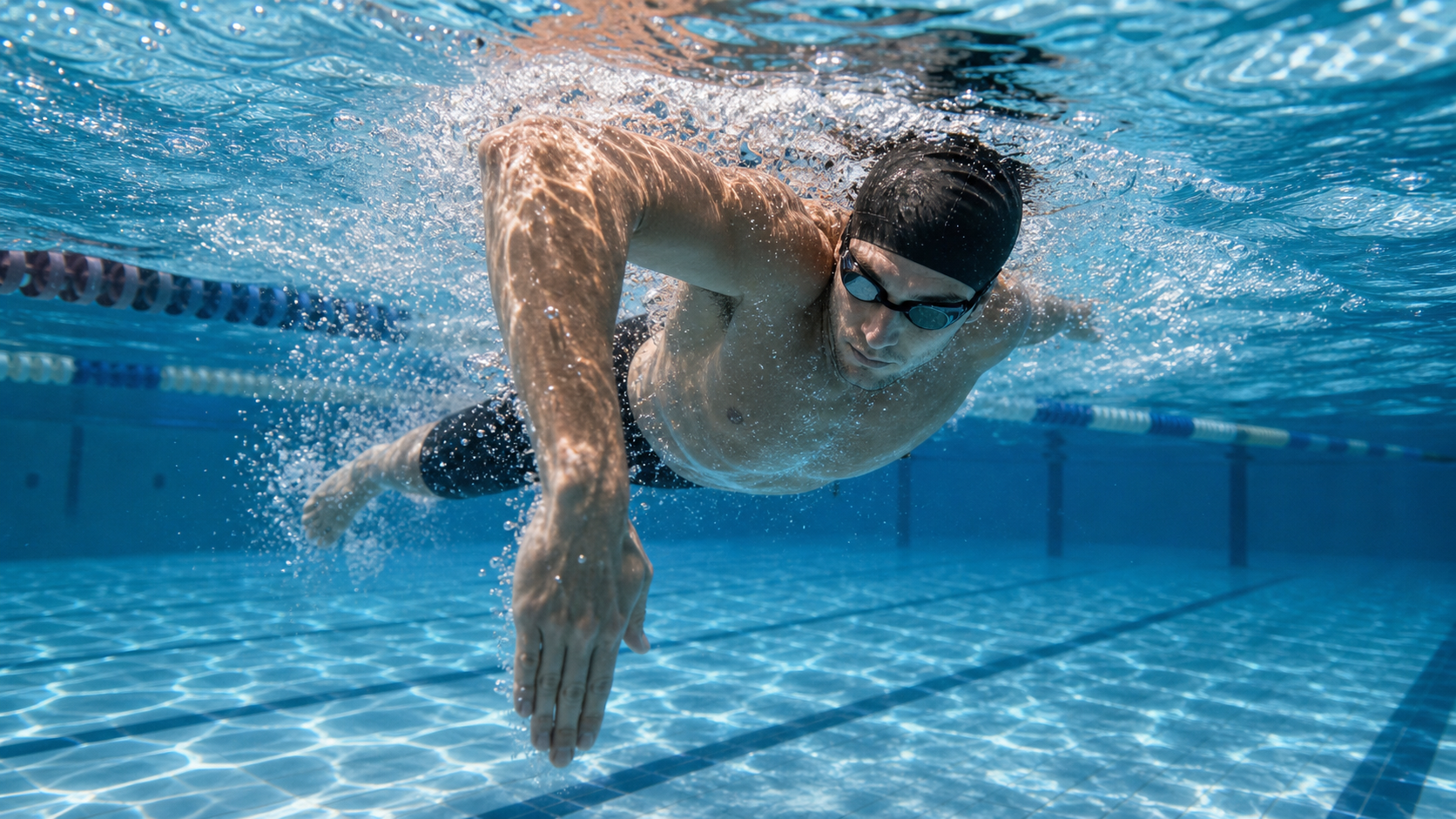
Introduction
If you’ve received systematic swim training, older-generation coaches may have told you: “You need to draw an S shape when pulling!” This theory holds that the arm tracing an S-shaped curve underwater can continuously find “still water,” making it more efficient than a straight pull. However, starting in the 1990s, the sports science community began fundamentally questioning this theory, and biomechanical research over the past two decades has provided an even clearer answer.
This article will organize the evolution of pull-path history, break down the problems with the S-shaped pull theory, and explain how modern swim training views the most efficient pull curve.
The Origins and Prevalence of the S-Shaped Pull Theory
The S-shaped pull theory was primarily proposed by American swimming researcher James Counsilman in the 1970s. Through underwater filming of elite swimmers, he observed that the “absolute path” of top swimmers’ hands in the water (relative to the pool bottom) did indeed trace an S-like trajectory, and he accordingly proposed the theory of “continuously seeking still water through curved pulling.”
This theory quickly became mainstream in swim instruction, influencing an entire generation of training methods. However, the problem lay in a misunderstanding of the observation perspective.
The Confusion Between Relative Path and Absolute Path
Later researchers pointed out that the S-shaped trajectory Counsilman observed was the hand’s absolute path relative to the pool bottom (a fixed coordinate system), not the hand’s path relative to the swimmer’s body.
| Observation Perspective | Hand Path | Significance |
|---|---|---|
| Relative to pool bottom (absolute path) | Appears S-shaped | Visual effect caused by body rotation + forward speed |
| Relative to body (relative path) | Nearly straight | The actual pulling motion trajectory |
When the body continuously moves forward while simultaneously rolling sideways, even if the arm pulls in a relatively straight line, the trajectory projected onto a stationary coordinate system will naturally appear curved. This is like a baseball pitcher’s pitch: the wrist’s motion relative to the pitcher’s arm is straight, but the ball traces a curve relative to the ground.
The Consensus of Modern Research: High-Elbow Straight Pull
Contemporary biomechanical research (including follow-up studies by scholars such as Cecil Colwin and Ernie Maglischo) generally agrees that the most efficient pulling method is the High Elbow Pull combined with a relatively straight path:
- Catch Phase: After the hand enters the water and extends forward, the elbow bends ahead of the hand (Early Vertical Forearm, or EVF), establishing the maximum pulling surface area.
- Pull Phase: Maintaining a high elbow, the forearm and palm push water straight backward, with a path nearly straight relative to the body.
- Finish Phase: The push is completed beside the hip, with the palm facing backward and upward as it exits the water.
Emphasizing an S-shaped path may cause the following problems:
- Deliberate outward and inward sculling motions waste time and energy
- Disrupts maintaining a high elbow, reducing the pulling surface area
- Increases rotational stress on the shoulder, raising the risk of injury
Core Points of the High-Elbow Pull
Modern freestyle pulling technique emphasizes the following key points:
- Early Vertical Forearm (EVF): After the hand enters the water, get the forearm vertical as quickly as possible, rather than bending the elbow first. This requires good shoulder joint flexibility and active engagement of the latissimus dorsi.
- Elbow Always Higher Than the Hand: Throughout the entire pull, the elbow should remain above the hand, creating the maximum surface area to “grab the water.”
- Core-Driven Rotation Assists the Pull: The pulling motion is not purely arm strength; torso rotation engaging the latissimus dorsi is the primary power source.
Practical Advice
- Paddle Training (Paddles): Wearing paddles forces the palm to stay vertical, helping build muscle memory for the high-elbow pull. However, note that paddles are not suitable for prolonged heavy use, as this may overstress the shoulders.
- Catch-up Drill: With both hands extended forward, pull with one hand until it reaches the other hand before switching, focusing on quickly establishing the high-elbow position at the start of each pull.
- Slow-Motion Simulation: Stand in waist-deep water and simulate the pulling motion at low speed, feeling how the forearm pushes “against a wall” straight backward rather than “tracing a curve.”
- Video Feedback: Side-view underwater filming most clearly reveals elbow height, confirming that the elbow remains higher than the hand throughout the pull.
Conclusion
The S-shaped pull theory is a valuable lesson in the history of swimming science: our perspective on observing movement can profoundly shape how we define “correct technique.” The consensus of modern research points to the high-elbow straight pull, but this does not mean the arm can have no lateral adjustment at all—rather, deliberately pursuing an S-shaped path is unnecessary and counterproductive. Focusing your effort on building EVF and core-driven rotation is the true direction for efficiency gains.
Related Reading
- Freestyle Catch Technique: Is the S-Shaped Pull Really Outdated?
- Backstroke Pull Path: Modern Technique for S-Shaped Pulls and Straight-Arm Pulls
- Freestyle Pull Technique: Modern Perspectives on High-Elbow Entry and S-Shaped Arm Pulls
- Freestyle Drag Thinking: Why Your Progress Should Start with “Reducing Drag” Rather Than Relentlessly Training Arm Strength
CT 喇低賽) 武嶺牽車 才是王道 西進牽車四小時內秘訣 攝手位置 如何判斷 防抽筋小秘訣
7 年前
一個測試有沒有認真練車的方法😂 #公路車
10 個月前
live) 超越北高 之一日北高12小時 策略
7 年前
一日北高/長距離團騎 常見問題補充篇 / 組團或跟團的眉角 / 壯車友容易被瘦車友慢性拉爆 / 原來屁股痛可能是這個原因...? / 風場配速法 / 公路車 / CT Yeh
2 年前
西進武嶺 免費訓練分析服務 Intervals | 練不夠還是練過頭?你哪一種類型選手?AI模型告訴你! | 備戰神器 | 公路車 訓練 | CT Yeh
4 年前
JJSC一槍北港 百K團實錄!跟團技巧分享 ft. Roden / 中部練車新選擇 / 開箱全台最便宜早餐店!/ 公路車 / CT Yeh
1 年前
風櫃嘴 | 全台最多大砲的單車路線 | 尋寶網攝影師告訴你怎麼擺拍起來才好看 | 熱門攝影地點巡禮
6 年前
2025 彰化經典百K 多視角VLOG / 今年摔好多 / 全新LIVE系統測試 / 公路車 / CT Yeh
1 年前