Introduction
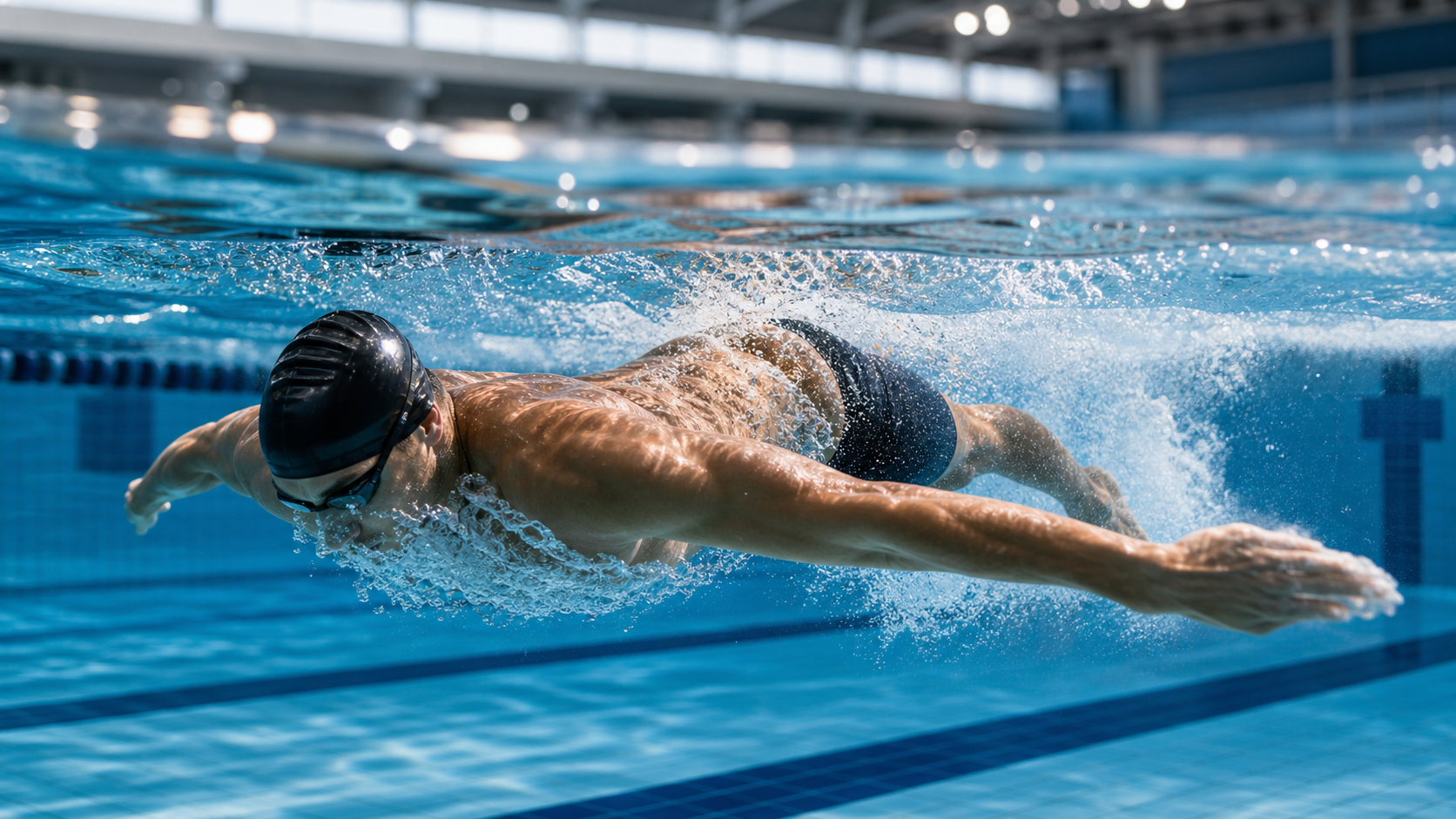
The butterfly is widely regarded as the most physically demanding and hardest to master of the four competitive strokes. Many swimmers can complete the stroke, yet their movements often look stiff and awkward, usually because of insufficient coordination in the undulation. The butterfly’s undulation is not random twisting, but a precise sequence of “chest press-down → hips lift → kick → chest lift-up.” If the timing of this sequence is off by even a fraction of a second, the entire motion loses its fluidity and propulsion.
This article will systematically break down each component of the butterfly undulation and provide targeted training methods.
The Mechanics of Undulation
Butterfly propulsion comes from two main sources: the arm pull and the dolphin kick. The role of undulation is to coordinate these two power sources so they complement rather than interfere with each other.
A full butterfly arm cycle includes two kicks:
- First kick (entry kick): As the hands enter the water and extend forward, the first kick is completed simultaneously. At this point, the body transitions from a chest press-down to a hip lift. The downward kick provides forward momentum and helps the hands “glide” into the catch position.
- Second kick (exit kick): As the hands finish the push phase beside the hips and prepare to exit the water, the second kick is completed simultaneously. This kick is usually stronger than the first and serves as the primary propulsive kick.
| Stroke Phase | Chest Position | Hip Position | Kick |
|---|---|---|---|
| Hands enter and extend | Pressing down | Lifting up | First kick (downward) |
| High-elbow catch | Gradually rising | Beginning to sink | Kick recovery |
| Pull and push | Rising to highest point | Sinking | Second kick (downward, primary) |
| Hands exit and recover | Beginning to press down | Lifting up | Preparing for first kick |
Common Coordination Errors
Error 1: Mismatched kick timing
The most common problem is the kick falling out of sync with the arm movements. An entry kick that comes too late (kicking only after the pull has already started) causes the body to generate two waves in different phases, canceling each other’s energy.
Error 2: Excessive undulation amplitude
An A-shaped wave (excessive up-and-down bobbing) may look like you are “swimming hard,” but it wastes a great deal of energy on vertical movement that contributes nothing to horizontal progress. Elite butterfly swimmers actually maintain a fairly compact undulation amplitude.
Error 3: Bending only at the waist
The undulation should originate from the thoracic spine and travel downward through the hips and legs, rather than being just a “worm-like wriggle” from the waist. Excessive waist bending causes core power to leak away and can easily lead to lower back pain.
Drills for Breaking It Down
Dolphin kick drill
Practice only the leg kick, with arms extended forward or held at the sides, focusing on feeling the wave transmission initiated from the chest. You can submerge with goggles to observe your body line underwater, or have a coach observe from above the surface.
Slow-motion butterfly
Deliberately slow down to half your normal pace, pausing for 1 second after each breathing cycle to feel the synchronization between the hand entry and the first kick.
Single-arm butterfly
Pull with one arm while the other extends forward, reducing coordination difficulty and allowing you to focus on the timing between one side’s arm and the kick.
Practical Tips
- Land-based undulation simulation: Lie prone on the floor or a yoga mat with arms extended forward, and practice transmitting the wave from the chest down to the hips. Build the movement memory before getting in the water.
- Fins as an aid: When first learning undulation coordination, using short fins (a monofin or bifins) helps you feel the propulsion generated by the kick, accelerating the development of proper coordination.
- Shorten each practice distance: Butterfly coordination training is best done in 25-meter increments, with full rest after each repeat to avoid form breakdown from fatigue.
- Video feedback: Underwater side-view filming is the most effective way to verify your undulation, paying particular attention to whether the vertical positions of the chest and hips match the expected timing.
Conclusion
Learning the butterfly undulation is a process of “feel first, technique follows.” Many swimmers try to “calculate” the timing in their heads, yet overlook that true coordination must be internalized through repeated practice. Accept the initial lack of fluidity, build the connected movement step by step through drills, and you will eventually discover that the butterfly can actually be the most efficient and fluid of the four strokes.
Related Reading
- Butterfly Undulation: Hip-Driven and Arm-Synchronized Coordination Training
- Butterfly Dolphin Kick and Body Undulation Coordination Training
- The Science of Butterfly Undulation: Hip Drive and Rhythm Coordination Training Guide
- Butterfly Wave Rhythm: Synchronizing Body Rise-and-Fall Tempo with Breathing Timing
風櫃嘴 衝刺慢動作回放!
8 年前
西進武嶺 自製新版AI配速表產生器 x 賽前攻略 抱佛腳! 沒有功率計也可以產生配速表嗎?有什麼其他眉角賽前要注意的呢? | 西進武嶺 / 東進武嶺 KOM 攻略 | 公路車 | CT Yeh
4 年前
[教學] Premiere 影片 手震 修正 教學 防抖 單眼 影像 GoPro 穩定 Video Stabilization
8 年前
西進武嶺 免費訓練分析服務 Intervals | 練不夠還是練過頭?你哪一種類型選手?AI模型告訴你! | 備戰神器 | 公路車 訓練 | CT Yeh
4 年前
教學) 如何做出專業 慢動作 影片 Slow Motion 120fps GoPro 7 ActionCam AX700 A99II
7 年前
CT 喇低賽) 武嶺牽車 才是王道 西進牽車四小時內秘訣 攝手位置 如何判斷 防抽筋小秘訣
7 年前
單車 梅山36灣 坡度介紹 路段介紹 空拍 (相關遊記影片,請參考說明或我的頻道喔,歡迎訂閱)
6 年前
[教學] Dashware 教學 如何製作有 速度 功率 心律的 騎車影片 Guages Video
8 年前