Introduction
If you ask a top swimmer, “What makes good swimming technique?”, they will likely say: “It’s about feeling the water.” This so-called “Feel for Water” or “catch feel” is one of the most frequently mentioned concepts in swim training, yet also one of the hardest to quantify and teach.
Feel is neither pure muscular strength nor just the repetition of technical movements—it is an integration of proprioception and fluid-dynamics awareness, allowing the swimmer to perceive in real time the direction and magnitude of the force their hands apply to the water, and to make adjustments within milliseconds.
This article attempts to break down the essence of feel from a scientific perspective, and how to cultivate this ability through specific training.
The Physiological Basis of Feel
Feel involves the coordination of two sensory systems:
Proprioception: Mechanoreceptors in the joints and muscles continuously report information about arm position, muscle tension, and joint angles to the brain. Swimmers use these signals to perceive the real-time state of their arms in the water.
Tactile Pressure Sense: The skin of the palm is densely packed with pressure receptors that sense the pressure distribution of water across different areas of the hand. This pressure distribution tells the swimmer whether the current “catch surface area” and push direction are correct.
Research shows that swim training can enhance the sensitivity of these sensory systems, making swimmers more attuned to subtle pressure differences. This explains why swimmers with years of experience can “feel” a 0.5 cm deviation in hand entry point, while beginners are completely unaware.
The Mechanical Definition of the “Catch”
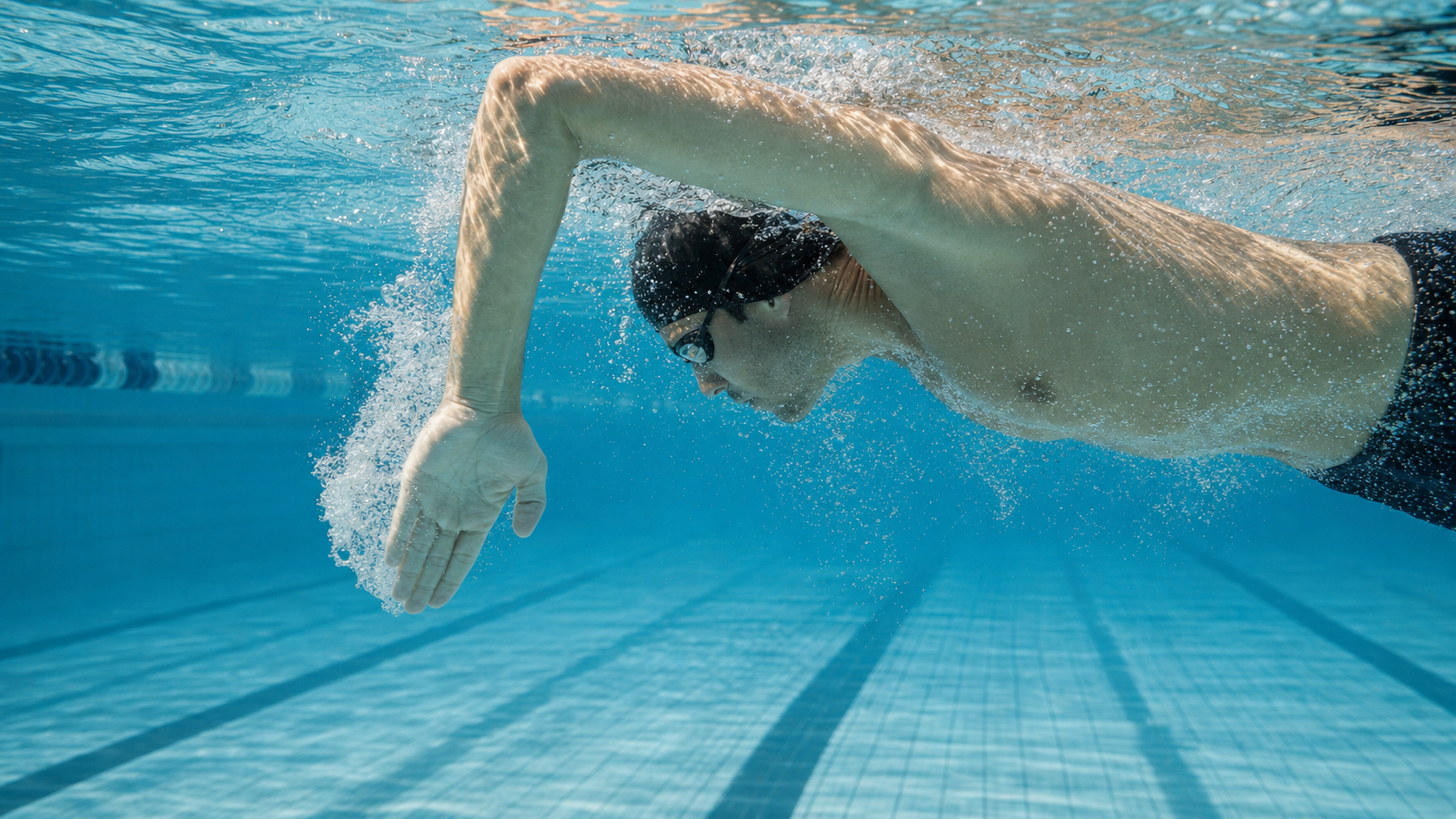
From a fluid-dynamics perspective, the “catch” refers to the moment at the start of the pull when the hand and forearm form a relatively stationary “paddle surface.” Using this paddle as a fulcrum, the body moves forward rather than the hand moving backward.
An ideal catch:
- After the hand enters and extends forward, the elbow rises quickly (EVF, Early Vertical Forearm)
- The forearm points vertically downward, with the palm facing backward
- You feel the palm “pressing” the water, with pressure evenly distributed across the entire palm
- Using this “fixed point” as a fulcrum, the core drives the body forward
Faulty catch sensations:
| Fault Description | Mechanical Issue | Correction Direction |
|---|---|---|
| The palm feels like it “slides through” the water | Elbow too low, incorrect forearm angle | Practice EVF, raise the elbow |
| Only the fingertips feel pressure | Palm angle is tilted | Adjust entry angle, palm facing backward |
| The arm accelerates faster and faster without feeling the water | Pull accelerates too early, losing the catch | Slow first half, fast second half |
Training Methods to Develop Feel
Method 1: Fist Drill
Swimming with clenched fists removes direct palm sensation, forcing the swimmer to rely more on forearm pressure perception. Immediately switching back to normal swimming after the fist drill usually produces a noticeably enhanced “catch” sensation in the palm.
Method 2: Spread Finger Drill
Spread the fingers as wide as possible to increase water flow between the fingers, training the ability to perceive subtle pressure differences. Some studies show that slightly spread fingers (about 3–5 mm) are more efficient for propulsion than fully closed palms.
Method 3: Catch-up with Pause
During each catch, pause for 1 second when the elbow reaches its highest point, feeling the pressure distribution on the forearm and palm. Confirm that you have “caught” the water before starting the pull.
Method 4: Closed-Eye Swimming
Remove visual distractions and focus entirely on palm pressure perception. Practice short distances in a familiar environment (near a lane line or wall).
Practical Tips
- Reserve 5 minutes of “perception warm-up” before each swim session: swim slowly, close your eyes, and feel the water pressure on your palms—not chasing speed, only building the sensory connection.
- Keep a training log noting your feel status: “strong/weak catch feel today,” tracking the correlation between feel and sleep, fatigue, and water temperature.
- Do not force feel-technique practice when fatigued; fatigue reduces proprioceptive sensitivity and can reinforce faulty movement patterns.
Conclusion
Feel is not a gift—it is a trainable skill. It requires a great deal of deliberate practice—not mechanical repetition, but every stroke performed with awareness, sensing the relationship between the palm and the water. As this perceptual ability gradually strengthens, swimmers will find their stroke efficiency improves dramatically, allowing them to swim faster and more economically at the same effort. Only by catching the water can you truly “pull” through it.
Related Reading
[教學] Premiere 影片 手震 修正 教學 防抖 單眼 影像 GoPro 穩定 Video Stabilization
8 年前
CT 喇低賽) 武嶺牽車 才是王道 西進牽車四小時內秘訣 攝手位置 如何判斷 防抽筋小秘訣
7 年前
#PUSHBIKE 原來這麼好玩! 小朋友 滑步車 初體驗 超可愛
6 年前
#公路車 #Vo2Max #最大攝氧量 測驗 體驗 | 心肺測試
6 年前
多機位拍片神器 DJI Action 2 拍出速度張力感 | 類空拍機視角 4陣列麥克風超強降風噪 實測! | 公路車 | CT Yeh
3 年前
CT 喇低賽) 單車 比賽總是沒照片? 攝影師的觀點大公開 姿勢就是力量! 請加速1.25倍收看
7 年前
類空拍神器 Feiyu Pocket 2s (有優惠連結)三軸穩定 運動攝影機 開箱!比GoPro 還強的滑順視角!三小時長時間錄影 行車記錄器 | 環花東365實測 | 公路車 CT Yeh
4 年前
Insta 360 One 超級防手震技術實測
7 年前