Introduction
Swimming training aids/tools are an important part of modern swimming training. From the most basic kickboard and pull buoy to advanced paddles, drag shorts, and parachute drags, each aid has its specific training purpose.
However, using more aids is not necessarily better. Incorrect use of training aids can not only significantly diminish training effectiveness but may also reinforce faulty movement patterns and even lead to sports injuries in areas such as the shoulders and knees. This article will focus on the two most common categories of aids—paddles and drag shorts—and explain their correct usage and common mistakes.
Paddles
Function and Purpose
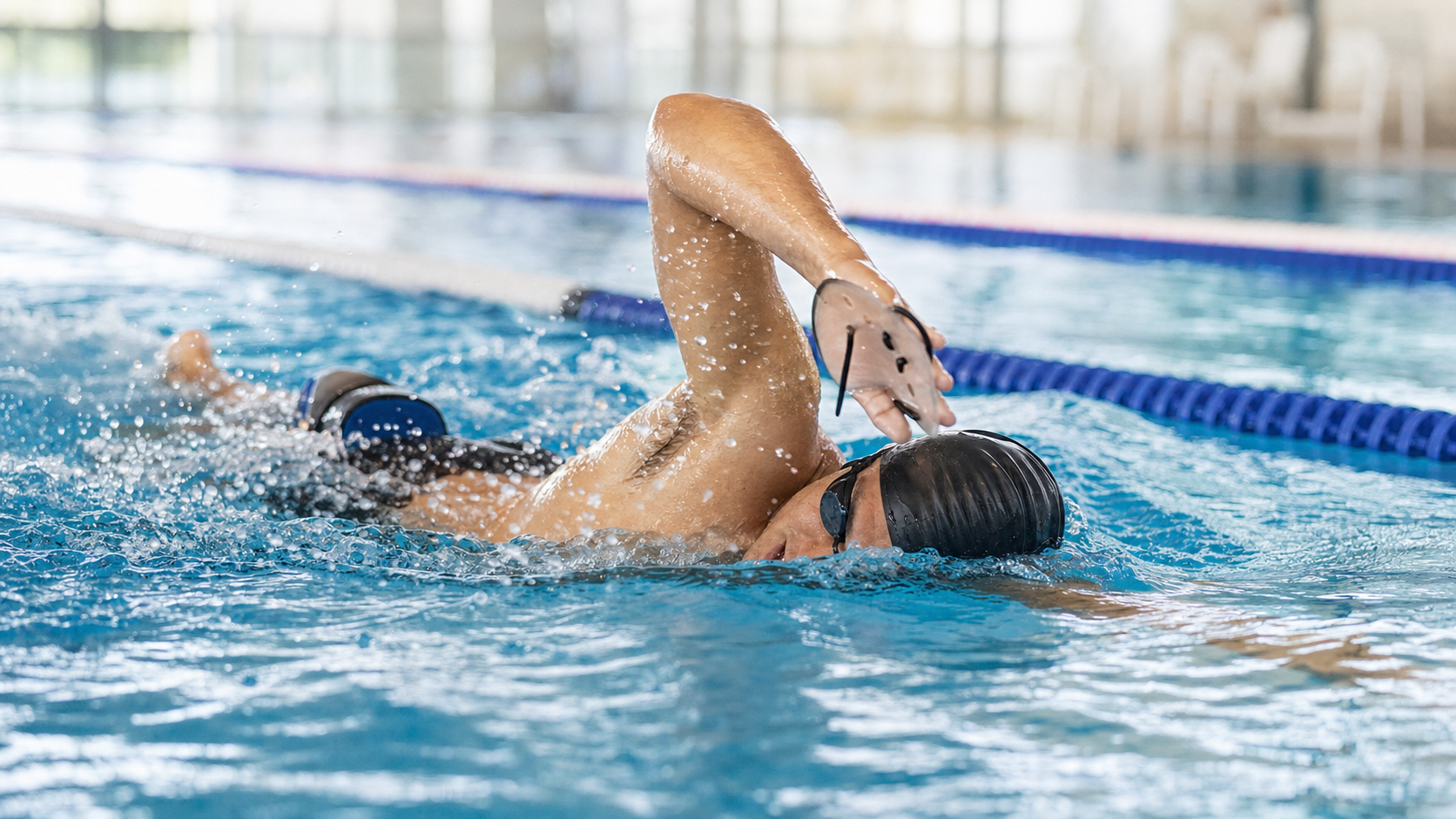
Paddles are rigid, paddle-shaped aids worn on the palms that increase the surface area of the hand and forearm. Their main training effects include:
- Enhanced feel for the water: The larger contact area makes it easier for swimmers to perceive the distribution of pressure during the pull.
- Strengthened pulling muscles: Greater resistance provides a stronger training stimulus to the latissimus dorsi and pectoralis major.
- Enforced high-elbow position: With well-designed paddles (especially finger-loop models), if the elbow drops, the paddle will literally “slip off,” forcing the swimmer to maintain a high-elbow position.
Correct Usage
| Item | Recommendation | Explanation |
|---|---|---|
| Size selection | Slightly larger than the palm | Oversized paddles mask technical flaws rather than correct them |
| Timing of use | Technique sets or power sets | Not recommended for prolonged use during aerobic endurance sets |
| Pairing with a pull buoy | Recommended | Eliminates kick interference, allowing focus on upper-body technique |
| Volume per session | No more than 30% of total training volume | Excessive use increases the risk of shoulder injury |
Common Mistakes
Mistake 1: Bigger is better
Many swimmers choose paddles far larger than their palms, believing that greater resistance means greater training effect. In reality, oversized paddles allow swimmers to “pull water” even with a dropped elbow and poor catch position, thereby masking technical problems.
Mistake 2: Wearing them for long aerobic sessions
Paddles significantly increase the load on the shoulders with every stroke. Wearing them for extended aerobic training (e.g., swimming 3,000 meters with paddles the entire time) is one of the leading causes of shoulder impingement injuries.
Mistake 3: Using them before technique is stable
Paddles amplify existing technical issues (both correct and incorrect ones). Therefore, it is recommended to introduce paddle training only after basic technique (high-elbow catch, correct hand entry point) has achieved a certain level of stability.
Drag Shorts
Function and Purpose
Drag shorts are loose-fitting shorts worn over swimwear that create additional water resistance while swimming. Their main training effects include:
- Aerobic endurance training: More output is required at the same speed, improving aerobic capacity.
- Power training: Simulates the feeling of “riding into a headwind,” building the strength needed to overcome resistance.
- Speed perception contrast: After removing the drag shorts at the end of a session, swimmers experience a noticeable sense of speed, which helps build speed awareness.
Correct Usage
- Suitable users: Swimmers with relatively stable technique. For those with unstable technique, the reduced speed caused by drag shorts may increase tension and worsen body position.
- Training distance: Focus on moderate-distance sets (100–400 meters); avoid extremely long distances to prevent breakdown in form.
- Pace setting: A 10–20% reduction in speed while wearing drag shorts is normal; do not force the original pace at the expense of technique.
- Contrast training after removal: One of the greatest benefits of drag shorts training is the “sensory contrast” after taking them off. It is recommended to swim a set immediately after removal to feel the change in speed perception.
Other Training Aids Overview
- Kickboard: Trains kicking technique while isolating upper-body interference; suitable for all levels.
- Pull Buoy: Keeps the legs afloat and stationary, isolating the kick to focus on upper-body pulling technique.
- Parachute Drag: Provides greater resistance than drag shorts, mainly used for sprint power training; less suitable for everyday use by recreational swimmers.
Practical Recommendations
- Establish a “training aid usage plan”: Before each session, decide the primary goal (technique improvement, power, or aerobic), then choose the corresponding aid to avoid random usage.
- After using paddles, observe whether there is any shoulder discomfort (soreness or tightness). This is a warning sign that you should reduce usage or pause entirely.
- When first using drag shorts, start with short sets of 200–400 meters to confirm that your technique does not break down under increased resistance, then gradually increase usage.
Conclusion
Swimming training aids are tools, not magic. Used correctly, they can accelerate technical progress and physical development; used incorrectly, they can lead you further down the wrong path and even cause injury. Understanding the design purpose of each aid and selecting the appropriate one based on your technical level and training goals is the key to maximizing the benefit of every session.
Related Reading
- The Complete Guide to Resistance Tools in Swimming Training: Application Strategies for Paddles, Drag Parachutes, and Resistance Cords
- In-Water Resistance Training: Transferring Swimming Aids to Land-Based Functional Training
- The Complete Guide to Swimming Aids: How to Choose Buoyancy Shorts, Paddles, and Fins?
- Kickboards and Paddles Serve Different Training Purposes: How to Use Training Aids Correctly
3D 列印車褲墊 / 舒適改善? / 無痕 x 分區壓縮 / ATK & Decider系列 / JE22黑科技 / #公路車 #CTYEH
11 個月前
[教學] Premiere 影片 手震 修正 教學 防抖 單眼 影像 GoPro 穩定 Video Stabilization
8 年前
西進武嶺 免費訓練分析服務 Intervals | 練不夠還是練過頭?你哪一種類型選手?AI模型告訴你! | 備戰神器 | 公路車 訓練 | CT Yeh
4 年前
訓練台體驗) 2019台北自行車展 三大家 訓練台體驗 Tacx Neo Flux 2 Xepdo Apx Wahoo Kickr
7 年前
CT 喇低賽) 武嶺牽車 才是王道 西進牽車四小時內秘訣 攝手位置 如何判斷 防抽筋小秘訣
7 年前
碟煞公路車 銑面器 !? 原來銑完差這麼多! 降低蹭碟機率! | TIME 公路車 保養小記錄 | CT Yeh
3 年前
#公路車 #Fitting 靠人工智慧APP 幫你調整單車
6 年前
洗單車神器 吹水機! 實際洗車用用看 暴力洗鍊條大法 | 公路車 | CT Yeh
4 年前