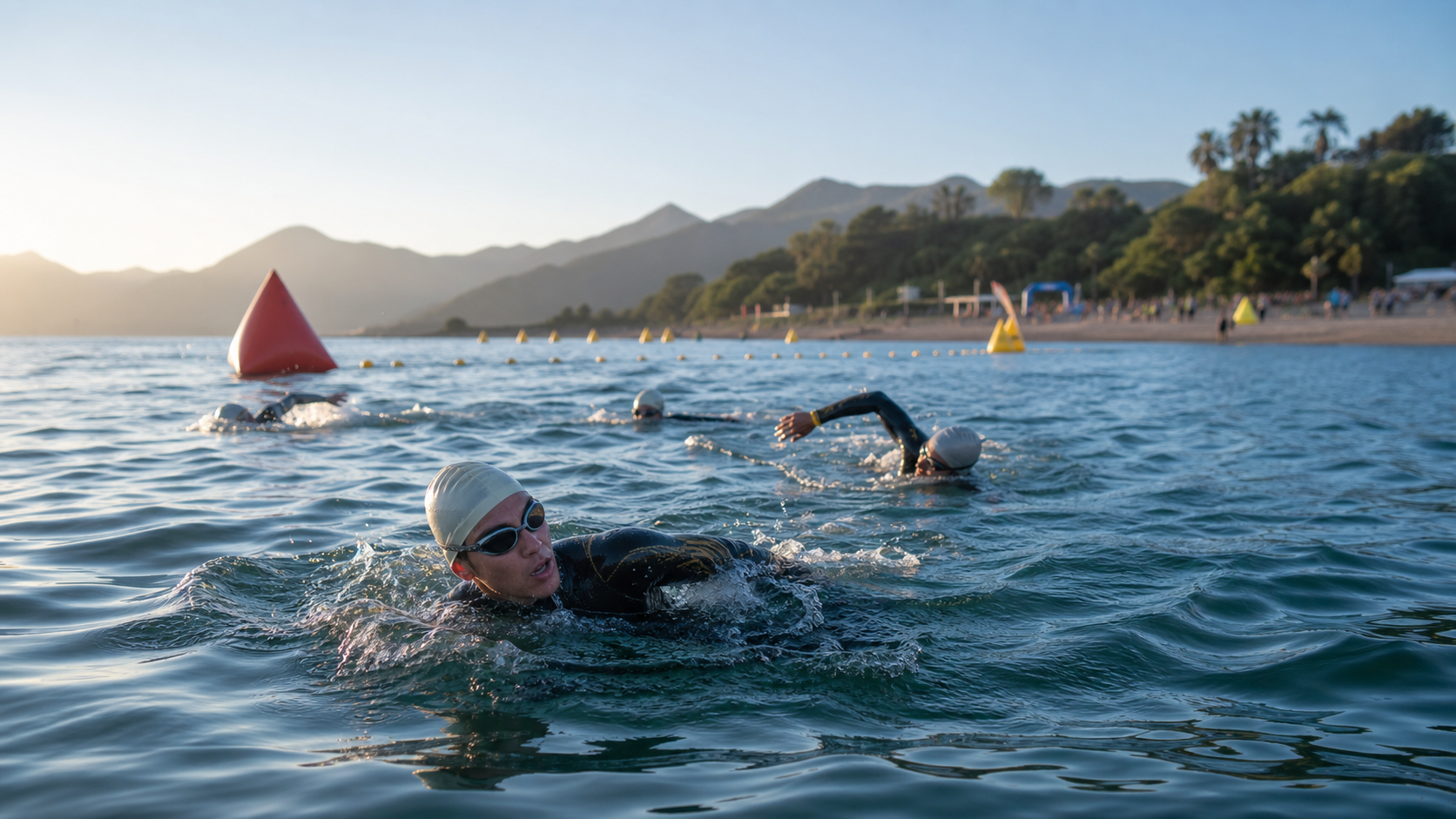
Introduction
For many triathletes, the swim leg is the most anxiety-inducing part of the race. Unlike cycling and running, the swim takes place in open water, with chaotic starts, poor visibility, and no option to stop and rest at will. Add the constraints of a wetsuit, swim cap, and goggles, and your heart rate often spikes before the starting gun even sounds. However, the swim leg accounts for only 10 to 15% of total triathlon time. The key challenge is completing this distance with minimal energy expenditure, preserving strength for the bike and run that follow.
Pre-Race Preparation: Familiarizing Yourself with the Course Is Fundamental
Pre-race course reconnaissance is far more important than you think.
Essential pre-race course checks:
- Water temperature check: Is a wetsuit needed? In Taiwan, wetsuits are typically permitted when water temperature is below 24°C and prohibited above 28°C
- Start format: Beach start, water start, or dive start? Different formats require different physical preparation
- Course confirmation: Buoy colors and turning directions—remember “yellow for turns, red for the finish” or the specific instructions for that day
- Sun direction: If swimming eastward, the morning sun may shine directly into your eyes, so goggle lens color should be chosen in advance
- Currents and waves: Especially important in ocean swims—increase effort on the against-current section and relax to conserve energy on the with-current section
Gear preparation checklist:
| Gear | Notes |
|---|---|
| Wetsuit | Test-fit before race day to ensure no leaks and no neck chafing; practice quick removal after exiting the water |
| Swim cap | Wear the race-issued cap over your own; fold the wetsuit collar outward over it |
| Goggles | Adjust tightness before the race; keep a spare pair in T1 |
| Petroleum jelly | Apply to neck, armpits, and ankles to prevent wetsuit chafing |
| Timing chip | Usually secured to the ankle; fasten it before putting on the wetsuit |
Start and Early-Segment Strategy
The most dangerous moment of the triathlon swim is the first 200 to 300 meters after the start. With a large group of athletes starting simultaneously, hand and foot collisions, being stepped on, and being pushed off course—all mishaps happen at this point.
Starting position selection:
- If swimming is your strength: Position near the main line (usually the shortest route) and compete with the front pack
- If swimming is your weakness: Start from the side, sacrificing a short distance for space to avoid collisions
- If you are prone to anxiety: Choose the outermost position, even if it means swimming a few dozen extra meters for peace of mind
Heart rate management in the first 300 meters:
Cold water entry combined with adrenaline often pushes heart rate above 90% of maximum right after the start. At this point, deliberately slow your stroke rate and use a rhythm of deep nasal inhales and mouth exhales to stabilize your heartbeat. Do not panic and speed up just because you fall slightly behind.
Sight Navigation and Energy-Saving Stroke Techniques
Open water has no black line to follow, and sighting technique directly affects your actual swimming distance.
Sighting techniques:
- Lift your head every 6 to 8 strokes to quickly scan for the buoy ahead
- Use fixed landmarks (bridges, hilltops, buildings) as directional aids
- Follow the water line: In dense packs, use the foam trail ahead to help with direction
Drafting to save energy:
Swimming behind or slightly to the side of other athletes (“drafting” or “side drafting”) can save approximately 7 to 10% of energy expenditure. This requires practice, but the benefit is significant in longer-distance races.
Exiting the Water and the T1 Transition
In the final 50 meters before exiting, switch to head-up swimming to confirm your exit point. When your feet can touch the ground, switch to dolphin jumps (leaping forward with both feet)—faster than swimming. Once fully upright, run in long strides while removing your swim cap and goggles with both hands.
T1 efficiency key points:
- Pre-thread the zipper pull cord on your wetsuit so you can unzip and pull it down to your waist in one motion upon exiting
- Strip the upper half of the wetsuit while running toward T1
- T1 area practice: rehearse the sequence repeatedly—sit down → remove wetsuit → put on cycling shoes → put on helmet → grab your bike
Practical Advice
- Finish time in the swim leg doesn’t matter; energy preservation does—many athletes swim 1 minute faster but lose 5 minutes on the run
- The day before the race, do a 10 to 15-minute practice swim in the race water to get used to the temperature and feel
- If you panic in the water, roll onto your back, take deep breaths, and continue once your heart rate stabilizes—never force yourself to swim while panicking
Conclusion
The swim leg of a triathlon tests not just swimming skill, but mental toughness and strategic judgment. Treat the swim as a “warm-up” rather than a “race,” and enter T1 in optimal condition so you can perform at your true level in the long bike and run ahead. Swimming is the foundation; the finish line is the goal.
Related Reading
- Special Techniques for the Triathlon Swim Leg: Transition Area Preparation and Exit Techniques
- The Final 100 Meters of the Triathlon Swim Leg: Key Strategies Before the T1 Transition
- Optimizing Triathlon Swim Exit and T1 Transition Speed: The Critical 120 Seconds from Water to Bike
- Triathlon Swim Pacing Strategy: Controlled Swimming to Preserve Energy
[防寒衣體驗] 鐵人魂 三鐵 防寒衣試穿會 於松運 深水游泳池 鯨魚池
8 年前
Live) 備戰2019彰化經典百K 賽前攻略 (已完賽請看新影片
7 年前
單車 一日北高 ( 雙城 ) 肥宅雙人瘋狂行 紀錄片 REACTO
10 年前
FTL 與 SYB 車隊專訪 西進武嶺 實用攻略分享! 2小時 如何練?!你不知道的眉角!新手準備武嶺必看 EP1 | 實力派女車友 | 精華版 | 公路車 | CTYeh
4 年前
2019 夏季KOM 5小 完賽心得 準備攻略 東進武嶺 夏季登山王之路 Taiwan KOM Challenge
7 年前
2023桃園團體繞圈賽 / 海鷗繞圈賽 | 全程空拍數據版 | 公路車 | CT Yeh
2 年前
西進武嶺 免費訓練分析服務 Intervals | 練不夠還是練過頭?你哪一種類型選手?AI模型告訴你! | 備戰神器 | 公路車 訓練 | CT Yeh
4 年前
單車賞雪 裝備準備及注意事項分享 | 公路車
5 年前