Introduction
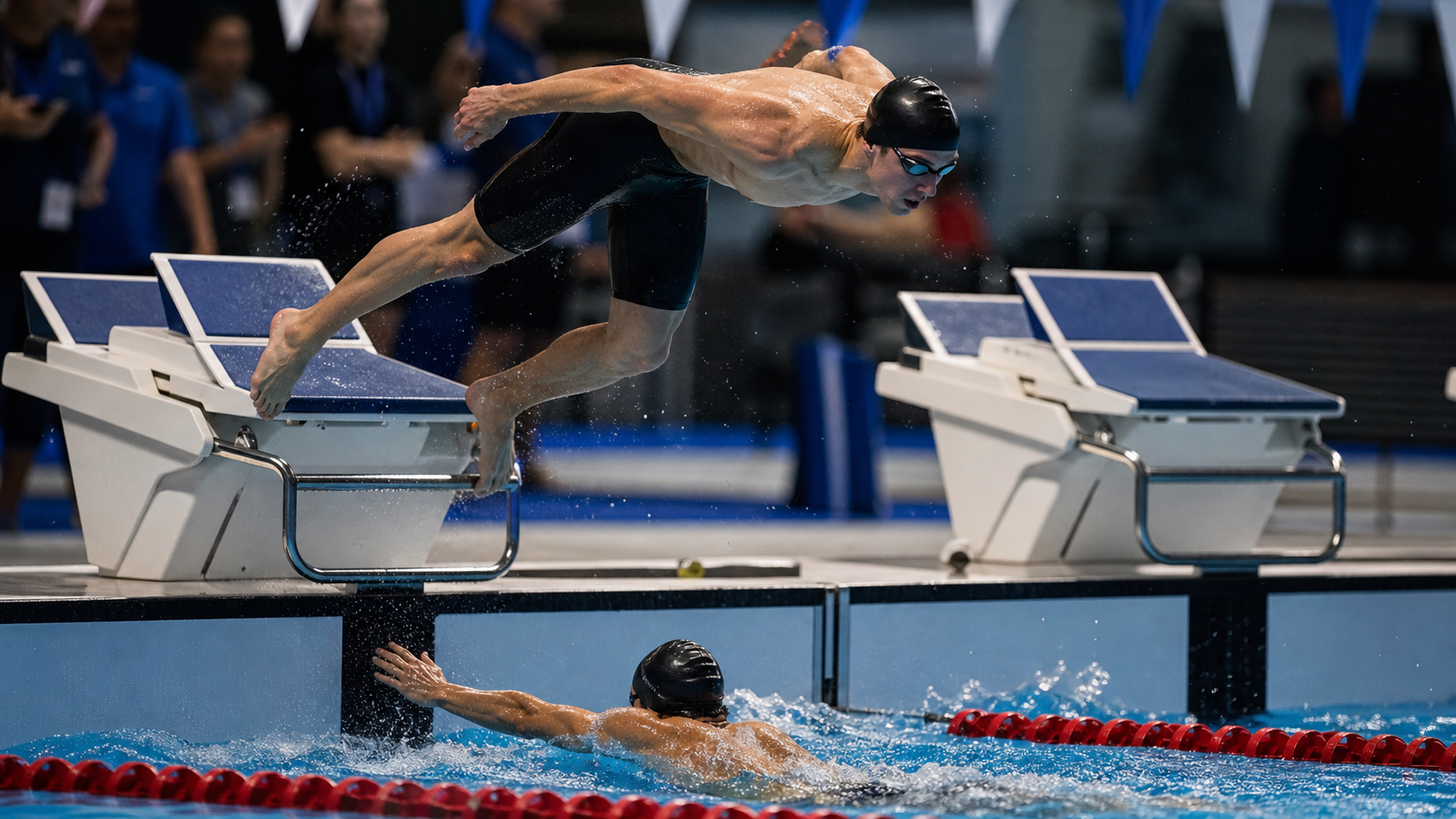
The swimming relay is the event in competitive swimming that demands the most team coordination. In the 4×100 freestyle, 4×200 freestyle, and 4×100 medley relay, the outcome of each race is decided in an instant at every exchange. According to World Aquatics rules, the next swimmer may only start after the preceding swimmer has “touched the wall”—a false start (leaving before the touch) results in disqualification for the entire team. However, the ideal exchange is to dive at the exact moment the preceding swimmer touches the wall, achieving nearly a “0-second” transition. This precise handoff timing requires extensive training and flawless judgment to execute.
Exchange Rules and Technical Fundamentals
Core Rules:
- A valid touch occurs when the preceding swimmer’s hand (either hand) contacts the timing pad or the wall
- The next swimmer’s “starting motion” (feet leaving the block) must occur after the touch
- Swimming uses electronic timing detection with accuracy to 0.01 seconds, and the exchange time difference is fully recorded
Interpreting the Exchange Time Difference (Reaction Time in Relay):
| Exchange Time Difference | Meaning | Assessment |
|---|---|---|
| Below -0.01s | False start, disqualified! | Strictly prohibited |
| 0.00s–0.03s | Perfect exchange | Elite level |
| 0.03s–0.08s | Good exchange | Competitive |
| 0.08s–0.15s | Average level | Room for improvement |
| Above 0.15s | Conservative exchange | Loses competitiveness |
Exchange Judgment Techniques: Visual and Rhythmic
There are two mainstream methods for judging the exchange:
Method One: Visual Judgment (Most Common)
The next swimmer stands on the starting block, eyes focused on the preceding swimmer’s position relative to the wall, and dives at the appropriate moment.
Key points for visual judgment:
- Do not watch the preceding swimmer’s entire body; focus only on the “hand’s” position and speed
- Begin preparing when the preceding swimmer’s arm extends forward on the final stroke
- Gauge the speed at which the preceding swimmer is approaching the wall and calculate the dive timing
- The starting motion from initiation to leaving the block takes approximately 0.6 to 0.7 seconds, so you must “predict” the touch time in advance
Method Two: Auditory Judgment (Supplementary)
Some pools’ automatic timing pads provide audible feedback upon touch, but reaction time based on auditory cues typically lags by about 0.1 seconds, so it is mostly used as a supplementary confirmation to visual judgment.
The Preceding Swimmer’s Responsibility
The exchange is not solely the next swimmer’s responsibility—the preceding swimmer’s touch technique also affects the quality of the handoff:
Key Touch Technique Points:
- Maintain swimming speed over the final 5 meters; do not glide and decelerate (making it easier for the next swimmer to judge your speed)
- Touch the wall at high speed with an extended arm; do not “slap” the wall with the palm (a slapping motion delays the touch past the optimal point)
- Avoid lifting your head to look at the starting block before touching, as this can skew your body and compromise touch accuracy
Relay Team Lineup Deployment Strategy
In Taiwanese swimming competitions, the relay team lineup is a key strategic decision for coaches.
Lineup Order Principles:
- First leg: A well-rounded swimmer with precise starts who can set the team’s rhythm (with strong mental composure)
- Second leg: Usually the strongest swimmer (because they receive the best exchange position and can choose a favorable lane to chase down opponents)
- Third leg: A swimmer with strong pressure tolerance to hold the team’s position during the most competitive middle segment
- Fourth leg: The most explosive finisher, with the mental toughness to handle sprint pressure
Medley Relay (4×100) Stroke Order:
The fixed medley relay order is backstroke → breaststroke → butterfly → freestyle, with 100 meters per stroke. Coaches must assign legs based on each swimmer’s stroke strengths.
Exchange Practice Methods
Exchange technique requires extensive repetition to become consistent. Here are several effective training methods:
- Full-team exchange timing drills: The entire team practices exchanges in position, recording the exchange time difference each time, tracking progress in two-week intervals
- Visual tracking training: Dry-land simulation—Swimmer A walks toward the wall while Swimmer B practices initiating the starting motion the instant A touches the wall
- Pressure simulation drills: Practice exchanges after intense training (when swimmers are fatigued) to simulate judgment ability under race conditions
Practical Advice
- Exchange time difference goals: In early training, aim for 0.05 to 0.08 seconds; once consistent, pursue 0.03 seconds
- Pre-race communication: Confirm the preceding swimmer’s “final strokes” characteristics so the next swimmer has personalized cues for judgment
- Different swimmers enter the water at different speeds: Swimmers with fast entry make it easier for the next swimmer to judge; those with slower strokes require the next swimmer to pay extra attention to observing the rhythm
Conclusion
In swimming relays, that 0.03 seconds of the exchange represents the collective effort of the entire team’s training—a tangible manifestation of coordination and trust. On Taiwanese swimming competition stages, the advantage gained from a perfect exchange can ultimately decide which team claims a medal. Precise handoffs are the highest expression of a relay team’s collective technique.
Related Reading
- Complete Analysis of Relay Handoff Technique: The Art of 0.03 Seconds
- Relay Handoff Technique in Swimming: Optimizing Reaction Time and Underwater Propulsion
- Relay Leg Assignment Strategy in Swimming: Order Arrangement and Exchange Technique
- Key Technical Points in Swimming Relays: Handoff Timing and Teammate Coordination
CT 喇低賽) 武嶺牽車 才是王道 西進牽車四小時內秘訣 攝手位置 如何判斷 防抽筋小秘訣
7 年前
Zwift跨國線上追逐賽 第二站 台灣 TTR vs. 日本 JETT 第二場 (台灣追日本) | 數百位國內外公路車高手,同場較勁 | 多視角賽事直播
4 年前
西進武嶺 自製新版AI配速表產生器 x 賽前攻略 抱佛腳! 沒有功率計也可以產生配速表嗎?有什麼其他眉角賽前要注意的呢? | 西進武嶺 / 東進武嶺 KOM 攻略 | 公路車 | CT Yeh
4 年前
戰略) Zwift Race 如何咬在第一集團 如何評估自己要開多少推力 (請開1.5倍速看)
7 年前
Live) 備戰2019彰化經典百K 賽前攻略 (已完賽請看新影片
7 年前
新屋團體繞圈賽 | 眾多菁英好手賽道奔馳 | 千瓦女子軍團 | 無敵交管狂獲好評 明年你一定不能錯過 | #公路車
5 年前
2025 海鷗團體繞圈賽 網路直播 超激烈裁判長視角 / EIPC 李廷威、Waypoint 等眾多高手競爭 / feat. 卡密兒主持 / 海鷗繞圈賽
9 個月前
2023桃園團體繞圈賽 / 海鷗繞圈賽 | 全程空拍數據版 | 公路車 | CT Yeh
2 年前