Introduction
In the competitive swimming world, physical conditioning and technique are undoubtedly the foundation of victory, but psychological factors often determine whether an athlete can perform at 100% of their training level on race day. A saying circulates in Taiwan’s swimming competition circles: “Training builds the body; racing builds the mind.” For competitors with similar times, the difference in mental preparation is often the gap between standing on the podium and standing below it.
The Strategy of Lane Assignment
In swimming competitions, lane assignments are not random. The standard rules of World Aquatics and the Chinese Taipei Swimming Association are: swimmers with better times are assigned to the middle lanes (lanes 4 and 5), while those with slower times are placed in the outer lanes (lanes 1 and 8). This system has far-reaching implications:
Advantages of middle lanes:
- Opponents on both sides provide a pace reference, creating competitive stimulation
- Spectator attention is concentrated there, giving a psychological sense of being “valued”
- Water current effects are relatively balanced
Challenges of outer lanes:
- Only one side has an opponent for comparison
- Implies “lower expected performance,” which may affect confidence
- In some pools, outer lanes are slightly more affected by water currents
How to leverage the lane system:
| Race Scenario | Mental Strategy |
|---|---|
| Assigned to a middle lane | Acknowledge your own strength and aim to “hold your position” |
| Assigned to an outer lane | Embrace the role of “underdog,” focus on swimming your time and make opponents chase you |
| Opponent in the adjacent lane | Use the opponent’s presence as stimulation, but don’t obsess over their pace |
Opponent Analysis: Rationality, Not Fear
Opponent analysis is an important part of competitive swimming preparation, but it should be approached as a “rational tool” rather than a “source of fear.”
Effective ways to analyze opponents:
- Check entry times: Taiwan swimming competitions typically publish entry times, allowing you to know your opponents’ most recent personal bests
- Analyze opponents’ weaknesses: Watch race footage or live performances to identify their turn timing, back-half pacing, and breathing habits
- Assess opponents’ current form: The same athlete performs differently at different times; entry times are old data, and on-the-day performance is what truly matters
Correct use after analysis:
- Understand where your opponent is strongest and how you should respond
- Set “key strategies to surpass the opponent” (e.g., stay close in the first half, surge in the second half)
- But ultimately, base your strategy on “my best performance”—don’t alter your pacing plan because of an opponent
Opponent analysis pitfalls to avoid:
- Seeing a strong opponent’s entry time and “assuming defeat” in advance—this is self-limiting
- Staring at the opponent too much during the race and losing your own rhythm
- Letting an opponent’s unexpected incident (such as a false start or disqualification) throw off your own pace
Pre-Race Mental Preparation
The night before the race:
- Pull out your training logs and review your progress over the past few months to build a foundation of confidence
- Practice “success visualization”: close your eyes and imagine completing the entire race flawlessly, feeling the moment your hand touches the wall
- Avoid overthinking race strategy before bed (a strategy already set doesn’t need repeated revision)
On race day:
- Establish a fixed race-day routine (what time to wake up, what to eat, what time to arrive at the venue) so familiarity reduces anxiety
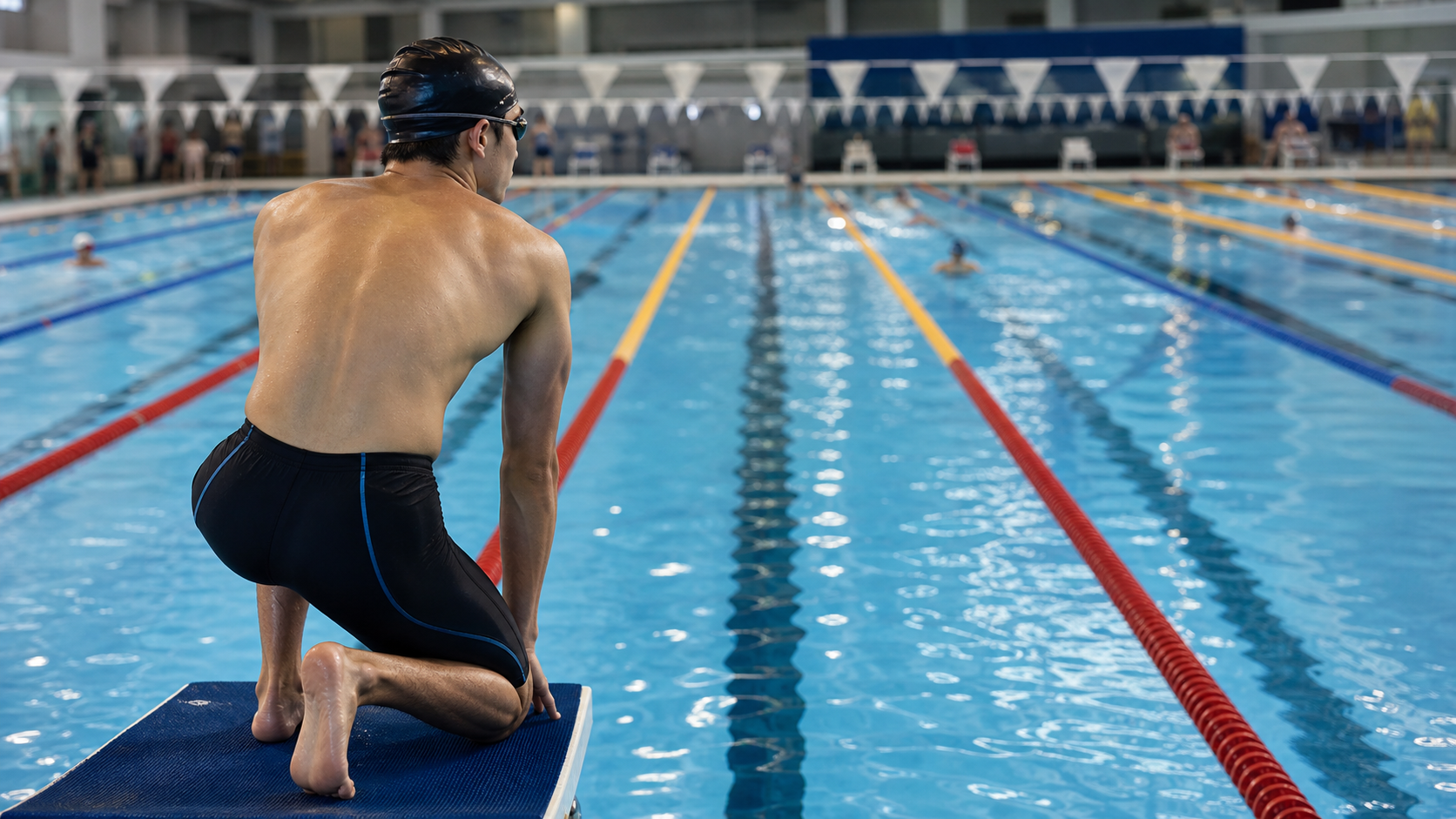
- Upon arriving at the venue, first observe the pool environment, locate your assigned lane, and “rehearse” your start in your mind
- During warm-up, focus on “finding the feel”—don’t panic if the warm-up doesn’t feel great
Just before stepping up:
- Take three deep breaths (inhale through the nose for 4 seconds, exhale through the mouth for 6 seconds) to activate the parasympathetic nervous system and reduce tension
- Tell yourself one specific strategic cue (e.g., “Hold steady for the first 50m, accelerate for the last 50m”) rather than a vague “you can do it”
- Once on the starting block, stop thinking about time—focus only on technique
In-Race Mental Management
- After the start: Don’t panic over a poor start or someone else taking the lead; execute your own pacing plan
- When the middle of the race gets tough: Pain is expected—tell yourself, “This is normal, keep going”
- Final sprint: Use “countdown counting” (10 more strokes, 5 more strokes) rather than feel to judge, preventing premature deceleration
Practical Advice
- Keep a “race-day journal”: record your mental state before each race and your final performance to identify your optimal mental preparation pattern
- Simulate race conditions during timed practice sets to practice activating the “race mindset”
- Establish a pre-race talk ritual with a trusted coach or teammate—a few words of encouragement can significantly boost your performance
Conclusion
Mental preparation for a swimming competition is the final and most important training discipline for an athlete. When you step onto the starting block, that moment belongs to you alone—your technique, your endurance, your mindset, all indispensable. Trust your training, trust yourself, and let the race be a stage to showcase your growth, not a place to prove your fears.
Related Reading
- Swimming Lane Assignments: Psychological Impact of Lane Choice on Performance
- Managing Race Nerves in Swimming: Lane Selection Psychology and Starting Reaction
- The Strategy of Lane Draws in Swimming: The Science of Middle-Lane Advantage
- Race Strategy Analysis for Swimmers: How to Study Opponents and Make a Plan
備戰 戀戀197 賽前關門點分析 西濱團練 #公路車 4K高畫質
6 年前
崇越盃武嶺冠軍高手 賽前JJSC 群峰會精華!對應大數據分析,會有落差嗎?/ feat. JJSC中部公路車約騎 /公路車 / CT Yeh
2 年前
西進武嶺 免費訓練分析服務 Intervals | 練不夠還是練過頭?你哪一種類型選手?AI模型告訴你! | 備戰神器 | 公路車 訓練 | CT Yeh
4 年前
live) 超越北高 之一日北高12小時 策略
7 年前
西進武嶺 自製新版AI配速表產生器 x 賽前攻略 抱佛腳! 沒有功率計也可以產生配速表嗎?有什麼其他眉角賽前要注意的呢? | 西進武嶺 / 東進武嶺 KOM 攻略 | 公路車 | CT Yeh
4 年前
一日北高/長距離團騎 常見問題補充篇 / 組團或跟團的眉角 / 壯車友容易被瘦車友慢性拉爆 / 原來屁股痛可能是這個原因...? / 風場配速法 / 公路車 / CT Yeh
2 年前
如何 搶 #中央山脈 報名 #公路車 #報名 #搶票
7 年前
FTL 與 SYB 車隊專訪 西進武嶺 實用攻略分享! 2小時 如何練?!你不知道的眉角!新手準備武嶺必看 EP1 | 實力派女車友 | 精華版 | 公路車 | CTYeh
4 年前