Introduction
Many runners consider strength training to be “a gym thing” that has nothing to do with running. However, research shows that regular runner-specific strength training can reduce injury risk by up to 50%, while also improving running form and running economy. For half-marathon runners in preparation, 20–30 minutes of strength training twice a week is one of the most cost-effective investments.
Common Injuries in Half-Marathon Runners
Understanding the causes of injuries allows you to choose preventive exercises with precision:
| Injury Type | Main Cause | Related Weakness |
|---|---|---|
| Iliotibial Band Syndrome | Weak hip abductors | Gluteus medius, gluteus maximus |
| Plantar Fasciitis | Poor calf and plantar flexibility + weak core | Gastrocnemius, core |
| Runner’s Knee (Anterior Knee Pain) | Imbalance between quadriceps and glutes | Gluteus maximus, quadriceps |
| Tibial Stress Fracture | Excessive bone loading + insufficient muscle shock absorption | Posterior calf muscles |
5 Key Strength Moves
Move 1: Single-Leg Glute Bridge
Target Muscles: Gluteus maximus, gluteus medius, hamstrings
How to Perform:
- Lie on your back with knees bent and feet flat on the floor
- Lift one leg and extend it, then drive through the other foot to push your hips up until your shoulders, hips, and knees form a straight line
- Hold at the top for 3 seconds, then lower slowly
- 3 × 12 reps per side
This move directly strengthens your “pushing power” and prevents IT band issues.
Move 2: Side-Lying Clamshell
Target Muscles: Gluteus medius
How to Perform:
- Lie on your side with knees bent at 45 degrees, keeping ankles together
- Slowly rotate the top knee upward (like a clamshell opening), making sure your pelvis doesn’t tilt backward
- Hold at the top for 2 seconds, then lower slowly
- 3 × 15 reps per side
You can add a resistance band for extra difficulty. A weak gluteus medius is one of the most common root causes of injury among runners.
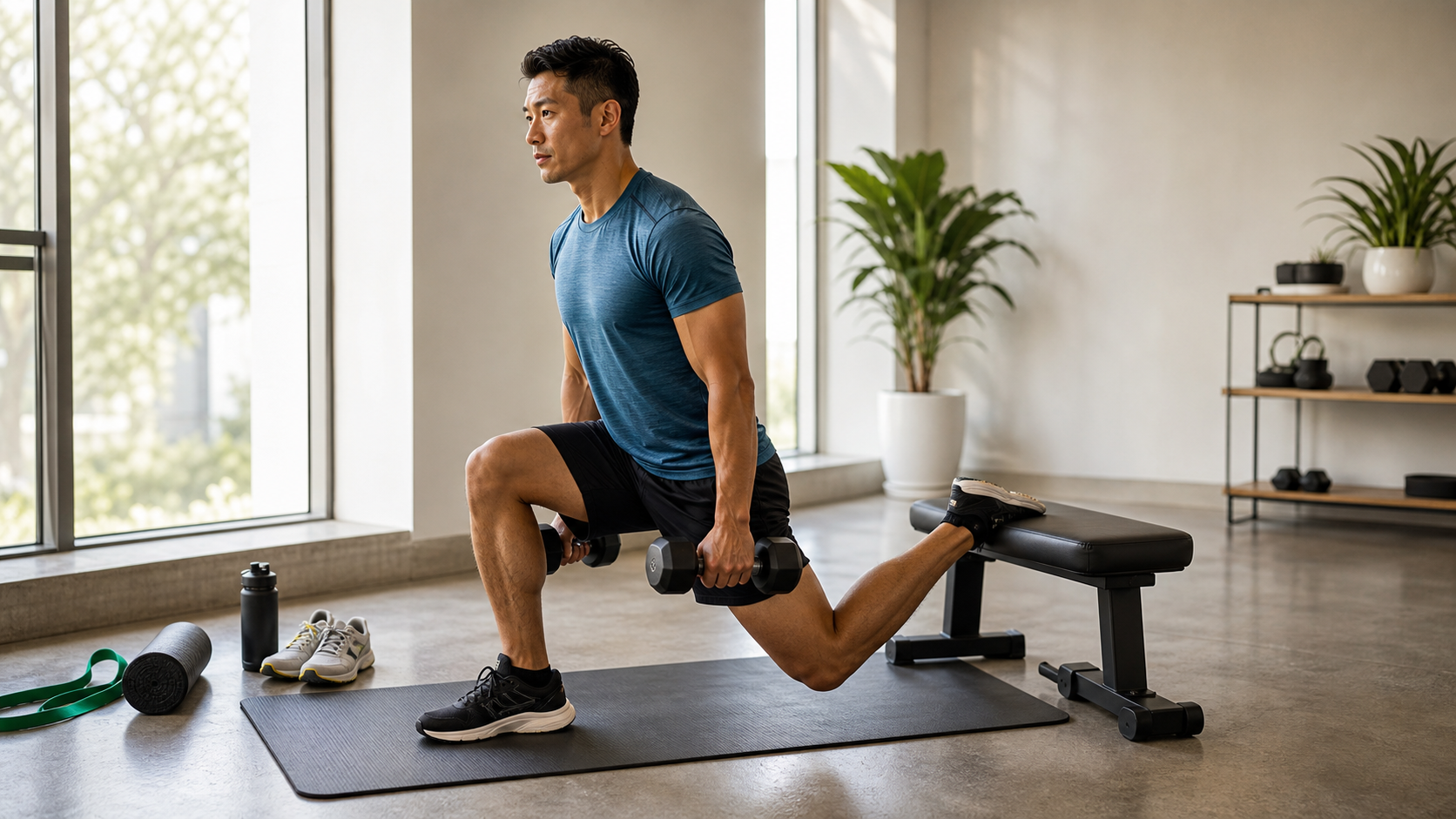
Move 3: Bulgarian Split Squat
Target Muscles: Quadriceps, gluteus maximus, core
How to Perform:
- Place the top of your rear foot on a chair or step, with your front foot a big step forward
- Lower your body straight down, keeping the front knee from passing the toes and bringing the rear knee close to the ground
- Rise slowly while keeping your core engaged
- 3 × 10 reps per side; you can hold dumbbells to increase difficulty
This is the most practical single-leg strength move for runners, directly mimicking the single-leg support phase of running.
Move 4: Calf Raise
Target Muscles: Gastrocnemius, soleus
How to Perform:
- Stand on the edge of a step with your heels hanging off
- Slowly raise your heels to the highest point and hold for 2 seconds
- Lower slowly until your heels drop below the step edge (full stretch)
- 3 × 15–20 reps; advanced runners can perform them on one leg
Strong calf muscles absorb the impact of every stride and are key to preventing plantar fasciitis.
Move 5: Plank + Side Plank
Target Muscles: Core, transversus abdominis, gluteus medius
How to Perform:
- Hold a standard plank for 30–45 seconds, keeping your body in a straight line
- Then transition to a side plank, holding for 20–30 seconds on each side
- 3 sets
A strong core maintains running form, reduces energy waste, and protects the lumbar spine.
Training Schedule Recommendations
- Frequency: Twice a week, ideally after an easy run or on a recovery day
- Duration: 20–25 minutes per session (5 moves × 3 sets)
- Avoid: Do not perform strength training on long-run days or interval days to prevent fatigue from stacking up
Practical Tips
- Start with bodyweight movements and only add load once your form is correct
- Progress every 4 weeks: increase weight, shorten rest periods, or switch to unilateral variations
- If you have existing injuries, have a physical therapist assess you first and choose appropriate exercises
Conclusion
Strength training is not a supporting act—it is an indispensable part of a half-marathon training plan. An investment of 25 minutes twice a week will keep you healthy through high-mileage training and help you complete 21 kilometers with more efficient form. A strong body runs farther and lasts longer.
Related Reading
- Strength Training for Runners: Six Key Moves to Prevent Injury
- Strength Training for Half-Marathon Runners: Twice-Weekly Lower-Body and Core Reinforcement
- Running Injury Prevention: The 5 Most Common Running Injuries and How to Prevent Them
- Injury Prevention Training for Endurance Athletes: Ten Key Moves to Protect Your Athletic Career
Never Stop 西進武嶺 前後雙機 完整全程錄影 訓練台 實境
8 年前
一日北高常見問題大集合 | 攻略 | 路線 | 訓練 | 補給 | 自行車 單車 | 一日雙城 | 雙塔 | TWB北高360 | 屁股痛
6 年前
西進武嶺 免費訓練分析服務 Intervals | 練不夠還是練過頭?你哪一種類型選手?AI模型告訴你! | 備戰神器 | 公路車 訓練 | CT Yeh
4 年前
[教學] Premiere 影片 手震 修正 教學 防抖 單眼 影像 GoPro 穩定 Video Stabilization
8 年前
一日北高/長距離團騎 常見問題補充篇 / 組團或跟團的眉角 / 壯車友容易被瘦車友慢性拉爆 / 原來屁股痛可能是這個原因...? / 風場配速法 / 公路車 / CT Yeh
2 年前
2019 夏季KOM 5小 完賽心得 準備攻略 東進武嶺 夏季登山王之路 Taiwan KOM Challenge
7 年前
CT 喇低賽) 武嶺牽車 才是王道 西進牽車四小時內秘訣 攝手位置 如何判斷 防抽筋小秘訣
7 年前
實景訓練台) 彰化經典百K 高強度喵團 90分鐘 跟著一起練功 2019 Indoor workout Changhua Classic 100 Taiwan
7 年前