Introduction
Chronic lower back pain is one of the most common musculoskeletal problems in Taiwan. According to statistics from the Health Promotion Administration, approximately 80% of Taiwanese adults will experience at least one severe episode of back pain in their lifetime. Prolonged sitting at desks, poor posture, and insufficient core strength are the main contributing factors. Among all exercise options, swimming is regarded by many physical therapists as a high-quality choice for back pain rehabilitation, thanks to the properties of buoyancy and water resistance.
How Swimming Improves Back Pain
Strengthening the Core Muscles
Swimming requires the body to maintain a streamlined position in the water, a movement that continuously activates the core muscles (including the transversus abdominis, multifidus, and erector spinae). These deep muscles are precisely the ones responsible for protecting the spine. Once strengthened, the pressure borne by the intervertebral discs and facet joints can be effectively distributed, thereby reducing pain.
Spinal Decompression Effect
When the body is upright, the lumbar intervertebral discs bear a pressure of up to 60–80 kg (using a body weight of 70 kg as an example). Once in the water, buoyancy substantially removes this axial pressure, giving the discs an opportunity for “decompression,” which helps promote nutrient exchange and repair within the discs.
Improved Flexibility and Mobility
Water resistance provides gentle yet uniform resistance. The stroking and kicking movements in swimming can mildly stretch the muscles and fascia surrounding the spine, improving spinal mobility and reducing pain caused by muscle spasms.
Effects of Different Swimming Strokes on Back Pain
| Stroke | Effect on Back Pain | Suitability | Notes |
|---|---|---|---|
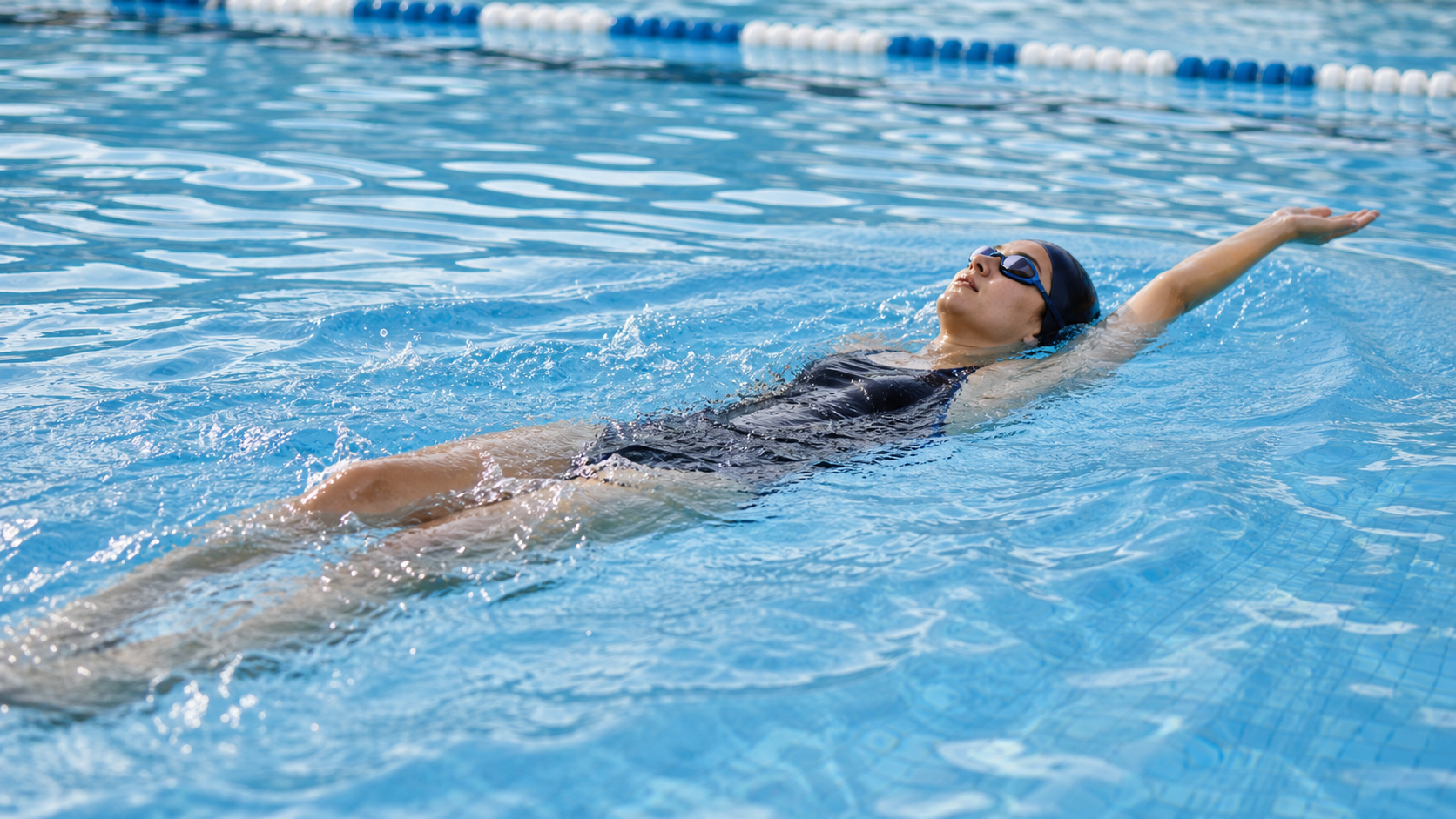
| Backstroke | Best | ★★★★★ | The spine extends naturally with almost no lumbar pressure |
| Freestyle | Good | ★★★★☆ | Attention needed to cervical spine load when turning the head |
| Breaststroke | Moderate | ★★★☆☆ | Excessive lumbar extension can worsen lower back pain |
| Butterfly | Not recommended | ★☆☆☆☆ | The undulating motion of the lower back places high stress on the discs |
The backstroke is the first choice for back pain sufferers because, when floating face-up, the spine receives the most even support. If choosing freestyle, special attention should be paid to “body-roll breathing” rather than “lifting the head to breathe,” in order to reduce rotational load on the cervical spine.
Three Key Precautions for Back Pain Sufferers When Swimming
- Do not swim during the acute phase (severe pain): During an acute flare-up of a herniated disc or inflammation of the nerve roots, rest should come first; consider water-based exercise only after the acute phase has passed
- Avoid excessive lumbar extension: If the lower back arches excessively during the breaststroke kick, it increases pressure on the facet joints at the back of the spine; pay special attention to drawing in the abdomen during the kick to maintain a neutral lumbar position
- Warm up thoroughly before entering the water: Perform core-activation exercises such as pelvic tilts and cat-cow at poolside to activate the deep muscles before swimming
A study published in the journal Physical Therapy found that after an 8-week program of swimming and water-based exercise, chronic lower back pain patients saw their Visual Analogue Scale (VAS) pain scores drop by an average of 4.2 points (on a 10-point scale), while the control group (land-based exercise) saw a reduction of only 2.8 points—a difference that was statistically significant.
Practical Recommendations
- Combine swimming with core training: Swimming builds core endurance, but targeted land-based core exercises (such as planks and bird-dog) can more precisely strengthen the deep stabilizer muscles; the two complement each other
- Choose a pool with ramp access: Avoid climbing ladders to enter and exit the pool, reducing the bending load on the lower back when using stairs
- Use pull buoys or kickboards as aids: In the early stages, you can focus only on arm strokes while holding a kickboard between the legs, reducing the rotational demands on the lower back
- Stretch the spine after swimming: While the muscles are still warm after swimming, perform spinal decompression movements such as “child’s pose” or “supine knee-to-chest” for better results
- Follow up with your doctor: Those diagnosed with a herniated disc or spondylolisthesis should discuss their swimming plan with a spine specialist or physical therapist beforehand
Conclusion
Swimming is one of the most back-friendly aerobic exercise options for chronic back pain sufferers, but “the right stroke” and “correct technique” are the keys to effectiveness. Prioritizing the backstroke, avoiding the butterfly, and drawing in the abdomen to maintain core stability—these three principles can turn every time you enter the water into beneficial therapy for your spine. Combined with land-based core training and regular follow-up visits, most chronic back pain sufferers can rediscover freedom of movement in the water.
Related Reading
- Swimming to Relieve Chronic Back Pain: A Water-Based Approach to Spinal Decompression and Core Strengthening
- Water-Based Core Training for Chronic Lower Back Pain: Activating Spinal Stabilizer Muscles in the Water
- Swimming for the Prevention and Improvement of Shoulder and Neck Pain
- Protecting the Lumbar Spine Through Swimming: Posture Recommendations for Patients with Spinal Conditions
一日北高/長距離團騎 常見問題補充篇 / 組團或跟團的眉角 / 壯車友容易被瘦車友慢性拉爆 / 原來屁股痛可能是這個原因...? / 風場配速法 / 公路車 / CT Yeh
2 年前
靠單車減肥35公斤 心得分享與整理
7 年前
一日北高常見問題大集合 | 攻略 | 路線 | 訓練 | 補給 | 自行車 單車 | 一日雙城 | 雙塔 | TWB北高360 | 屁股痛
6 年前
[教學] Premiere 影片 手震 修正 教學 防抖 單眼 影像 GoPro 穩定 Video Stabilization
8 年前
抖肩舞 台灣x日本交流版 (台灣 vs 前橋) 赤城山登山賽 coincidance
8 年前
CT暗黑廚房) 車友必備 宇宙無敵鮮蚵湯 幫助訓練恢復 天然食補 好市多 超肥鮮蚵 破PR
7 年前
[防寒衣體驗] 鐵人魂 三鐵 防寒衣試穿會 於松運 深水游泳池 鯨魚池
8 年前
4K單車實境) 嘉義 梅山36灣 訓練台 爬坡 輕鬆騎
6 年前