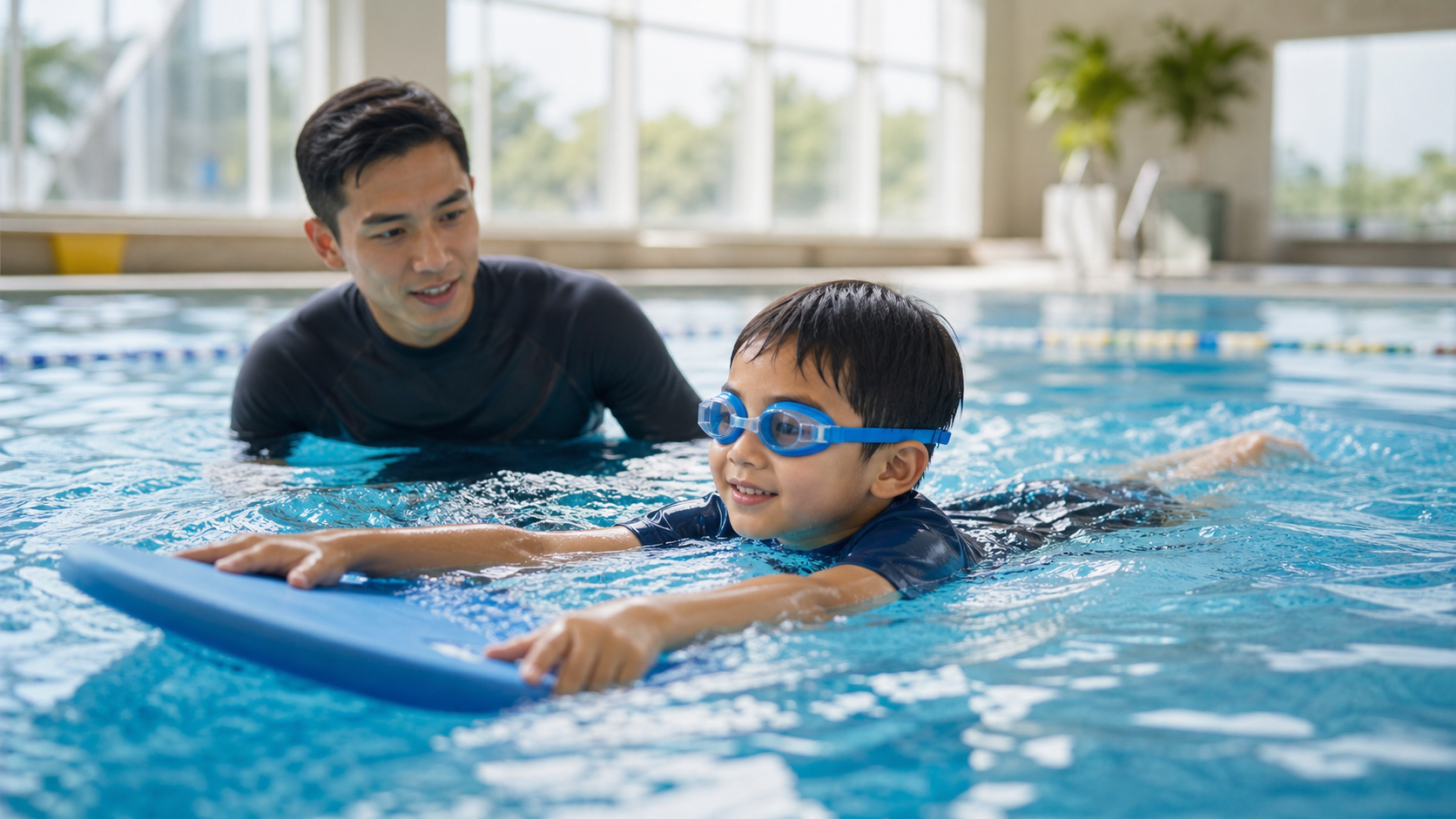
Introduction
Teaching children to swim is increasingly common in Taiwan, with many parents taking their kids to parent-child swimming classes from an early age. Beyond the practical considerations of water safety, the comprehensive benefits of swimming for child development have become a hot topic in sports science research in recent years. Studies show that early swimming training is not just the acquisition of motor skills, but also an important catalyst for brain development.
The Impact of Swimming on Children’s Neuromuscular Development
Strengthening Bilateral Coordination
Swimming requires alternating or synchronized movement of the left and right limbs (such as the alternating arm pulls and kicks in freestyle, or the symmetrical movements in breaststroke). This bilateral coordination training directly stimulates the development of the corpus callosum (the nerve bundle connecting the left and right brain hemispheres). The corpus callosum matures rapidly during childhood, and appropriate bilateral coordination training can accelerate its myelination process, helping to improve hand-eye coordination, writing ability, and the speed of motor learning.
A large study by Griffith University in Australia (the Swim Study), which tracked more than 7,000 children, found that 4–5-year-olds with swimming training outperformed their non-swimming peers in visual-motor integration, verbal skills, mathematical reasoning, and reading ability—a difference equivalent to 6–15 months of developmental advancement.
Spatial Awareness and Motor Planning Ability
The aquatic environment provides a three-dimensional movement experience, requiring children to adjust their body posture in real time to cope with water resistance and buoyancy. This multi-dimensional motor experience strengthens neural connections in the cerebellum (responsible for coordination and balance) and the parietal lobe (which processes spatial information), with positive effects on future learning in geometry, map reading, and even sports activities.
Developmental Benefits of Swimming by Age Group
| Age Group | Primary Developmental Benefits | Recommended Swimming Format |
|---|---|---|
| 0–3 years | Water safety awareness, sensory integration, parent-child bonding | Parent-child swimming classes, focused on water play and exploration |
| 4–6 years | Bilateral coordination, spatial awareness, language development | Preschool swimming classes, learning basic water skills |
| 7–12 years | Self-discipline, goal setting, teamwork | Formal swimming lessons, may join school or community teams |
| 13–18 years | Stress management, self-efficacy, athletic performance | Competitive or recreational swimming, emphasizing consistency |
Confidence and Emotional Regulation
Learning to swim is one of the few experiences in childhood where a child can “overcome fear and acquire a skill entirely on their own.” From being afraid of water, to being able to move in the water, to learning to breathe—each milestone strengthens a child’s self-efficacy—the belief in one’s ability to face challenges. This psychological trait has broad transfer effects throughout development.
The Scientific Basis for Swimming’s Impact on Children’s Cognitive Development
The benefits of aerobic exercise on the brain are well supported by science: it promotes the secretion of brain-derived neurotrophic factor (BDNF), often called “fertilizer for the brain,” which promotes neuronal growth and synaptic connections. As a full-body aerobic exercise, swimming effectively stimulates the release of BDNF.
Furthermore, swimming’s rhythmic breathing pattern (inhale-hold-exhale) is thought to have neural effects similar to meditative breathing training, helping children learn attention regulation and reducing ADHD-related symptoms. Some studies show that children with hyperactivity who swim regularly demonstrate significant improvements in classroom attention and behavioral control.
Practical Recommendations for Children’s Swimming in Taiwan
- Parent-child swimming can begin from 6 months of age: Water experiences in infancy are aimed at sensory integration and parent-child interaction, not technical skill acquisition
- Choose swimming instructors with children’s teaching certification: Taiwan’s Sports Administration recognizes certifications from the National Water Rescue Association and swimming instructor examinations; choosing a certified instructor offers greater assurance
- Never force a child into the water: If a child shows strong resistance, respect their pace—forcing them may cause aquaphobia and hinder long-term development
- Value the process over speed: The goal of learning to swim is not “mastering a stroke the fastest,” but building a positive relationship between the child and water
Practical Tips
- 2–3 fixed sessions per week: Consistency matters more than intensity; sustained aquatic stimulation is needed to accumulate neurological developmental benefits
- Encourage children to describe their experience after class: Conversations like “How did the water feel today?” strengthen language and sensory integration
- Combine swimming with land-based activities: Swimming should not replace running, jumping, and play—a rich variety of movement experiences is most beneficial for overall development
- Pay attention to water temperature: Children’s thermoregulation is weaker than adults’; pool water should be maintained at 28–30°C to avoid excessive cold
- Establish swimming rituals: Fixed swimming days, changing routines, and pre-swim songs help young children build a sense of security and anticipation
Conclusion
The impact of swimming on children goes far beyond “learning a water skill”—it is a catalyst for brain development, a training ground for emotional resilience, and a practice space for social skills. Taiwan has abundant swimming education resources. Introducing children to the aquatic environment early gives them not just the gift of safety, but also neurological developmental assets that benefit them for life.
Related Reading
- The Impact of Swimming on Children’s Cognitive Development: Latest Findings from Neuroscience and Educational Research
- Children’s Swimming Development: The Neurological Golden Window for Learning to Swim at Ages 6–12 and Training Design
- Neuromuscular Coordination in Swimming: Learning and Automatization of Aquatic Movement Patterns
- Neuromuscular Coordination in Swimming: Motor Memory and Skill Consolidation
滑雪新手們慘摔學習全紀錄(請開字幕),滑雪好好玩 | Snowboard + Ski | 岩原 スキー場 | 滑雪APP使用 | GoPro Max
6 年前
#PUSHBIKE 原來這麼好玩! 小朋友 滑步車 初體驗 超可愛
6 年前
[教學] Premiere 影片 手震 修正 教學 防抖 單眼 影像 GoPro 穩定 Video Stabilization
8 年前
元宇宙單車運動!智騎 X7 Pro 智能訓練台 ThinkRider 居家線上練功
5 年前
西進武嶺 免費訓練分析服務 Intervals | 練不夠還是練過頭?你哪一種類型選手?AI模型告訴你! | 備戰神器 | 公路車 訓練 | CT Yeh
4 年前
一日北高常見問題大集合 | 攻略 | 路線 | 訓練 | 補給 | 自行車 單車 | 一日雙城 | 雙塔 | TWB北高360 | 屁股痛
6 年前
一起升級!海鷗盃LSD團練...JJSC Zone2招待 騎到手抖 / 公路車 / CT Yeh
2 天前
NEKO's Fun 高美濕地團練
8 年前