Introduction
The Time Trial (TT) is known as “the sport of the ascetic,” because there is no peloton to shelter you, no chance to save energy by drafting behind other riders—every single watt is produced entirely by yourself. In a time trial, riders start alone and complete a set distance as fast as possible, with rankings determined purely by time.
Taiwan’s time trial culture has developed rapidly in recent years, from professional-level Tour de Taiwan time trials to amateur highway races, with the format becoming increasingly diverse. Even the “King of the Mountain” (KOM) segments on Strava are essentially a form of time trial. Understanding the core principles of time trialing not only improves race results but also makes daily training more targeted.
Key Physical Principles of Time Trialing
| Additional power required to increase speed by 1 km/h | Source of impact | Difficulty of improvement |
|---|---|---|
| Aerodynamic drag | Riding position, equipment | Moderate |
| Rolling resistance | Tires, air pressure | Easy |
| Gravity (when climbing) | Body weight, cadence | Difficult |
| Mechanical losses | Drivetrain | Easy |
On flat time trial courses, aerodynamic drag accounts for more than 80% of total resistance, so reducing wind resistance is the most critical factor in improving time trial performance.
Three Levels of Aero Optimization
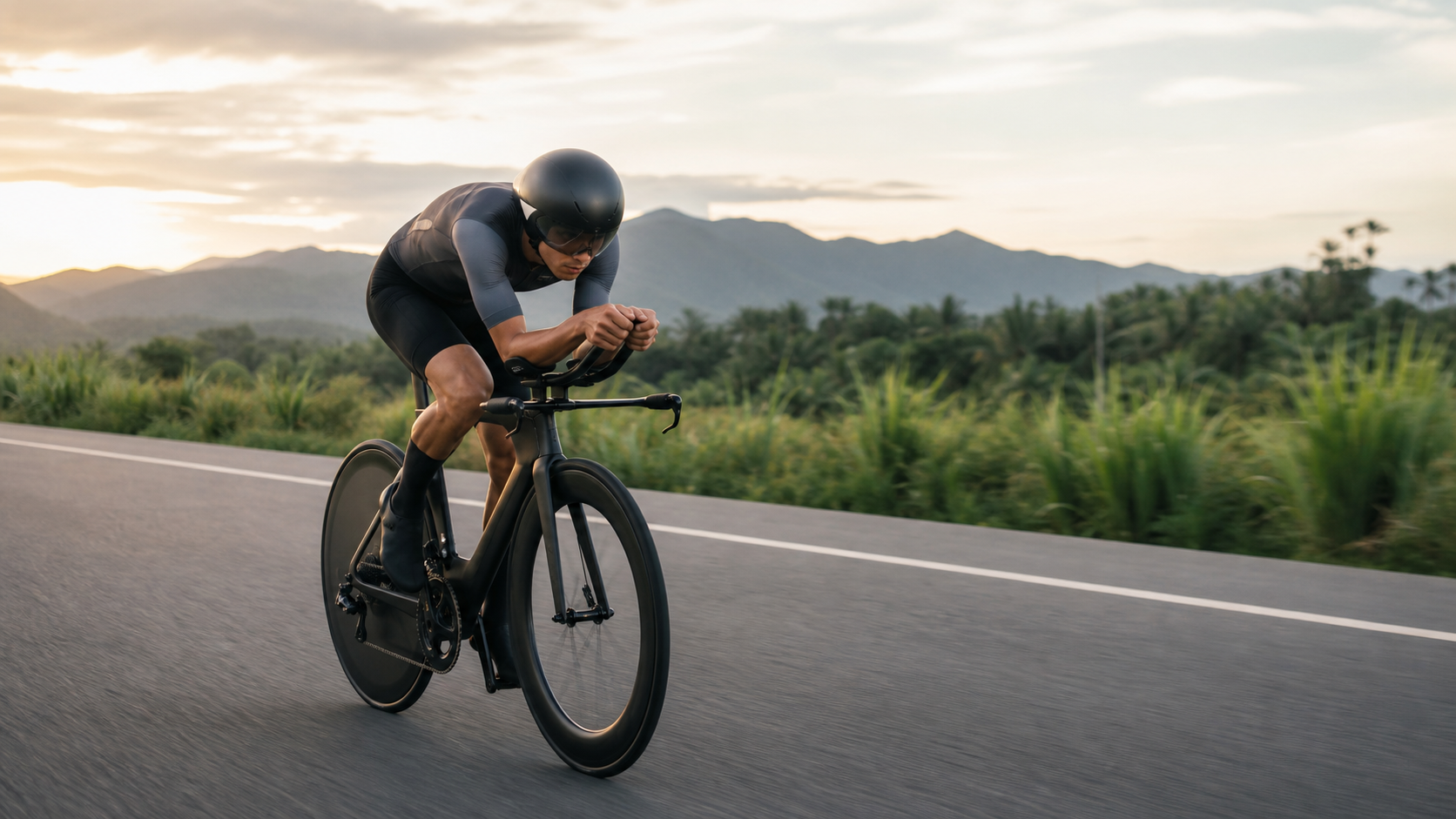
The first level is riding position optimization—this is the most cost-effective and most impactful improvement. A standard TT position requires:
- Upper body as horizontal as possible, head lowered to the extension line of the back
- Arms narrowed, both elbows placed on the armrests of the TT bars
- Knees not flaring outward, maintaining a streamlined motion
An excellent TT position can reduce aerodynamic drag by 30–40% compared to an upright riding position, translating to a speed gain of approximately 2–4 km/h. However, the TT position also affects breathing efficiency, requiring extensive practice to maintain power output while holding an aero position.
The second level is equipment selection, including TT helmets (reducing drag by approximately 5–10W compared to standard helmets), deep-section wheels or disc wheels (reducing 5–15W), and skinsuits (reducing 5–10W). For amateur riders on a limited budget, a TT helmet offers the highest return on investment of any single piece of equipment.
The third level is complete bike configuration, including TT frames, fork shaping, and handlebar angles, which involves a higher budget. It is recommended to fully optimize the first two levels before considering this.
Time Trial Pacing Strategy
The most common mistake in time trials is going out too hard in the first half and blowing up in the second half. Scientific research shows that if the power difference between the first and second halves of a time trial exceeds 5%, overall performance is significantly affected.
Power Target Setting
For riders with a power meter, the target power for a time trial should be set at 95–105% of FTP, adjusted by distance:
- Under 10 km: 105–110% FTP
- 20–40 km: 95–100% FTP
- Over 40 km: 90–95% FTP
Riders without a power meter can use heart rate as a proxy indicator; the target heart rate for a time trial is typically 90–95% of HRmax. However, note that heart rate has a “lag effect”—it takes 1–2 minutes after the start for heart rate to reach a steady state, so do not misjudge your output as insufficient based on the low heart rate at the start and accelerate.
Segment Strategy
Climbing sections: Slightly increase power on the uphill (5–10% above target), using gravity to help recover on the descent. Descending sections: Do not completely ease off; keep pedaling to maintain speed and momentum. Corners: Brake early, then quickly regain speed after the exit, avoiding sudden power spikes.
Practical Advice
- Pre-race warm-up is crucial: Time trials require immediate high-power output, and a thorough 20–30 minute warm-up (including several 30-second high-intensity activations) can significantly improve performance
- Wind assessment: After confirming the course direction, understand the day’s wind conditions—pace conservatively into headwinds and push hard with tailwinds
- Transition area planning: Time trials typically start at 30-second to 1-minute intervals; understand the start order and transition area procedures to avoid timing mistakes
- Race day breakfast: Eat a high-carbohydrate breakfast 3 hours before the start, and take an energy gel 30 minutes before the start to ensure adequate muscle glycogen
- Data review: After each TT, carefully analyze power data to identify breakdown points (where power drops more than 5%) and make targeted improvements
Conclusion
The beauty of the time trial lies in its purity. On this course free from tactical interference, your preparation, your training, and your mental toughness are objectively recorded to the second. Every time trial is a complete self-examination—you will know clearly where you are strong and where you are weak. Embrace this transparency and let the time trial become the most honest coach driving your progress.
Related Reading
- The Science of Cycling Time Trials: The Speed Art of the Lone Warrior
- In-Depth Technical Analysis of Time Trials: The Speed Art of ITT and TTT
- The Complete Cycling Time Trial (TT) Race Preparation Guide: Position Aerodynamics, Pacing Strategy, and Equipment Selection
- The Complete Guide to Individual Time Trial Position and Pacing: Triple Optimization of Wind Resistance, Power, and Psychology
2023自行車展!與環台賽選手一同表演賽 / 全自動AI Fitting?/ TIME新車發表/神秘充電桌等 精華分享 VLOG | CT Yeh | 公路車
3 年前
Live) 備戰2019彰化經典百K 賽前攻略 (已完賽請看新影片
7 年前
2019 夏季KOM 5小 完賽心得 準備攻略 東進武嶺 夏季登山王之路 Taiwan KOM Challenge
7 年前
Zwift跨國線上追逐賽 第二站 台灣 TTR vs. 日本 JETT 第二場 (台灣追日本) | 數百位國內外公路車高手,同場較勁 | 多視角賽事直播
4 年前
2025 乘鞍 KOM 登山賽挑戰實錄 / 日本公路最高 ! 賽前探路篇 / 比富士山厲害,無敵絕景!/ 40週年 / 中文YT首發 / 公路車 / CT Yeh #乘鞍ヒルクライム
11 個月前
CT 喇低賽) 武嶺牽車 才是王道 西進牽車四小時內秘訣 攝手位置 如何判斷 防抽筋小秘訣
7 年前
2024 彰化經典百K 參賽直播 / 黃亭茵集團 / 公路車 / CT Yeh
2 年前
TBA 北高360 逆風爆熱再送空汙 苦行挑戰賽全記錄 4K沈浸式臨空畫質| 公路車 | CT Yeh
3 年前