Introduction
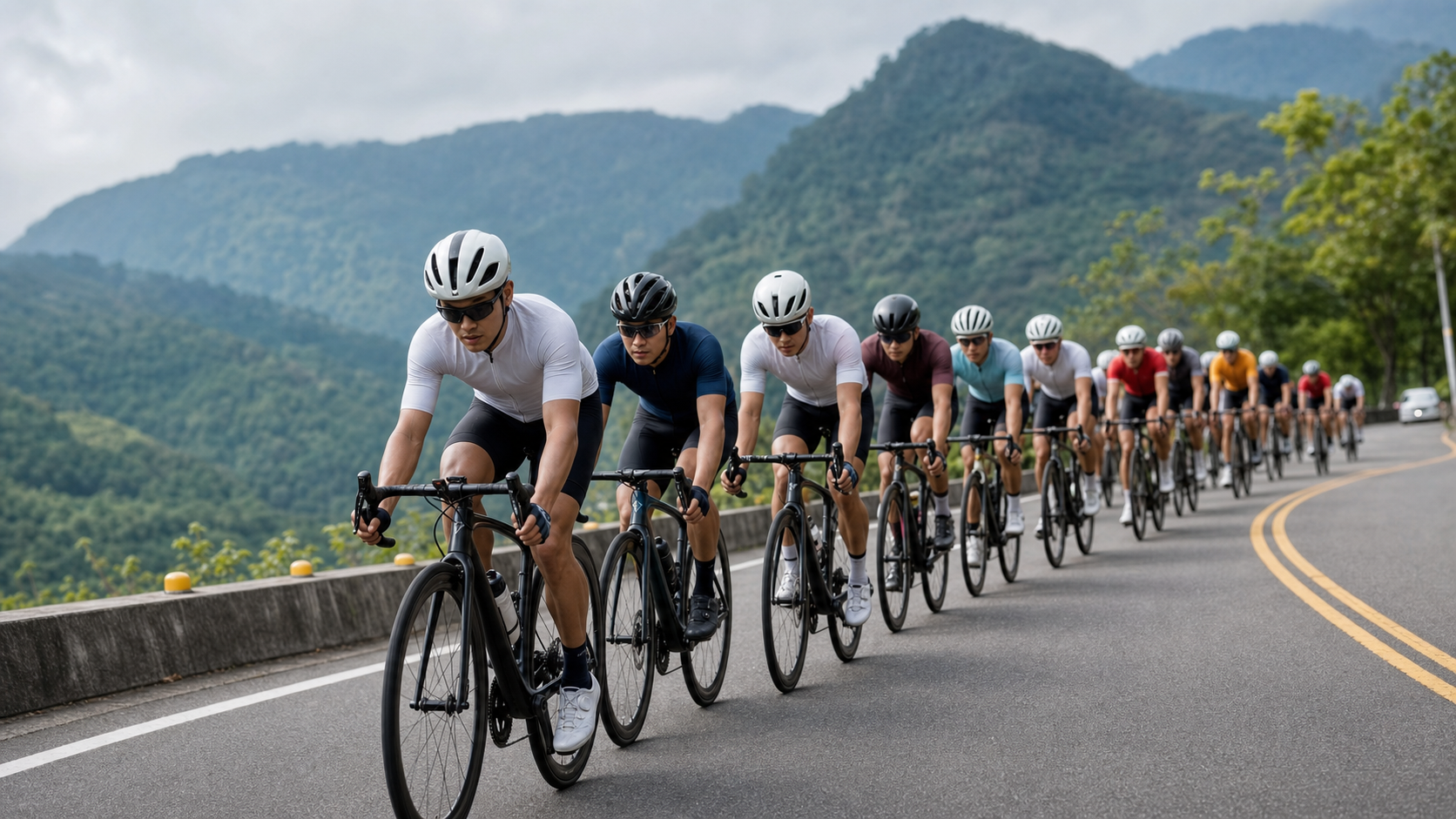
Road racing is the most tactically demanding discipline in cycling. Unlike the solitary battle of a time trial, road racing is filled with strategy, gamesmanship, and teamwork within the peloton. An experienced group rider can conserve 20–40% more energy than a rider unfamiliar with pack techniques under the same physical condition, gaining a decisive edge in the final sprint or climb.
For amateur cyclists in Taiwan, group riding is the most critical skill to master when entering races. Many first-time racers end up exhausted and dropped because they are unfamiliar with pack etiquette, or they affect other riders due to technical issues, losing the joy of racing.
Fundamentals of Peloton Dynamics
Understanding the physics of the peloton is the first step to mastering group riding.
| Position in the Peloton | Aerodynamic Drag Saved | Pros and Cons |
|---|---|---|
| Front (on the pace) | 0% | Most demanding, but controls the tempo |
| 2nd–5th position | 20–30% | Energy-saving with good visibility |
| Middle of the pack | 35–40% | Most energy-efficient, but little room to react |
| Back of the pack | 30–35% | Energy-saving but high risk (accordion effect) |
The Danger of the Accordion Effect
When the group accelerates or decelerates, riders at the back must make much larger speed adjustments than those at the front—a phenomenon known as the “accordion effect.” A rider at the rear may need to briefly sprint at 5 km/h just to keep up when the front only accelerates by 1 km/h. This means that although aerodynamic drag is lower at the back of the pack, energy expenditure can actually be higher than in the middle.
The ideal position is the front third of the group, where you can save significant energy while still responding quickly to accelerations and splits.
Essential Drafting Techniques
Wheel Gap Control
Maintaining a wheel gap of approximately 30–50 cm from the rider ahead is the core skill of group riding. Too far back and you lose the draft effect; too close and you risk overlapping wheels and crashing. Beginners should start with a 1-meter gap and gradually close it as proficiency improves. Note: increase the gap appropriately on descents or at high speeds.
Vision Management
The most common mistake among beginners is staring at the rear wheel of the rider directly ahead. Proper vision management is to “look 2–3 riders ahead,” allowing you to anticipate the movement of the entire group rather than reacting passively after the fact.
Responding to Group Accelerations
Accelerations in the group typically follow several patterns:
- Progressive acceleration: The gradient increases or someone gradually picks up the pace, giving ample time to prepare
- Sudden attack: A rider suddenly accelerates in an attempt to break away—you must react immediately, as hesitating for more than 2 seconds may cost you the group
- Organized pace-lining: The front rider pulls off to the side after finishing their turn, causing the group to accelerate as a whole—stay calm and follow through
Tactical Positioning
Preparation Before a Climb
Before entering a climb, move up to the front quarter of the group in advance. The group will naturally split according to climbing ability on the ascent. If you start the climb from the back, you may need to expend extra energy to close the gap when the front accelerates, ultimately getting dropped anyway.
The Position Battle Before the Final Sprint
The final 5–10 kilometers before the finish line are the most critical period for position fighting. Sprinters rely on their “lead-out train” teammates to protect their position. Even amateur riders competing solo need to understand the group’s dynamics during this phase to avoid being pushed to the outside and losing their sprint opportunity.
Practical Advice
- Start with small groups: Beginners should practice group riding in small training groups of 5–10 riders before taking on larger race pelotons
- Know the race rules: Regulations regarding pace-lining and blocking vary across races in Taiwan—read the rulebook carefully before the race to avoid time penalties or disqualification
- Practice emergency braking: Sudden braking is sometimes necessary in the pack; practicing emergency stops regularly can reduce the risk of accidents
- Communication and hand signals: Learning standard group hand signals (hazard warnings, turns, slowing down, etc.) protects both yourself and others
- Conservative approach for first races: For your first road race, aim to “finish safely and learn by observing” rather than chasing a result
Conclusion
Group riding is an art that takes time to master. Every road race is a new learning experience—even professional riders reflect on their positioning and timing after each race. For amateur riders, enjoying the cooperation and gamesmanship with fellow riders in the peloton is itself the greatest appeal of road racing.
Related Reading
- Peloton Positioning in Road Racing: Aerodynamic Principles for Saving Energy
- Group Riding in Road Races: How to Find a Safe Position in a 150-Rider Peloton
- Road Bike Group Riding Techniques: Safe and Energy-Efficient Drafting Skills
- Complete Analysis of Professional Cycling Team Tactics: Formations, Echelon Effect, and Final Sprint Launch
2025 海鷗團體繞圈賽 / 前八強賽事精華!/ 環台賽等級拍攝 / 國手菁英隊伍較勁 / CT Yeh #公路車
8 個月前
CT 喇低賽) 武嶺牽車 才是王道 西進牽車四小時內秘訣 攝手位置 如何判斷 防抽筋小秘訣
7 年前
備戰 戀戀197 賽前關門點分析 西濱團練 #公路車 4K高畫質
6 年前
新屋團體繞圈賽 | 眾多菁英好手賽道奔馳 | 千瓦女子軍團 | 無敵交管狂獲好評 明年你一定不能錯過 | #公路車
5 年前
風櫃嘴 | 全台最多大砲的單車路線 | 尋寶網攝影師告訴你怎麼擺拍起來才好看 | 熱門攝影地點巡禮
6 年前
2025 紫南宮99.9K環縣自行車挑戰賽 直播 / 第一集團跟了20K / CT動態數據直播系統 / 公路車 / CT Yeh
1 年前
如何 搶 #中央山脈 報名 #公路車 #報名 #搶票
7 年前
戰略) Zwift Race 如何咬在第一集團 如何評估自己要開多少推力 (請開1.5倍速看)
7 年前