Handling Mechanical Failures in Cycling Races: On-Course Emergency Solutions for Flat Tires and Dropped Chains
Introduction
No rider wants to encounter a mechanical failure during a race, but prepared riders can respond quickly when one occurs and minimize the damage; unprepared riders may abandon a meticulously planned race over a simple flat tire.
Taiwan’s cycling events feature complex terrain—fine gravel on mountain roads, softened asphalt from summer heat, and overheated rims on long descents are all factors that increase the risk of mechanical failure. Understanding how to prevent and handle common failures is an essential skill for every serious competitor.
Common Failure Types and Occurrence Rates
| Failure Type | Occurrence Rate | Difficulty of Resolution | Key Preparation |
|---|---|---|---|
| Flat tire (tread puncture) | ★★★★★ | Moderate | Practice quick tire changes |
| Dropped chain | ★★★ | Easy | Learn chain re-engagement techniques |
| Derailleur malfunction (shifting failure) | ★★ | Moderate | Precise pre-race adjustment |
| Brake failure | ★ | Difficult | Thorough pre-race inspection |
| Loose quick release/axle | ★ | Easy | Confirm tightness before the race |
Quick Flat Tire Handling
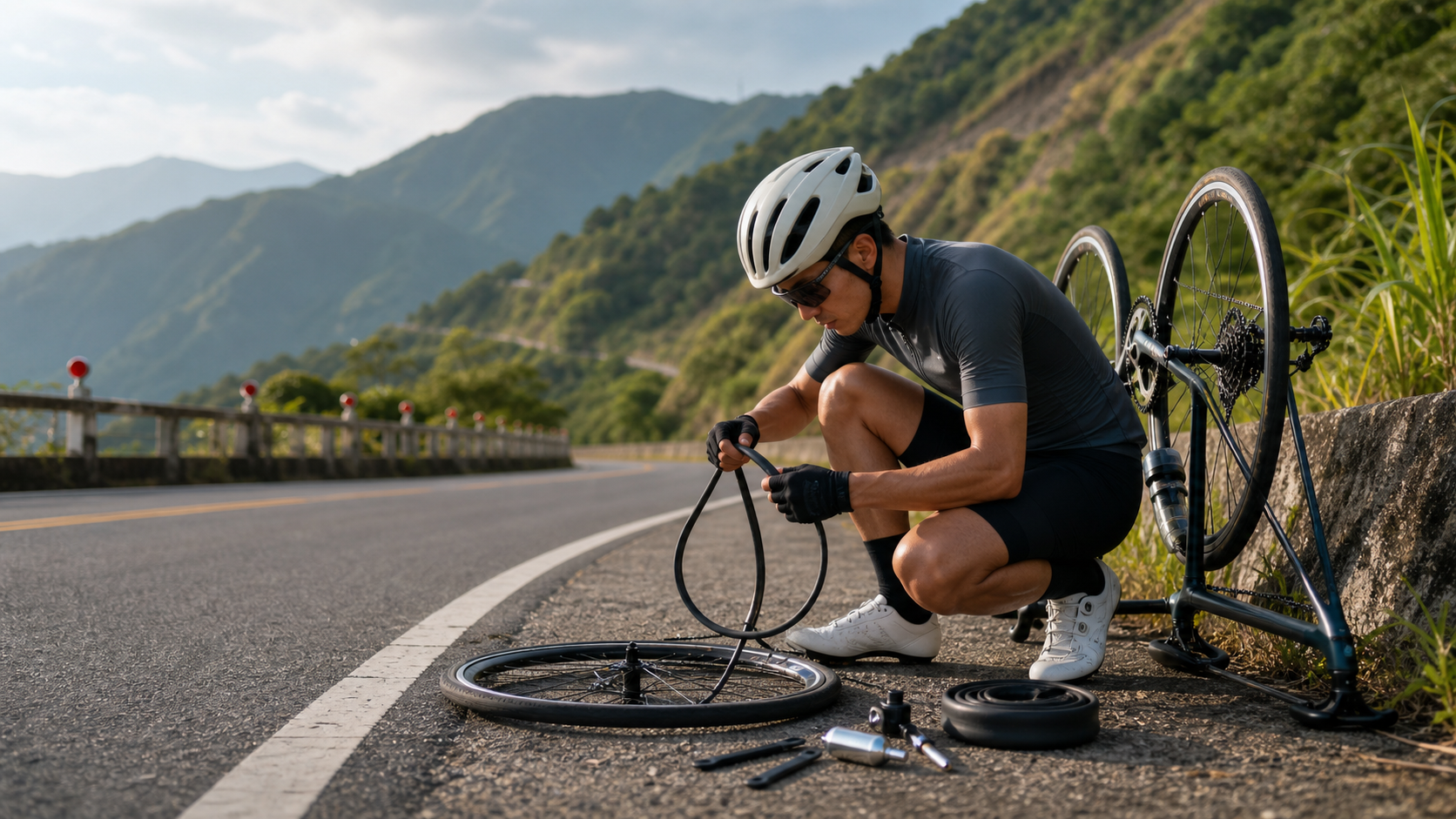
Flat tires are the most common mechanical failure in racing. The standard procedure when it happens:
1. Stop Safely (15 seconds)
The moment you feel the tire starting to soften, move immediately to the shoulder, avoiding sudden deceleration within the pack that could cause a chain-reaction crash. Stay calm, avoid hard braking, and let the bike slow gradually to a stop.
2. Diagnose and Choose a Solution (30 seconds)
Confirm which tire is flat (front/rear) and the type (slow leak or explosive blowout):
- Front flat: Relatively easy to handle—replace the tube or inflate with CO2
- Rear flat: More complex—requires dropping the chain and re-engaging the rear derailleur
3. Standard Quick Tire Change Procedure (Target 3–5 minutes)
- Deflate: Remove the valve core
- Pry: Use tire levers (recommend carrying 2–3) starting opposite the valve, prying in one consistent direction
- Remove the tube: Pull it out starting at the valve, then work it off one side of the rim
- Install the new tube: Insert the valve into the valve hole, then tuck the tube into the rim starting from the valve
- Mount the tire: Press it on by hand (the final section is the hardest—be careful not to pinch the tube)
- Inflate: Use a CO2 inflator to reach adequate pressure (about 80–90 psi for road tires is enough to ride on; top up to normal after the race)
CO2 vs. Floor Pump
CO2 inflators are the most common tool in racing. Their advantage is speed (inflation in 5 seconds); the drawback is that once triggered, they cannot be stopped mid-use. It is recommended to carry 2 CO2 cartridges plus 1 spare tube.
Handling a Dropped Chain
Front Derailleur Drop (chain falls to the inside of the crankset)
The most common chain-drop scenario, usually occurring when shifting to the smallest chainring or during a shift on a steep climb:
- Stop pedaling (continuing will make the chain harder to free)
- Shift the front derailleur to the smallest chainring position
- Hold the crankset with one hand, and with the other, lift the chain up from between the crank arm and chainring, then re-seat it on the chainring
- Pedal a few revolutions to confirm the chain runs smoothly
Rear Derailleur Drop (chain falls to the outside of the cassette)
Slightly more complex to handle:
- Shift the rear derailleur to the largest cog (easiest gear)
- Manually pick the chain up from the outside top of the cassette and re-seat it on the largest cog
- Pedal slowly for a few revolutions to let the chain settle naturally
On-the-Spot Response to Shifting Failures
If you encounter shifting failure during a race, don’t panic:
- Front derailleur failure: Manually push the chain to your preferred chainring position and rely on the rear derailleur to manage most of your speed
- Rear derailleur failure: Set the bike to the most comfortable fixed gear ratio and finish the remaining distance on that
- Electronic shifting battery dead: Check whether an emergency ride mode is available (varies by brand), or finish on a fixed gear ratio
Practical Advice
- Practice tire changes before the race: At least once per season, do a full tire change drill and time yourself to confirm you can finish within 5 minutes, building muscle memory
- Carry a spare parts checklist: CO2 ×2, spare tube ×1, tire levers ×2, quick link ×1, multi-tool
- Know the race’s neutral service: Large events usually provide neutral service vehicles—learn how to request assistance
- Preventive measures before high-risk sections: Drop tire pressure by 5–10 psi before gravel sections or long descents to reduce the chance of puncture flats
- Chain cleaning and lubrication: Good chain maintenance significantly reduces the likelihood of dropped chains and rough shifting—complete cleaning and lubrication the day before the race
Conclusion
Mechanical failures cannot be completely avoided, but the ability to respond calmly can be cultivated through preparation and practice. A rider who can change a tire and get back underway in 3 minutes, and one who needs 15 minutes or even abandons the race, face the same problem yet arrive at completely different outcomes. Make mechanical skills your competitive advantage, not your weakness.
Related Reading
- Emergency Handling of Bike Mechanical Failures: On-the-Road Fixes for Flats and Broken Chains
- Bike Touring Mechanical Failure Response: Quick Guide to Common Problems
- Wilderness Rescue: The Complete Guide to Emergency Mechanical Fixes on Bike Tours
- Handling Mechanical Issues on a Taiwan Loop Tour: Self-Rescue Steps for Flats and Broken Chains in the Wild
爬陡坡被爆胎的車友跑步超車 #cycling #里佳部落
9 個月前
Canyon 公路車斷把手 五年老車特規還能修嗎? 維修保養全記錄 feat. 501單車監理站 | 公路車 | CT Yeh
4 年前
碟煞公路車 銑面器 !? 原來銑完差這麼多! 降低蹭碟機率! | TIME 公路車 保養小記錄 | CT Yeh
3 年前
摔車後補裝備: 好市多新款單車安全帽& Specialized Romin 北高整路屁股都不痛的坐墊 | 一千元居然有MIPS | CT Yeh | 公路車
4 年前
CT 喇低賽) 單車 比賽總是沒照片? 攝影師的觀點大公開 姿勢就是力量! 請加速1.25倍收看
7 年前
#公路車 #Fitting 靠人工智慧APP 幫你調整單車
6 年前
自助洗車場 洗單車 50元有找 清鍊條大法 居然還有小小兵
7 年前
單車胎壓觀察到的有趣現象,SRAM Quarq TyreWiz 2.0 無內胎胎壓計 / 裝了有哪些幫助? / Tubeless / 公路車 / CT Yeh
1 年前