Introduction
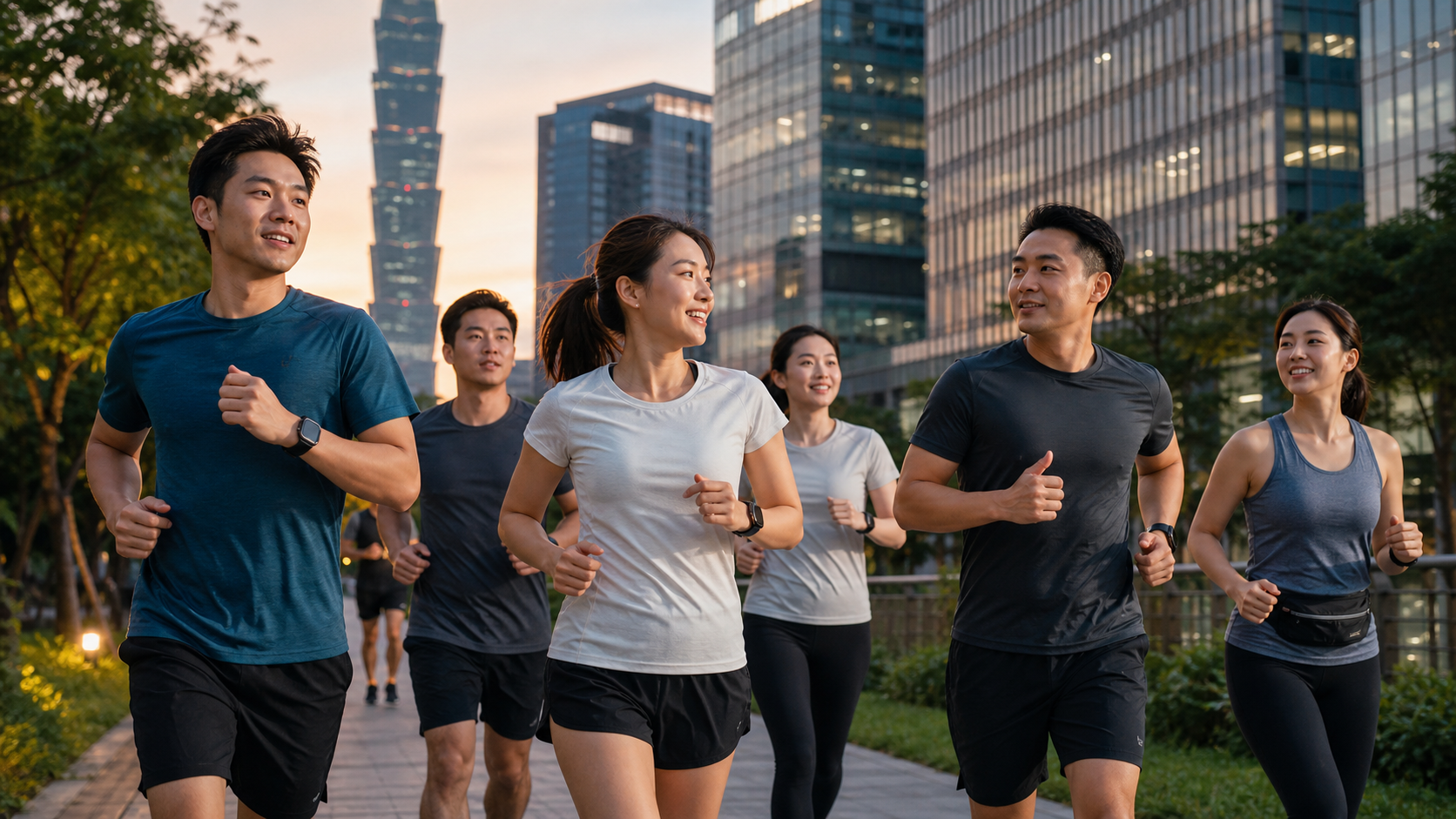
“Want to go for a run after work?” This phrase is becoming increasingly common in the hallways of Taiwanese tech companies, financial institutions, and foreign enterprises. Road running, a sport once confined to personal space, is quietly seeping into Taiwan’s workplace culture, becoming a new medium for companies to unite teams and for employees to build horizontal social networks.
The Formation of Taiwan’s Corporate Running Culture
The rise of corporate running teams in Taiwan can be traced back to the early 2010s, when the Taipei Fubon Marathon introduced the innovative “Corporate Relay” category. This format allowed companies to field teams of 4 to 5 runners to complete a full marathon in relay fashion, significantly lowering the technical barrier for collective employee participation and enabling even staff who couldn’t run a full marathon to represent their company. This design ignited the first spark of Taiwan’s corporate running culture.
Subsequently, corporate running culture expanded from race participation to daily training. Some companies began offering subsidies for after-work running training, changing rooms and shower facilities, and support for running club organizations, transforming running from an individual activity into a corporate benefit. Taiwanese tech companies and foreign enterprises are especially enthusiastic about this—employees gathering after work at the company lobby or a nearby park to run 5 to 10 kilometers together before heading home has become a daily sight at such companies.
Three Forms of Corporate Running Culture:
- Race-oriented: Companies form teams to participate in external marathons or corporate running events, with the primary goals of completing the race and showcasing the corporate image
- Training-oriented: Companies support daily running communities with fixed practice schedules and coach guidance, fostering a more serious training atmosphere
- Social-oriented: Focused on social runs and inter-departmental competition, emphasizing a relaxed and fun community culture without strict training plans
| Company Type | Running Culture Intensity | Common Forms | Level of Support |
|---|---|---|---|
| Foreign tech companies | High | Training-oriented + Race-oriented | High (subsidies, facilities, coaches) |
| Taiwanese tech companies | Medium-high | Race-oriented primarily | Medium (partial subsidies) |
| Banking and insurance | Medium | Social-oriented + Charity runs | Medium |
| Manufacturing | Low to medium | Race-oriented (image purposes) | Low |
| Startups | High but informal | Social-oriented | Low but strong self-organization |
The Workplace Social Function of Corporate Running
The impact of corporate running on workplace relationships often exceeds management’s expectations:
Breaking Down Hierarchical Conversation Spaces: When it comes to running, department heads and entry-level employees stand on the same starting line. During runs, the parallel conversation model (see “Running and Socializing” earlier) enables cross-hierarchical connections that are hard to establish on a daily basis. Many employees report that interacting with senior executives in the company running community feels more natural and effective than in formal settings.
Horizontal Cross-Departmental Connections: Taiwanese companies commonly have departmental silos. Running communities give employees from different departments the chance to meet outside work contexts, paving the way for future cross-departmental collaboration. Many running community members say that when they encounter running buddies from other departments at work, communication is exceptionally efficient.
Mental Health as Corporate Responsibility: In recent years, Taiwanese companies have begun incorporating employee mental health into ESG metrics. Organizing running activities has become a concrete action for companies to invest in employee physical and mental well-being, while also helping reduce employee turnover rates.
Practical Advice
If you want to promote a running culture at your own company, or join an existing corporate running community, here are a few points to consider:
- Start small: You don’t need to organize a formal running club right away. Simply post “Anyone want to run together?” in a Slack/Teams group and find 2 to 3 like-minded colleagues to get started
- Make use of company benefits: Many companies have sports subsidy budgets—ask HR whether running-related subsidies or facility support are available
- Design low-barrier participation formats: A fixed weekly casual after-work run is more likely to keep colleagues engaged than a high-intensity training plan
- Connect to external race goals: Using a corporate marathon or relay race as a shared goal can effectively boost community cohesion
- Stay inclusive: Ensure the running community welcomes members of all paces, avoiding “running off too fast” and making beginners feel excluded
- Regular post-run meals: Eating together is the most effective bonding tool in Taiwanese workplace culture—a meal after a run can rapidly deepen community relationships
Conclusion
The rise of Taiwan’s corporate running culture reflects a deep-seated need in workplace life: in a high-pressure work environment, people crave a shared ritual that simultaneously cares for the body, builds genuine connections, and offers a temporary escape from screens. Running provides all of this, plus a healthier pair of legs and a better mood. When your colleague asks you in the hallway, “Want to run after work?”—hidden within that question might be the beginning of your next most important workplace relationship.
Related Reading
- The Rise of Taiwan’s Road Running Culture: Evolution from Niche to Nationwide Sport
- Women’s Running Communities: The Development and Support Networks of Taiwanese Women’s Running Groups
- Running Apparel Culture: The Style Aesthetics and Personal Expression of Taiwanese Runners
- Taiwanese Women’s Running Communities: The Local Culture of Running Sister Groups and Mother Runners
浪漫 #臺三線 #單車 員工旅遊 桃園到台中 老少咸宜 環台賽 路線探索
6 年前
太平山單車員工旅遊 | 這樣玩CP值最高!| 公路車
5 年前
新屋團體繞圈賽 | 眾多菁英好手賽道奔馳 | 千瓦女子軍團 | 無敵交管狂獲好評 明年你一定不能錯過 | #公路車
5 年前
元宇宙運動 ! RouvyAR 虛擬實境約騎! 台灣路段開箱 帶你日月潭環潭一圈 | 團騎競賽參加教學 | 常見小問題整理 三人共享一年不用一千 | 公路車 | 訓練台 | CTYeh
5 年前
車隊介紹) 台北 一年開團365天 車隊 Apollo Ride 晨騎 好選擇 ( 陽明山 風櫃嘴 冷水坑 平等里 聖人 關渡 大稻埕 ) 找人騎車
7 年前
白沙屯媽祖進香在家走!UREVO 坡度自調走步機 / 可連接訓練遊戲APP MyWhoosh / 邊看直播邊走起來 / CT Yeh
11 個月前
2023桃園團體繞圈賽/環台賽等級拍攝/賽事精華/ 10人一隊缺一不可!50隊廝殺大場面 / 第三屆 海鷗繞圈賽 /公路車/CT Yeh
2 年前
抖肩舞 台灣x日本交流版 (台灣 vs 前橋) 赤城山登山賽 coincidance
8 年前