Introduction
The modern brain almost never truly rests. Work messages, social media stimulation, and worries about the future constantly drain our psychological resources throughout the day. Swimming, unexpectedly, has become the way many people find genuine mental quiet.
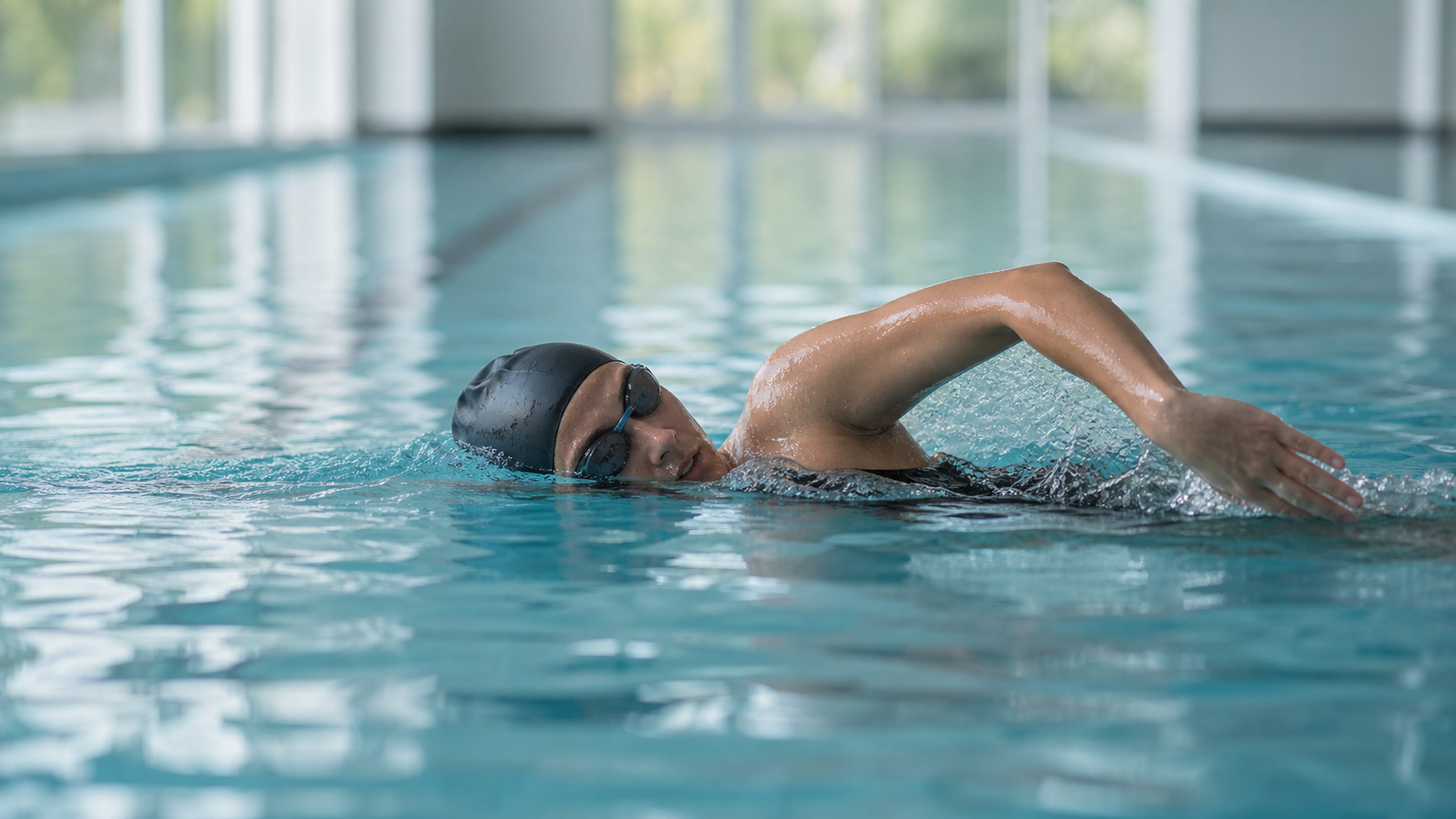
Underwater is a unique sensory environment: external sounds disappear, vision blurs, the body’s weight dissolves, and breathing becomes the strongest perceptual focus. This environment naturally meets the conditions for meditation—focusing on the present moment, filtering out external stimuli, and connecting with the body. “Mindful Swimming” has been developed for years in the Western mindfulness exercise community, and in Taiwan, more and more people are incorporating it into their swimming practice.
The Principle of Swimming as Dynamic Meditation
Meditation doesn’t have to be sitting still. Moving Meditation is an important branch of mindfulness practice, which includes walking meditation, tai chi, and yoga. Swimming’s characteristics make it an excellent vehicle for dynamic meditation:
Why it’s especially easy to enter a mindful state in water:
- Sensory isolation: Underwater, you can’t hear phones or voices, vision is limited, and external stimuli are greatly reduced
- Breathing becomes central: The rhythm of breathing while swimming forces you to focus on your breath, which closely aligns with the basic principles of meditation
- Rhythmic repetitive movements: The same strokes, kicks, and head turns for breathing create a mantra-like calming effect through repetition
- Enhanced body awareness: Water resistance lets you clearly feel every movement, helping to build body-scan awareness
Research shows that regular aerobic swimming can lower cortisol (stress hormone) levels and boost serotonin and dopamine secretion. When combined with mindfulness practice, these benefits are further amplified.
Specific Methods for Mindful Practice in Water
Basic practice: Breath anchoring
No need to change how you swim—just bring your attention to your breathing:
- When swimming freestyle, notice the sensation of each breath as you turn your head—the moment your mouth opens, the temperature of the air entering
- When your face is in the water, notice the sound of bubbles from exhaling and the sinking sensation of your body
- When thoughts drift away, gently bring your attention back to the rhythm of your breath, without judgment
Advanced practice: Body-scan swimming
Swim at a slow pace in the water, moving your attention sequentially through different body parts:
| Body part | Focus of sensation |
|---|---|
| Hands | The water pressure and direction felt by your fingers during the pull |
| Shoulders | The angle of the shoulder rotation, the sense of muscle extension |
| Chest | The sensation of the ribcage expanding on inhalation |
| Abdomen | The contraction of the core muscles during body rotation |
| Legs | The rhythm of the kick, the degree of knee bend |
| Toes | The sensation of extension in the toes while kicking |
Closed-eye swimming meditation (only in shallow water or with protection):
In a safe shallow area (within 1 meter), try briefly closing your eyes while floating or swimming backstroke, relying entirely on hearing and touch for orientation—this is a deep sensory deprivation practice that surprisingly reveals how much autonomous wisdom the body possesses.
Post-swim still-water meditation:
After finishing your swim, stand in the water for 3–5 minutes with your eyes closed, simply feeling the water surrounding you, feeling the body’s fatigue and relaxation, and feeling your breath gradually steady. This “post-swim stillness” is often the purest few minutes of the entire day.
Practical Advice
Tips for starting mindful swimming practice:
- You don’t need to be mindful for the entire swim at first; try incorporating mindfulness practice into just the last 10 minutes of each swim
- Slowing down is key: reduce your usual pace by 30–40% to give every movement room to be noticed
- Don’t force a “blank mind”—mindfulness isn’t about emptying your thoughts, but about observing them drift away and gently bringing them back—this mechanism is very easy to practice while swimming
- In Taiwan, you can search for courses like “正念游泳工作坊” (Mindful Swimming Workshop) or “Mindful Aquatics”; having an instructor makes it easier to get started
- For those with anxiety or emotional distress, multiple clinical studies support mindful swimming as an adjunctive therapy; you can discuss incorporating it into your daily practice with a psychologist
Recommended mindful swimming resources in Taiwan:
- Water yoga classes at Taipei’s public swimming pools contain some mindfulness elements
- “水中放鬆” (Water Relaxation) courses are available at some private swimming clubs
- Reading books like Open Water Swimming or the Chinese edition of 水中冥想 (Meditation in Water) can deepen your understanding
Conclusion
A swimming pool may be the place in Taiwan that least resembles a meditation center—harsh lighting, the smell of chlorine, and people splashing water from time to time. But it is precisely under these imperfect conditions that learning to draw your attention back to your own breath and body becomes true mindfulness practice. Water gives us a naturally quiet space, as long as we’re willing to dive in and find it. The combination of swimming and meditation is one of the best ways to let exercise nourish both body and mind.
Related Reading
- Mindful Swimming Practice: Training Methods for Water Meditation and Breath Awareness
- Swimming and Stress Management: Practical Methods of Water Meditation and Research on the Mental Health Benefits of Regular Swimming
- Swimming and Mental Health: Scientific Research on Water Meditation and Stress-Relief Effects
- Swimming and Stress Relief: The Mental Health Benefits of Water Exercise
[防寒衣體驗] 鐵人魂 三鐵 防寒衣試穿會 於松運 深水游泳池 鯨魚池
8 年前
#PUSHBIKE 原來這麼好玩! 小朋友 滑步車 初體驗 超可愛
6 年前
元宇宙單車運動!智騎 X7 Pro 智能訓練台 ThinkRider 居家線上練功
5 年前
實景訓練台) 彰化經典百K 高強度喵團 90分鐘 跟著一起練功 2019 Indoor workout Changhua Classic 100 Taiwan
7 年前
一個測試有沒有認真練車的方法😂 #公路車
10 個月前
[教學] Premiere 影片 手震 修正 教學 防抖 單眼 影像 GoPro 穩定 Video Stabilization
8 年前
近視雷射三個月後悔嗎?單車族/工程師必看,Smart TransPRK 術後血淚史與後遺症全公開 / CT Yeh
4 個月前
西進武嶺 免費訓練分析服務 Intervals | 練不夠還是練過頭?你哪一種類型選手?AI模型告訴你! | 備戰神器 | 公路車 訓練 | CT Yeh
4 年前