Introduction
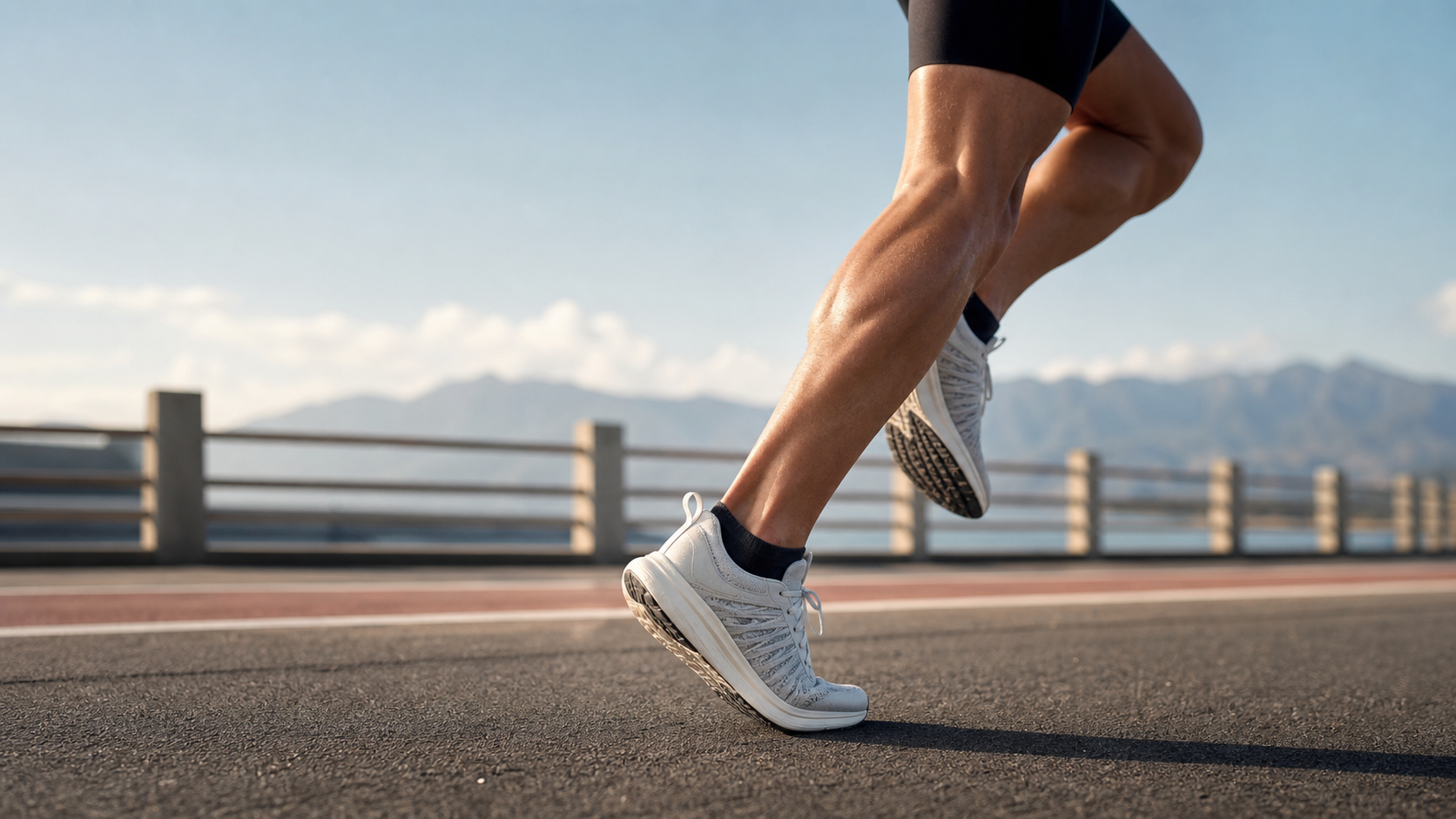
If there were a biological structure capable of storing and releasing energy equivalent to 35% of the propulsive force required for each running step, it would undoubtedly be the human body’s most remarkable energy-saving device. This is the elastic energy storage function of the Achilles Tendon. Modern sports science research reveals that the incredible running economy displayed by elite African long-distance runners stems largely from the superior energy storage efficiency of their Achilles tendons. Understanding the spring function of the Achilles tendon is essential knowledge for Taiwanese runners seeking to improve efficiency and prevent injuries.
Biomechanics of the Achilles Tendon: The Spring Model
The elastic energy storage of the Achilles tendon follows the working principle of the “Muscle-Tendon Unit”:
Stance Phase (Energy Storage): When the foot contacts the ground, body weight compresses the ankle, stretching the Achilles tendon. During this time, the gastrocnemius and soleus muscles contract nearly isometrically (with minimal shortening), and a large amount of mechanical energy is stored as elastic potential energy within the collagen fibers of the Achilles tendon.
Push-off Phase (Energy Release): Just before toe-off, the Achilles tendon releases its stored elastic energy, generating forward-upward propulsion. Only at this point does the gastrocnemius begin actively shortening; the two forces combine to produce a powerful push-off.
| Running Speed | Achilles Tendon Energy Storage (J/step) | Percentage of Total Propulsive Energy |
|---|---|---|
| Jogging (6 min/km) | Approx. 25–30 J | 30–35% |
| Marathon Pace (4:30/km) | Approx. 35–45 J | 40–50% |
| 10K Pace (3:30/km) | Approx. 50–60 J | 45–55% |
| Sprinting | Approx. 70–90 J | 50–60% |
The Achilles tendon’s elastic energy recovery rate reaches as high as 90–95% (far exceeding synthetic rubber’s 80%), making it one of the most efficient biological elastic structures on Earth.
Factors Affecting Achilles Tendon Energy Storage Efficiency
Not everyone’s Achilles tendon possesses the same energy storage capacity. Key factors include:
Achilles Tendon Morphological Characteristics:
- Tendon Length: Longer Achilles tendons (relative to gastrocnemius muscle belly length) have greater energy storage capacity, which explains why runners with slender, long legs often exhibit better running economy
- Tendon Cross-Sectional Area: A thicker Achilles tendon has higher stiffness, allowing it to maintain elasticity without saturation under greater loads
- Collagen Fiber Arrangement: Well-trained Achilles tendons have more organized collagen fiber alignment, resulting in higher energy storage efficiency
Neuromuscular Factors:
- The precise timing of the stretch reflex affects the synchronization of energy storage and release
- The level of muscle pre-activation determines stiffness at the moment of ground contact
Synergy with the Plantar Fascia:
- The Plantar Fascia is an extension of the Achilles tendon’s energy storage system; together they form the “Windlass Mechanism”
- Collapsed arches (flat feet) reduce the efficiency of the windlass mechanism, decreasing elastic energy recovery
Methods for Training Achilles Tendon Elastic Energy Storage
The good news is that the Achilles tendon’s energy storage capacity can be significantly improved through targeted training:
-
Isokinetic/Isometric Calf Strength Training:
- Single-leg calf raises (standing position): 3 sets × 15 reps, slow lowering (3–4 second eccentric phase), fast push-up
- Purpose: Increase collagen fiber density and organization in the Achilles tendon
-
Plyometric Training:
- Jump rope, hopping in place, box jump land-and-rebound: trains the Achilles tendon’s rapid store→release cycle efficiency
- Start with low impact and gradually increase intensity every 2 weeks
-
Isometric Loading:
- With the ankle at 70 degrees of dorsiflexion, hold a wall-supported single-leg position for 30–45 seconds × 5 sets
- Research shows this is particularly effective for rehabilitating and preventing Achilles tendinopathy
-
Progressive Barefoot/Minimalist Running:
- 1–2 times per week, perform 10–15 minutes of easy running on grass
- Forces the Achilles tendon to take on more elastic energy storage work, gradually building capacity
Practical Recommendations
A comprehensive strategy for preventing Achilles tendon injuries while strengthening elastic function:
- Warm-up is Essential: When morning temperatures are lower in Taiwan, Achilles tendon flexibility decreases; warm up with 10 minutes of easy jogging before picking up the pace
- Control Training Volume: Increase weekly mileage by no more than 10%; the Achilles tendon adapts more slowly than muscle (6–12 weeks)
- Heel-to-Toe Drop Selection: Progressively transition from 10mm drop shoes to lower drops, giving the Achilles tendon adequate adaptation time
- Calf Strength is a Protective Shield: Twice-weekly eccentric calf training is the most effective measure for preventing Achilles tendinitis
- Don’t Ignore Pain Signals: If morning stiffness in the Achilles tendon area persists for more than 2 weeks, or if pain occurs after activity, immediately reduce mileage and seek professional evaluation
Conclusion
The Achilles tendon is a precision device that evolved over millions of years specifically for long-distance running. Its elastic energy storage function is a key secret to why humans can run continuously for hours without fatigue. If Taiwanese runners can correctly understand and train this natural spring, they can not only improve running efficiency but also build a physiological defense line against injuries. Every calf training session is an investment in your most important running gear—your own body.
Related Reading
- Tendon Elasticity in Road Running: How the Achilles Tendon Stores and Returns Energy to Make You Run More Efficiently
- Elastic Energy Storage of the Achilles Tendon: The Invisible Engine of Running Economy
- Storage and Return of Elastic Energy in Running Tendons: An Ultrasound Measurement Study of the Achilles Tendon
- Application of Plyometric Training in Road Running: A Guide to Enhancing Elastic Tendon Power
#公路車 #Fitting 靠人工智慧APP 幫你調整單車
6 年前
西進武嶺 免費訓練分析服務 Intervals | 練不夠還是練過頭?你哪一種類型選手?AI模型告訴你! | 備戰神器 | 公路車 訓練 | CT Yeh
4 年前
3D 列印車褲墊 / 舒適改善? / 無痕 x 分區壓縮 / ATK & Decider系列 / JE22黑科技 / #公路車 #CTYEH
11 個月前
iPhone內建一秒變長腿🤣 車友必備#cycling
2 年前
白沙屯媽祖進香在家走!UREVO 坡度自調走步機 / 可連接訓練遊戲APP MyWhoosh / 邊看直播邊走起來 / CT Yeh
11 個月前
CT 喇低賽) 武嶺牽車 才是王道 西進牽車四小時內秘訣 攝手位置 如何判斷 防抽筋小秘訣
7 年前
Fitting訓練兩用功率車 ! Thinkrider ST900 完整實測!/ 坡度升降 / 鄰居測試/ smart bike/公路車/ CT Yeh
2 年前
戰略) Zwift Race 如何咬在第一集團 如何評估自己要開多少推力 (請開1.5倍速看)
7 年前