Introduction
Standing on the starting block, with competitors beside you, spectators below, and announcements over the loudspeaker—this moment’s mental state often determines the outcome of the race. Many Taiwanese swimmers perform excellently in training but underperform in important competitions. The root of the problem usually lies not in physical fitness, but in a lack of Psychological Skills.
Psychological skills are not innate; like muscular strength, they can be developed through systematic training. This article focuses on two core skills: Attentional Control and Pre-race Routines.
Attentional Control: Focusing on What You Can Control
Attentional Narrowing Theory
Sports psychology research shows that under high-pressure conditions, athletes’ attention tends to “spread outward”—overly focusing on spectators, opponents, or race outcomes, while neglecting the “Process Cues” that matter most for performance.
External Attention Traps (to avoid):
- “That swimmer is very strong; I might not win.”
- “If I don’t break my personal best, I’ll let my coach down.”
- “The spectators are watching me; I can’t mess up.”
Process Cues (to focus on):
- “Stable entry angle, fingers closed.”
- “Push hard off the wall on turns, delay breathing.”
- “Maintain stroke rate after 50m; don’t rush.”
Attention Training Methods
| Method | How to Apply | Frequency |
|---|---|---|
| Cue Words | Repeatedly use 1–2 cue words during training to stay focused | Every training session |
| Mindful Swimming Practice | 10 minutes of conscious awareness of each stroke’s sensation | 3 times per week |
| Distraction Simulation Training | Add noise or spectator viewing during training to practice maintaining focus | 1–2 times per month |
| Meditation Practice | 5–10 minutes of breathing meditation daily to enhance general attentional capacity | Daily |
Pre-race Routines: Building Your Personal Pre-race Ritual
A Pre-race Routine is a fixed sequence of behavioral and psychological preparation, designed to:
- Reduce pre-race anxiety (through the sense of security brought by familiar processes)
- Activate the optimal arousal state (bringing the mind and body into competition mode)
- Reduce unnecessary decision-making costs (saving cognitive resources for the race itself)
Example of a Typical Pre-race Routine (Race Day)
2 hours before the race:
- Fixed breakfast or pre-race meal (no trying new foods)
- Play personal training playlist
- Read pre-race preparation notes (technical focus points + strategy reminders)
60 minutes before the race:
- Change into racing swimsuit
- 5 minutes of breathing regulation in the locker room
- Mental Imagery: mentally swim through the entire race in first person, feeling every turning point
15–20 minutes before the race (in-water warm-up):
- Fixed warm-up sequence (e.g., 400m mixed warm-up → 4×50m progressive pace)
- Starting block test + 1–2 sprint efforts to feel the pace
In the marshalling area:
- Relaxed breathing (4-second inhale, 4-second exhale)
- Repeat 1–2 cue words (e.g., “relaxed entry,” “steady stroke rate”)
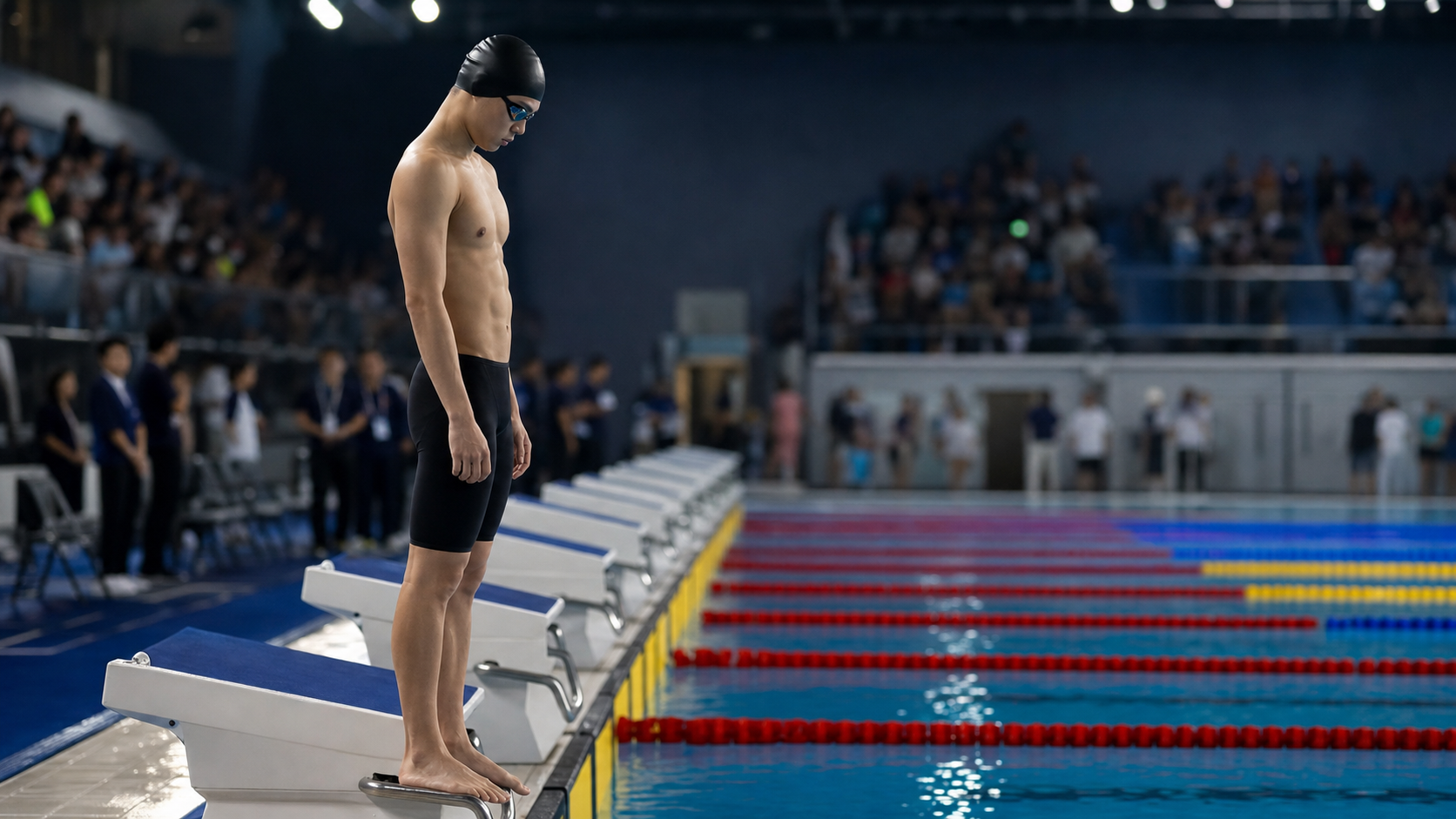
After stepping onto the starting block:
- Fixed physical actions (e.g., arm swings, deep breaths)
- Look forward, focusing attention on “the moment of entry into the water”
Practical Recommendations
- Rehearse your pre-race routine repeatedly in training so it can be executed automatically during competition
- Design an “If-Then Plan”: anticipate how to respond if unexpected situations occur before the race
- Avoid lengthy technical discussions with your coach before the race: keep your mind simple and avoid overloading your brain
- Record your mental state before and after each race: identify the psychological characteristics associated with your best performances
- Young athletes should develop a formal pre-race routine from age 14: the earlier it is established, the better
Conclusion
Swimming competitions are not just physical contests; they are also mental ones. Attentional control keeps you clear-headed under pressure, and a pre-race routine ensures you enter the water in optimal condition. These two skills take time to develop, but once internalized, they become your most reliable weapons in the most critical moments. Starting today, incorporate mental training into your daily routine.
Related Reading
- Mental Preparation for Swimming Races: Breathing and Focus Techniques Before the Start
- Mental Preparation for Swimmers: Pre-race Anxiety Management and Imagery Training Practice
- Pre-race Mental Preparation for Swimming: How Elite Athletes Find Calm in the Water
- Managing Pre-race Nerves in Swimming: Analyzing Pre-race Anxiety from a Sports Psychology Perspective
[教學] Premiere 影片 手震 修正 教學 防抖 單眼 影像 GoPro 穩定 Video Stabilization
8 年前
西進武嶺 免費訓練分析服務 Intervals | 練不夠還是練過頭?你哪一種類型選手?AI模型告訴你! | 備戰神器 | 公路車 訓練 | CT Yeh
4 年前
CT Talk) 數據面窺看 武嶺大神們 平時的備戰 共通點 (娛樂性質XD)
7 年前
FTL 與 SYB 車隊專訪 西進武嶺 實用攻略分享! 2小時 如何練?!你不知道的眉角!新手準備武嶺必看 EP1 | 實力派女車友 | 精華版 | 公路車 | CTYeh
4 年前
西進武嶺 自製新版AI配速表產生器 x 賽前攻略 抱佛腳! 沒有功率計也可以產生配速表嗎?有什麼其他眉角賽前要注意的呢? | 西進武嶺 / 東進武嶺 KOM 攻略 | 公路車 | CT Yeh
4 年前
live) 超越北高 之一日北高12小時 策略
7 年前
備戰 戀戀197 賽前關門點分析 西濱團練 #公路車 4K高畫質
6 年前
崇越盃武嶺冠軍高手 賽前JJSC 群峰會精華!對應大數據分析,會有落差嗎?/ feat. JJSC中部公路車約騎 /公路車 / CT Yeh
2 年前