Introduction
“Training your glutes” has become a fitness buzzword in recent years, but for runners, glute training means far more than aesthetics. The glutes are the largest muscle group in the human body, playing a dual role in running: generating propulsive force and stabilizing the pelvis. When glute function is insufficient, the entire kinetic chain compensates, eventually leading to injuries in the knees, hips, or lower back.
The glutes are made up of three main parts: the gluteus maximus, the gluteus medius, and the gluteus minimus. Of these, the gluteus maximus and gluteus medius are the most critical for runners, but they serve completely different functions during running and therefore require different training approaches.
Gluteus Maximus: The Core of Propulsion
The gluteus maximus is the largest single muscle in the human body and bears the primary responsibility for propulsion during the “push-off phase” of running. As the foot is about to leave the ground, the gluteus maximus contracts powerfully to drive the body forward.
Symptoms of a weak gluteus maximus while running:
- Insufficient push-off power, making running feel “laborious but slow”
- Excessive compensation from the quadriceps, increasing stress on the front of the knee
- A forward-leaning torso and a “sitting-low” hip posture while running
- Noticeable lower back fatigue after long-distance runs
Effective gluteus maximus strengthening exercises:
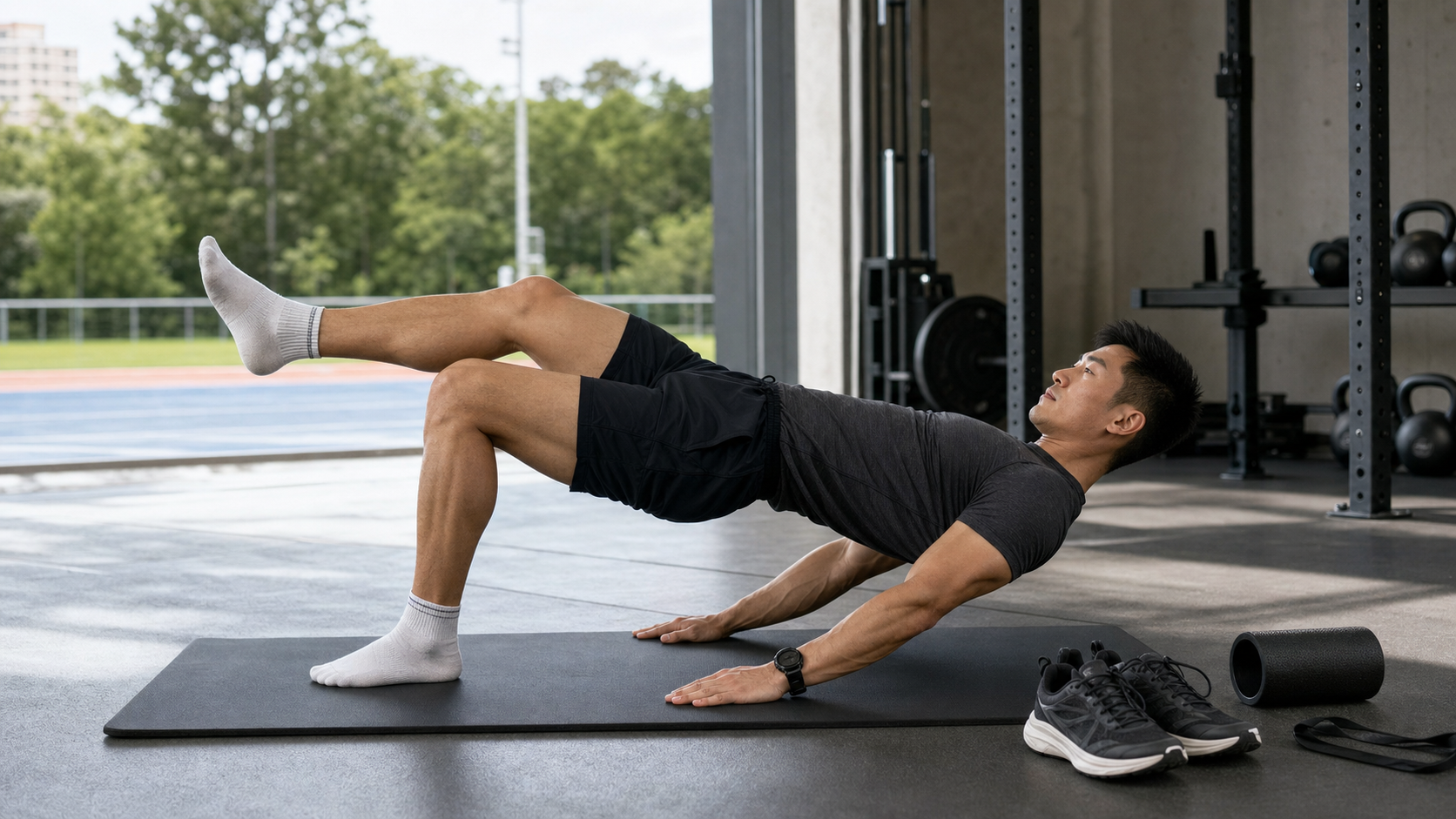
- Glute Bridge: The most fundamental gluteus maximus exercise, which can be progressed with a resistance band or performed single-leg
- Romanian Deadlift: Emphasizes the hip hinge pattern, which closely mirrors the running push-off motion
- Bulgarian Split Squat: Combines push-off drive with single-leg stability, making it one of the best compound exercises for runners
Gluteus Medius: Guardian of Pelvic Stability
The gluteus medius sits on the outer side of the hip, and its primary function is to keep the pelvis level during single-leg stance. During running, every time one foot lands, the gluteus medius on the opposite side must contract powerfully to prevent the opposite side of the pelvis from dropping.
| Gluteus Medius Condition | Running Performance | Common Injuries |
|---|---|---|
| Strong | Stable pelvis, smooth gait | Low injury risk |
| Weak | Pelvis rocks side to side (Trendelenburg sign) | Iliotibial band syndrome, runner’s knee, low back pain |
Gluteus medius weakness is more common among female runners, which is related to female pelvic structure (a larger femoral neck angle forming a wider Q-angle), which can easily lead to “knee valgus” (inward knee collapse).
Effective gluteus medius strengthening exercises:
- Clamshell: Lying on your side with knees bent at 90 degrees, slowly abducting the top knee — the most beginner-friendly gluteus medius exercise
- Side-lying hip abduction: Lying on your side with legs straight, raising the top leg in a straight-leg abduction, more challenging than the clamshell
- Lateral band walk: With a resistance band placed above the knees, walking sideways to dynamically strengthen the gluteus medius
- Single-leg deadlift: Trains the stabilizing function of the gluteus medius in a dynamic movement, the closest exercise to an actual running scenario
Common Mistakes in Glute Training
Many runners make the following mistakes when training their glutes:
- Only doing heavy squats: Heavy squats primarily target the quadriceps and erector spinae, and the glutes may not be sufficiently engaged
- Neglecting the gluteus medius: Most people only know to train the gluteus maximus, but the gluteus medius is even more critical for running
- Anterior pelvic tilt during training: Excessive arching of the lower back during glute bridges or squats indicates the core isn’t engaged, which also prevents the gluteus maximus from contracting effectively
- Moving too fast: Glute training emphasizes “feeling the muscle contract” — moving too quickly instead lets other muscle groups compensate
Practical Recommendations
Twice a week, perform a dedicated glute training session in the following order:
- Clamshell × 15 reps × 3 sets (warm-up activation)
- Lateral band walk × 20 steps × 3 sets (dynamic activation)
- Glute bridge (with resistance band) × 15 reps × 3 sets
- Bulgarian split squat × 8-10 reps × 3 sets
- Single-leg deadlift × 8 reps × 3 sets
During your next run, pay attention to whether you feel more glute engagement and better pelvic stability. If you experience moderate delayed-onset muscle soreness in your glutes after running, that’s a sign the training is working!
Conclusion
Glute training is one of the best investments a runner can make: it strengthens propulsion and pelvic stability at the same time, effectively preventing the most common running injuries. The gluteus maximus makes you run more powerfully, and the gluteus medius makes you run more stably — you need both. Starting today, make glute training part of your running program, and your knees, hips, and lower back will thank you.
Related Reading
- Preventive Strength Training: Twice-Weekly Glute and Core Work Cuts Injury Rates
- Glute Training for Runners: Applying Bridges, Clamshells, and Side Leg Raises to Running
- Glute Training for Road Runners: Weak Gluteus Maximus Is the Real Culprit Behind Knee Injuries
- The Complete Guide to Glute Activation Training: Awaken Your Most Powerful Engine
一日北高/長距離團騎 常見問題補充篇 / 組團或跟團的眉角 / 壯車友容易被瘦車友慢性拉爆 / 原來屁股痛可能是這個原因...? / 風場配速法 / 公路車 / CT Yeh
2 年前
實景訓練台) 彰化經典百K 高強度喵團 90分鐘 跟著一起練功 2019 Indoor workout Changhua Classic 100 Taiwan
7 年前
西進武嶺 免費訓練分析服務 Intervals | 練不夠還是練過頭?你哪一種類型選手?AI模型告訴你! | 備戰神器 | 公路車 訓練 | CT Yeh
4 年前
2018 田中馬拉松 全程健跑 VR 360 環景錄影 體驗現場狂野加油氣氛! Insta 360
7 年前
Never Stop 西進武嶺 前後雙機 完整全程錄影 訓練台 實境
8 年前
2019 柯P 超越北高 第一集團實錄 (11小時實錄請參考另一部影片) 一日雙城 一日北高 NeverStop Taiwan Long Distance Cycling Challenge
7 年前
一日北高常見問題大集合 | 攻略 | 路線 | 訓練 | 補給 | 自行車 單車 | 一日雙城 | 雙塔 | TWB北高360 | 屁股痛
6 年前
福隆鐵人團練隨拍
8 年前