Introduction
The term “core” has been discussed in the running community for years, but many runners still misunderstand core training. The most common misconception is equating core training with abdominal training, believing that doing a few sets of sit-ups and planks every day counts as core work.
In reality, the core capacity required for running is “Dynamic Stability”—maintaining a neutral spine and pelvis position while the body is in motion, resisting unnecessary rotation and lateral flexion. This ability is fundamentally different from the appearance-focused abdominal training.
The True Function of the Running Core
During running, the core (broadly including the transversus abdominis, multifidus, pelvic floor muscles, and diaphragm) plays the following roles:
Energy Transfer Relay Station
Running propulsion is generated from the ankles and glutes, and must pass through a stable core to reach the upper body, driving arm swing and torso rotation. If the core is unstable, energy is lost during transfer, reducing running efficiency.
Shock Absorption
With every foot strike, the ground reaction force is approximately 2–3 times body weight. The core muscles must work together to absorb and disperse this impact, protecting the spine and joints.
Maintaining Postural Stability
In the later stages of long-distance running, fatigue often first manifests as core collapse—the lower back begins to sag, anterior pelvic tilt increases, leading to compensatory leg injuries.
| Core Function | Related Muscles | Running Impact |
|---|---|---|
| Anti-rotation stability | Obliques, multifidus | Arm swing efficiency, torso without swaying |
| Anti-lateral flexion stability | Quadratus lumborum, gluteus medius | Maintaining pelvic level |
| Intra-abdominal pressure maintenance | Transversus abdominis, pelvic floor muscles | Spinal protection, overall stability |
| Hip-spine linkage | Iliopsoas, erector spinae | Stride efficiency |
More Effective Exercises Than Sit-Ups
Traditional sit-ups primarily train the “flexion” movement of the rectus abdominis, but running rarely requires core flexion—it demands more “anti-rotation” and “anti-extension” capacity. Here are core exercises better suited to running needs:
Anti-Extension:
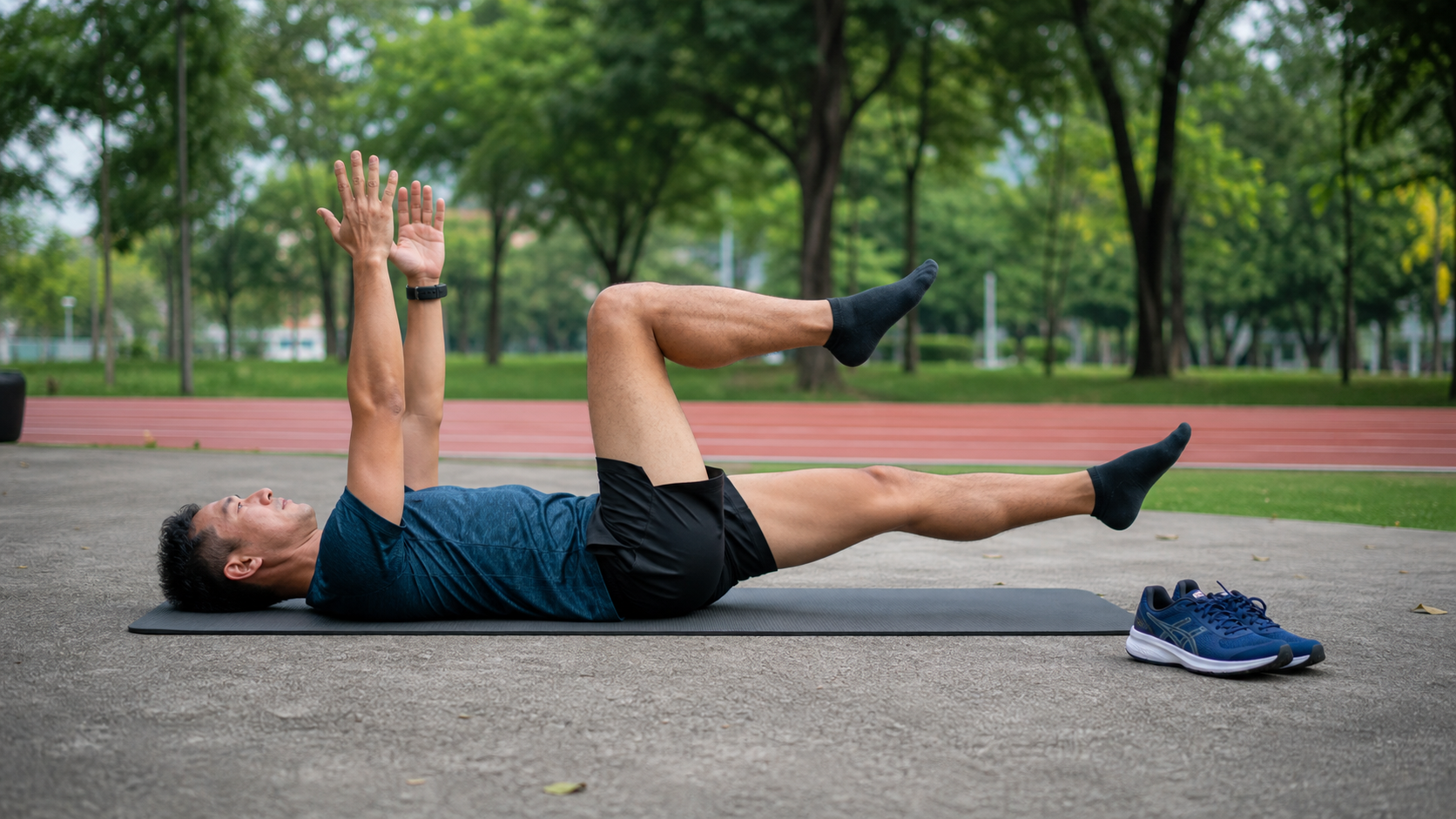
- Dead Bug: Lie on your back with limbs raised, slowly lower opposite arm and leg without touching the ground, keeping the lower back pressed into the floor. This is the safest and most effective transversus abdominis exercise.
- Advanced Plank: Once you’ve mastered the basic plank, add alternating limb raises (Bird Dog Plank) for a dynamic challenge.
Anti-Rotation:
- Pallof Press: Anchor a resistance band to the side, stand and press forward while resisting rotational force—the most direct anti-rotation exercise.
- Side Plank: Trains lateral stability of the quadratus lumborum and obliques; can add leg abduction to increase difficulty.
Dynamic Core Stability:
- Single-Leg Deadlift: Maintains a neutral spine during dynamic movement while challenging both the core and glutes.
- Lunge with Rotation: Combines lower-body drive with upper-body rotation—a compound movement that closely mimics the core demands of running.
Common Core Training Mistakes
- Holding your breath: Proper core training should be performed with natural breathing. While breath-holding can temporarily increase intra-abdominal pressure, it doesn’t transfer to running.
- Moving too fast: The focus of core training is “control”—moving slowly ensures deep muscles are truly engaged.
- Only training the front of the abdomen: Neglecting the posterior (multifidus, erector spinae) and lateral (quadratus lumborum) muscles results in incomplete core stability.
- Plank with an arched lower back: An arched lower back indicates the core isn’t properly activated. Movement quality matters more than duration.
Practical Recommendations
Performing 5–10 minutes of core activation before and after each run can significantly improve running posture:
Pre-Run Activation (5 minutes):
- Dead Bug × 10 reps (each side)
- Side Plank × 30 seconds (each side)
- Bird Dog × 10 reps (each side)
Post-Run Strengthening (10 minutes):
- Pallof Press × 15 reps (each side)
- Advanced Plank (dynamic) × 30 seconds
- Lunge with Rotation × 10 reps (each side)
After long-distance training, pay special attention to your core state in the final kilometers. If you feel your lower back beginning to sag, it means your core endurance needs strengthening.
Conclusion
The goal of core training isn’t six-pack abs—it’s maintaining spine and pelvis stability throughout kilometers or even tens of kilometers of running. Swap sit-ups for dead bugs, Pallof presses, and dynamic planks, and your running posture will become more efficient with significantly reduced injury risk. True core strength is being able to maintain an upright posture after finishing a full marathon.
Related Reading
- Core Stability and Running Efficiency: Which Core Exercises Are Most Effective
- Runner’s Core Training: Anti-Rotation, Anti-Lateral Flexion, and Pelvic Stability
- The Impact of Core Stability on Running Speed: More Than Just Ab Training
- Core Muscle Activation During Running: The Scientific Link Between Stability and Efficiency
[教學] Premiere 影片 手震 修正 教學 防抖 單眼 影像 GoPro 穩定 Video Stabilization
8 年前
西進武嶺 免費訓練分析服務 Intervals | 練不夠還是練過頭?你哪一種類型選手?AI模型告訴你! | 備戰神器 | 公路車 訓練 | CT Yeh
4 年前
#公路車 #Fitting 靠人工智慧APP 幫你調整單車
6 年前
一個測試有沒有認真練車的方法😂 #公路車
10 個月前
福隆鐵人團練隨拍
8 年前
CT 喇低賽) 單車 比賽總是沒照片? 攝影師的觀點大公開 姿勢就是力量! 請加速1.25倍收看
7 年前
Never Stop 西進武嶺 前後雙機 完整全程錄影 訓練台 實境
8 年前
實景訓練台) 彰化經典百K 高強度喵團 90分鐘 跟著一起練功 2019 Indoor workout Changhua Classic 100 Taiwan
7 年前